custom slipper socks is better understood as a specification range than as a product. What you receive depends almost entirely on what you write down first. This guide goes through the numbers worth confirming before you contact anyone, starting with custom slipper socks.
If you landed here by searching custom slipper socks, you are probably one of two people: someone building a buying brief, or someone checking whether a quote already received makes sense. Either way the reference points are the same – MOQ from 50 pairs, 3-7 days to sample, 5-25 days to produce – because buyers who want the specification and the commercial terms settled before asking anyone for a quote all run into the same four cost lines.
Note those down with intended use, grip sole and packing format before you send anything out.
On this page:
- Which yarn blend actually performs
- Four things that decide your unit price
- Sizing the first order
- QC: the checks to ask for before the shipment leaves
Related terms in the same decision: slipper socks wholesale; custom slipper socks manufacturer; slipper socks manufacturer.
Nearly every sourcing dispute traces back to a spec that was never written down. Put these on your enquiry sheet and most of the risk disappears.
| Spec | What to write | Why it matters |
|---|---|---|
| Packing format | Paper band, opp bag or box. | Matched to how the room presents them. |
| Intended use | Single-use or laundered and reused. | Decides the material and the unit price. |
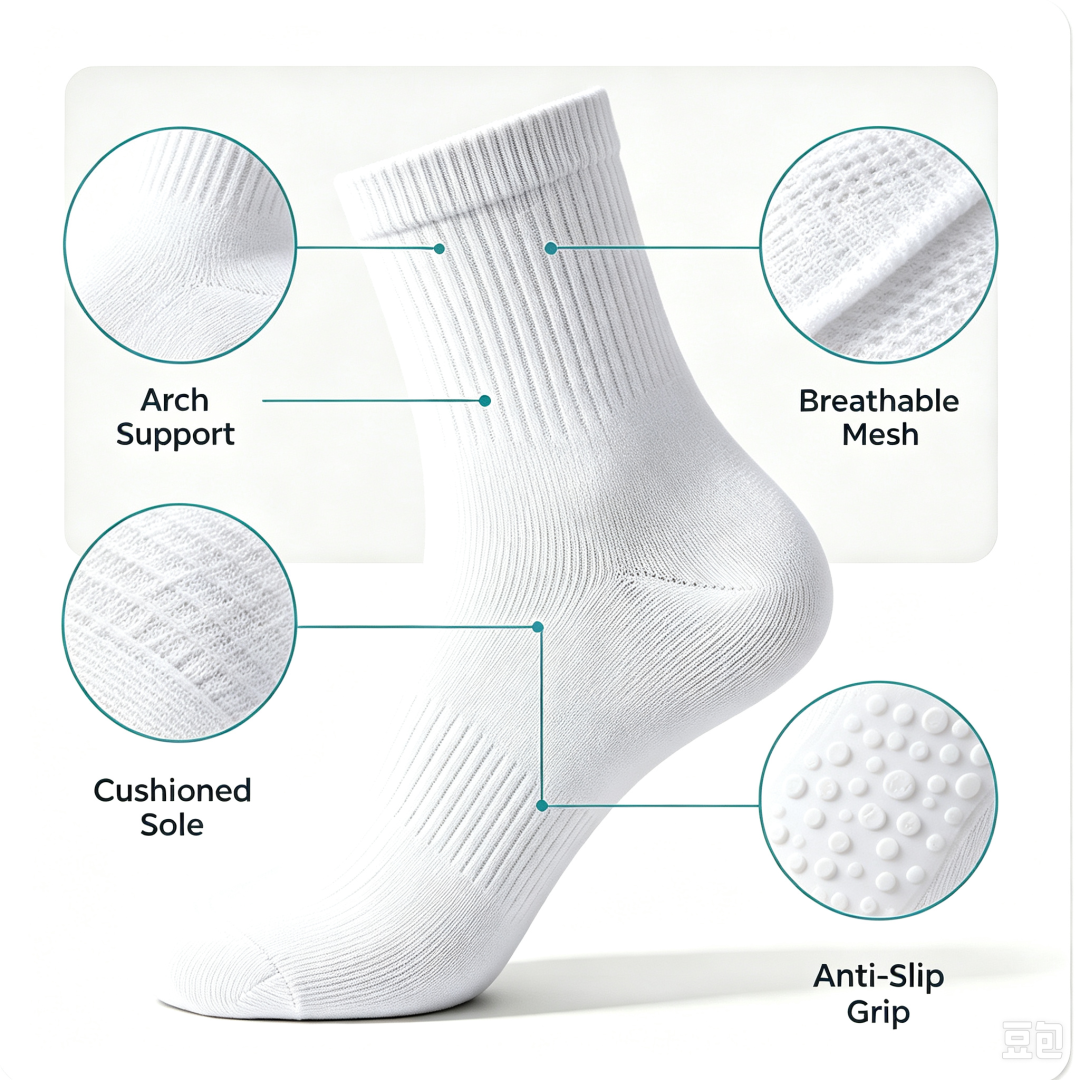
| Grip sole | Silicone dot coverage. | Safety in wet areas. |
Finally, agree the tolerance: size ±0.5 cm, weight ±5%, colour ΔE within an agreed range. Without tolerance, “close enough” becomes an argument. Related reading: custom sock manufacturer.
Which yarn blend actually performs
| Blend | What it gives you |
|---|---|
| Polyester with elastane and a grip sole | Where slip resistance is required. |
| Polyester terry or acrylic | The cost solution for single-use and slipper styles. |
| Combed cotton terry | Spa and premium guest rooms. |
Beyond the blend, three things decide the outcome more than the fibre name does:
- Staple quality. Combed cotton sheds short fibres, which is why it pills noticeably less than carded.
- Elastane share. Below about 3% the cuff will not recover; above 8% the sock feels tight and costs more.
- Reinforcement yarn. Nylon in the heel and toe is the cheapest durability you can buy.
For hotel socks the trade-off is usually between handfeel and durability — pick the one your buyer notices first. Cross-category comparison: custom anti-slip socks.
Four things that decide your unit price
Every quote you receive for hotel socks comes back to the same four variables.
1. Fibre system. Polyester with elastane and a grip sole – Where slip resistance is required.; Polyester terry or acrylic – The cost solution for single-use and slipper styles.; Combed cotton terry – Spa and premium guest rooms.
2. Construction time. Higher gauges knit more loops per pair, and every added zone, band or colour slows the machine down further. This is usually 20 to 30 percent of what you pay.
3. Fixed setup cost. Programming, screens and machine changeovers are charged per design, not per pair. This is why the jump from 50 to 500 pairs moves the price far more than 500 to 5,000.
4. Everything after knitting. Washing, boarding, pairing, labels and cartons add another 8 to 12 percent and are frequently forgotten in comparisons.
Hospitality socks should be costed per use. Packaging and freight frequently cost more than the sock itself.
Ask for the quote broken into those lines. A supplier who can split it will; one who cannot usually has not costed it. The commercial route is explained on ODM sock manufacturing.
Sizing the first order
There is no advantage in ordering more than you can sell through, and no advantage in ordering less than the factory can schedule cleanly. The useful question is what the first order is for.
| Purpose | Sensible first order | Why |
|---|---|---|
| Quality and communication test | close to the minimum | you are buying information, not margin |
| Live launch with a known sell-through | one to three months of cover | avoids a forced reorder mid-season |
| Seasonal or gift programme | full season cover in one run | colours and yarn lots will not match later |
The standard minimum is 50 pairs per design. Ask separately for the minimum per colourway and per size, because those are the numbers that actually shape the order, and a supplier who answers with a single figure is usually quoting a stock item.
Seasonal and highly constructed styles carry a higher minimum for a simple reason: the machine spends longer being set up than it does knitting. Terms and sampling rules are set out on ODM sock manufacturing.
QC: the checks to ask for before the shipment leaves
AQL 2.5 is the common default for apparel, and many European and US buyers additionally require zero tolerance for critical defects. AQL 4.0 suits promotional goods, and AQL 1.0 is used for high-value or medical channels. Then the product-specific checks:
| Check | Method |
|---|---|
| Grip adhesion | Test wet and after washing. |
| Packing count | Verify pieces per carton. |
| Colour consistency | Keep a sealed reference sample for long supply. |
| Weight and thickness | Weigh samples from each batch. |
Agree in writing what happens to rejected goods: rework, replacement or credit. Without that clause, an inspection report is just a document. Process and test references: extra custom options.
FAQ
Is a grip sole necessary?
Recommended for wet areas, and the wash durability of the dots should be in the contract.
What is the minimum order?
Usually 500 pairs per design; single-use styles often start at 1000 because the unit price is low.
How long is sampling?
3-7 days.
What is the fastest way to get an accurate quote?
Send a specification sheet — yarn composition, needle count, size set, construction, artwork route, quantity and packing. A quote built from that is usually within a few percent of final; a quote built from a photo is not.
Where to go from here
Ready to move? Put the spec sheet together first — yarn, needle count, sizes, construction, artwork, quantity, packing. Then custom slipper socks and custom sock manufacturer will get you a number you can plan against.