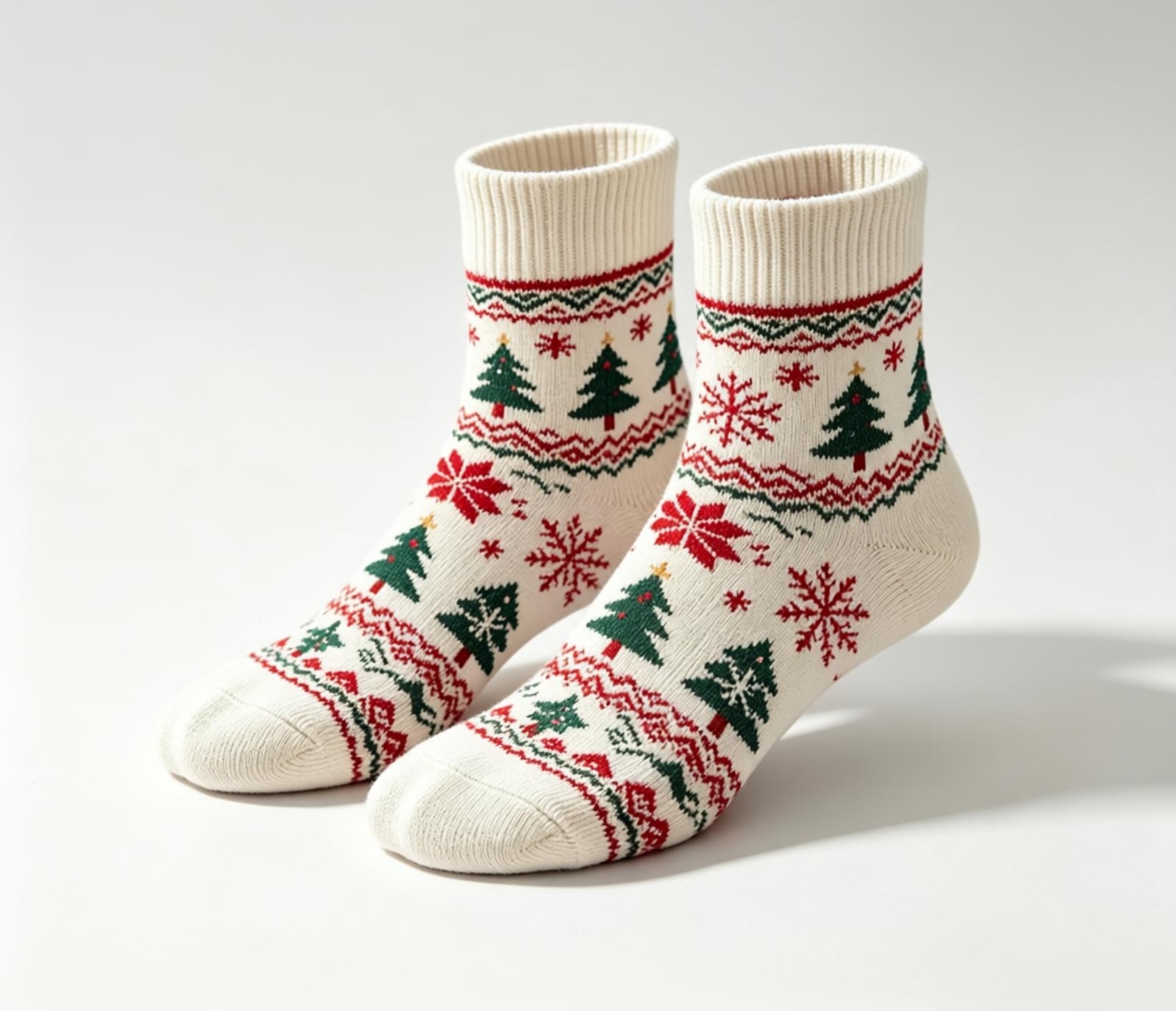
Buyers searching for custom christmas socks wholesale usually want three things settled before they write to anyone: the specification, the minimum and the calendar. The unit price is not one figure: it is a fixed setup cost spread across whatever quantity you order, which is why the per-pair number moves so sharply between a short run and a long one.
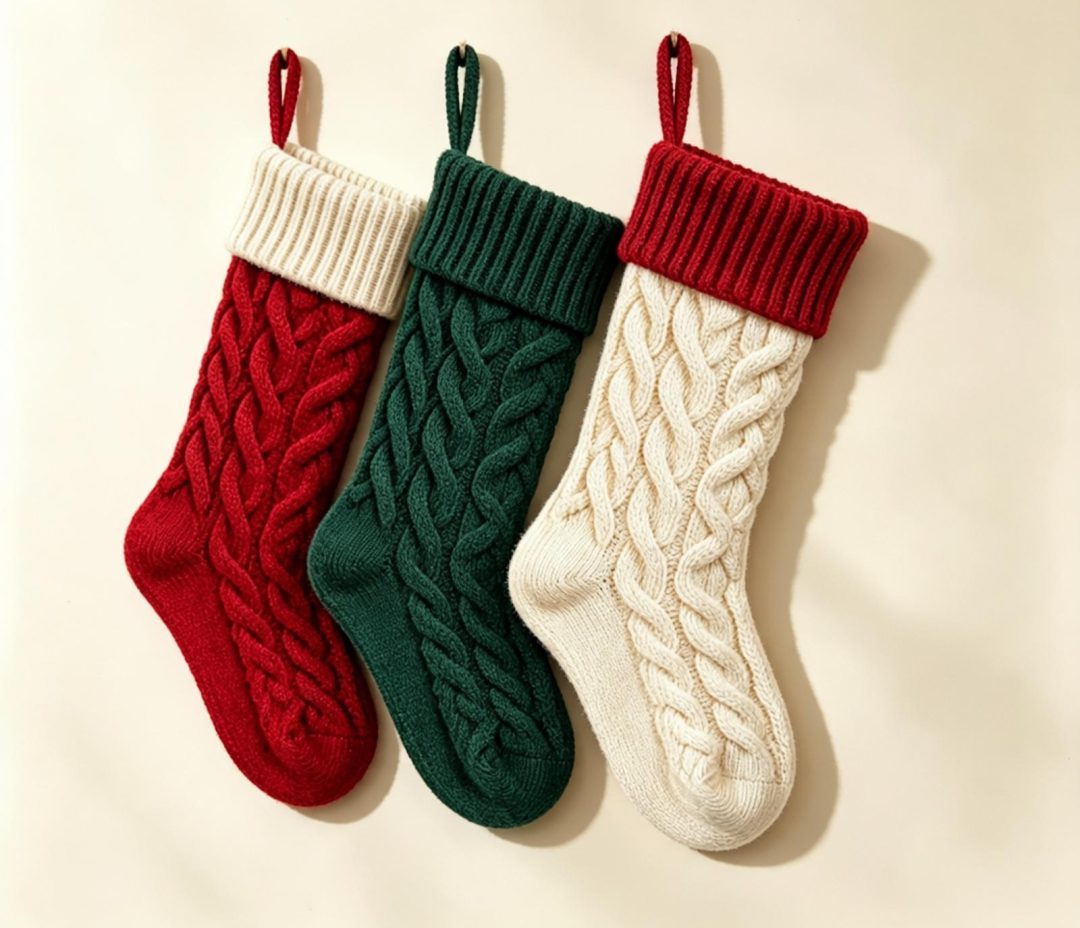
If you landed here by searching custom christmas socks, you are probably one of two people: someone building a buying brief, or someone checking whether a quote already received makes sense. Either way the reference points are the same – MOQ of 300 pairs per color, 3-7 days to sample, 5-25 days to produce – because buyers who are usually building a resale or distribution programme, not buying for personal use all run into the same four cost lines.
Note those down with seasonal calendar, gift packaging and size coverage before you send anything out.
What this covers:
- QC: the checks to ask for before the shipment leaves
- Four things that decide your unit price
- Additional checks for repeat orders
Search variants worth knowing about: christmas socks wholesale; custom christmas socks; christmas socks manufacturer – they cover the same ground from a different starting point.
QC: the checks to ask for before the shipment leaves
AQL 2.5 is the common default for apparel, and many European and US buyers additionally require zero tolerance for critical defects. AQL 4.0 suits promotional goods, and AQL 1.0 is used for high-value or medical channels. Then the product-specific checks:
| Check | Method |
|---|---|
| Set contents | Piece count inside each gift box. |
| Barcode and labelling | Fibre content and country of origin as required. |
| Attachment strength | Pull test on pom-poms, bells and similar trims. |
| Colour fastness | Reds are the usual crocking and bleeding problem. |
Agree in writing what happens to rejected goods: rework, replacement or credit. Without that clause, an inspection report is just a document. Process and test references: logo styles for custom socks.
Nearly every sourcing dispute traces back to a spec that was never written down. Put these on your enquiry sheet and most of the risk disappears.
| Spec | What to write | Why it matters |
|---|---|---|
| Size coverage | Adult one-size plus graded children’s sizes. | Family sets sell as multi-packs. |
| Seasonal calendar | Goods shipped by end of September, which means ordering in May or June. | Seasonal product is unsellable once the window closes. |
| Gift packaging | Hang tag, header card, opp bag or rigid box. | The sales channel dictates the packing format. |
Finally, agree the tolerance: size ±0.5 cm, weight ±5%, colour ΔE within an agreed range. Without tolerance, “close enough” becomes an argument. Related reading: Sockmader.
Four things that decide your unit price
Every quote you receive for Christmas socks comes back to the same four variables.
1. Fibre system. Wool blend – Premium gift sets.; Combed cotton 80% / nylon 17% / elastane 3% – Comfortable everyday wear.; Acrylic or polyester terry – Fluffy handfeel at low cost, the usual gift-box choice.
2. Construction time. Higher gauges knit more loops per pair, and every added zone, band or colour slows the machine down further. This is usually 20 to 30 percent of what you pay.
3. Fixed setup cost. Programming, screens and machine changeovers are charged per design, not per pair. This is why the first step up from the minimum moves the price far more than doubling an already large order.
4. Everything after knitting. Washing, boarding, pairing, labels and cartons add another 8 to 12 percent and are frequently forgotten in comparisons.
The real cost risk in seasonal socks is time, not unit price: the loss from discounting after the season dwarfs anything saved in negotiation.
Ask for the quote broken into those lines. A supplier who can split it will; one who cannot usually has not costed it. The commercial route is explained on white label sock program.
Additional checks for repeat orders
QC: the checks to ask for before the shipment leaves
AQL 2.5 is the common default for apparel, and many European and US buyers additionally require zero tolerance for critical defects. AQL 4.0 suits promotional goods, and AQL 1.0 is used for high-value or medical channels. Then the product-specific checks:
| Check | Method |
|---|---|
| Set contents | Piece count inside each gift box. |
| Barcode and labelling | Fibre content and country of origin as required. |
| Attachment strength | Pull test on pom-poms, bells and similar trims. |
| Colour fastness | Reds are the usual crocking and bleeding problem. |
Agree in writing what happens to rejected goods: rework, replacement or credit. Without that clause, an inspection report is just a document. Process and test references: logo styles for custom socks.
Where this decision actually sits in the buying process
Most programmes move through the same four gates, and each one has its own failure mode.
| Gate | The decision | What usually goes wrong |
|---|---|---|
| Concept | Is Christmas socks right for the range at all | Buyers commit before checking whether the channel wants it |
| Specification | Writing down what is actually being made | Vague briefs turn into repeated sample rounds |
| Supplier | Choosing who makes it | Comparison without a written spec is meaningless |
| Commitment | Quantities, dates, payment | Freight and lead time discover the date has already passed |
Work out which gate you are actually at before asking for anything else. Most wasted conversations happen because a buyer asks a commitment-stage question while still at the specification gate. Commercial terms start from white label sock program.
The numbers to put in your enquiry
Copy this block into your first email. It is the difference between a real quote and a placeholder.
| Line | Your value | Why the factory needs it |
|---|---|---|
| Yarn composition | e.g. Combed cotton 80% / nylon 17% / elastane 3% | Sets the largest single cost line |
| Gauge | 84N-144N | Determines knitting time and machine availability |
| Sizes needed | foot length in cm plus quantities | Sizing drives grading and waste |
| Artwork route | jacquard, print or embroidery | Each route carries a different setup minimum |
| Quantity per color | including the size split | Sets the unit price you are quoted |
| Target in-stock date | a real calendar date | Lets the factory quote honestly or decline |
Two lines are most often left blank, and they are the ones that cause the most trouble: the per-colour quantity and the real in-stock date. Without the first, the MOQ is quoted as one figure and your order may not qualify; without the second, nobody can tell you the truth about capacity. Reference route: custom christmas socks.
FAQ
What is the minimum order?
The minimum is 300 pairs per color; gift boxes usually start at 500-1000 sets because of the print minimum.
Can we reorder?
For seasonal styles it is better to carry safety stock in the first order. Peak-season capacity for reorders is unreliable.
When should we order?
Sea freight to Europe or the US takes 30-45 days on top of 5-25 days of production and packing, so May or June is the safe window.
What is the fastest way to get an accurate quote?
Send a specification sheet — yarn composition, needle count, size set, construction, artwork route, quantity and packing. A quote built from that is usually within a few percent of final; a quote built from a photo is not.
To place it in context, compare it against custom work socks.
Where to go from here
Ready to move? Put the spec sheet together first — yarn, needle count, sizes, construction, artwork, quantity, packing. Then custom christmas socks and Sockmader will get you a number you can plan against.