wholesale boot socks looks like a simple purchase until you try to specify one. Two orders with the same name can differ in yarn, needle count, cushion structure and finishing, and end up at very different prices. This page is written for buyers who already know they want the product and now need the parameters behind it. Full route: wholesale boot socks.
Short answer: for anyone searching wholesale boot socks, MOQ starts at 300 pairs per color, sampling takes 3-7 days and bulk production takes 5-25 days. People who look this up are usually building a resale or distribution programme, not buying for personal use, so below I have kept it to the parameters, the cost structure and the calendar rather than product adjectives.
The single most useful thing you can do before contacting a factory is write down reinforcement zones, leg height and abrasion target. Almost every delay traces back to that being left vague.
What this covers:
- The parameters that change how work socks perform
- Which yarn blend actually performs
- QC: the checks to ask for before the shipment leaves
Search variants worth knowing about: custom boot socks; custom work socks; boot socks wholesale – they cover the same ground from a different starting point.
The parameters that change how work socks perform
| Parameter | Where it is set | What it changes |
|---|---|---|
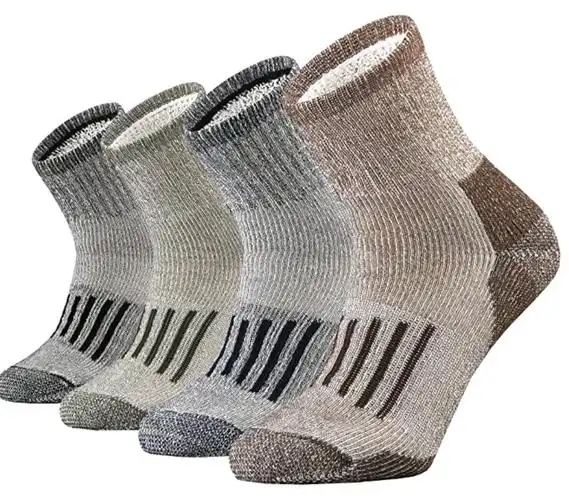
| Reinforcement zones | Double-layer or terry at heel and toe. | The main variable in work sock lifespan. |
| Leg height | Mid-calf or over-the-calf to clear the boot collar. | Must be matched to the work boot. |
| Abrasion target | Martindale cycles and a real wear test. | Workwear buyers always ask for this. |
Two supporting parameters matter just as much: 96N-144N; durability comes from reinforcement yarn and terry, not from gauge, and the finishing route (washing, boarding and heat-setting), which is what actually locks in the dimensions.
Write these as a table in your enquiry. A paragraph describing the product will be interpreted differently by every person who reads it. Reference: extra custom options.
Nearly every sourcing dispute traces back to a spec that was never written down. Put these on your enquiry sheet and most of the risk disappears.
| Spec | What to write | Why it matters |
|---|---|---|
| Reinforcement zones | Double-layer or terry at heel and toe. | The main variable in work sock lifespan. |
| Leg height | Mid-calf or over-the-calf to clear the boot collar. | Must be matched to the work boot. |
| Abrasion target | Martindale cycles and a real wear test. | Workwear buyers always ask for this. |
Two more that buyers forget: the needle count and the toe closure. 84N-96N coarse gauges serve terry and heavy socks, 108N-120N is the workhorse for everyday styles, 144N-168N carries fine jacquard and athletic structure, and 200N tops the range for dress socks and very fine jacquard. There are three toe closures: standard overlock, the cheapest and the one that leaves a seam ridge; Rosso linking, which is substantially flat; and hand-linked seamless, the most comfortable and the most expensive per pair. Related reading: custom socks from Sockmader.
Which yarn blend actually performs
| Blend | What it gives you |
|---|---|
| Wool 20-40% / acrylic / nylon | Abrasion resistance, cushioning and moisture handling. |
| Cotton / polyester / elastane | Everyday workwear that washes and dries fast. |
| High-tenacity nylon reinforcement yarn | Used in the heel and toe zones. |
Beyond the blend, three things decide the outcome more than the fibre name does:
- Staple quality. Combed cotton sheds short fibres, which is why it pills noticeably less than carded.
- Elastane share. Below about 3% the cuff will not recover; above 8% the sock feels tight and costs more.
- Reinforcement yarn. Nylon in the heel and toe is the cheapest durability you can buy.
Blend choice is a positioning decision, not a technical one. Decide what the wearer should feel on day one and after thirty washes, then work backwards to the fibre mix. Cross-category comparison: custom jacquard socks.
QC: the checks to ask for before the shipment leaves
AQL 2.5 is the common default for apparel, and many European and US buyers additionally require zero tolerance for critical defects. AQL 4.0 suits promotional goods, and AQL 1.0 is used for high-value or medical channels. Then the product-specific checks:
| Check | Method |
|---|---|
| Dimensions after washing | Size change after 30 cycles. |
| Toe seam strength | Pull test on the closing seam. |
| Abrasion test | Martindale or a structured wear trial. |
| Reinforcement placement | Does it actually cover the load points. |
Ask for the inspection report before the balance payment, not after. Once the container is on the water, every remedy gets slower and more expensive. Process and test references: extra custom options.
FAQ
What is the minimum order?
300 pairs per color, though workwear programmes usually run well above that floor.
How long is sampling?
3-7 days, plus 3-5 days if abrasion testing is included.
Why do work socks need reinforcement?
The forefoot and heel carry almost all the wear. Double-layer or terry reinforcement can more than double the service life.
What is the fastest way to get an accurate quote?
Send a specification sheet — yarn composition, needle count, size set, construction, artwork route, quantity and packing. A quote built from that is usually within a few percent of final; a quote built from a photo is not.
To place it in context, compare it against sock packaging options.
Where to go from here
The short version: fix the specification, then the quantity, then the date. Everything else is negotiable; those three are not. If you want the full route, start at wholesale boot socks and keep custom socks from Sockmader open while you write your spec sheet.