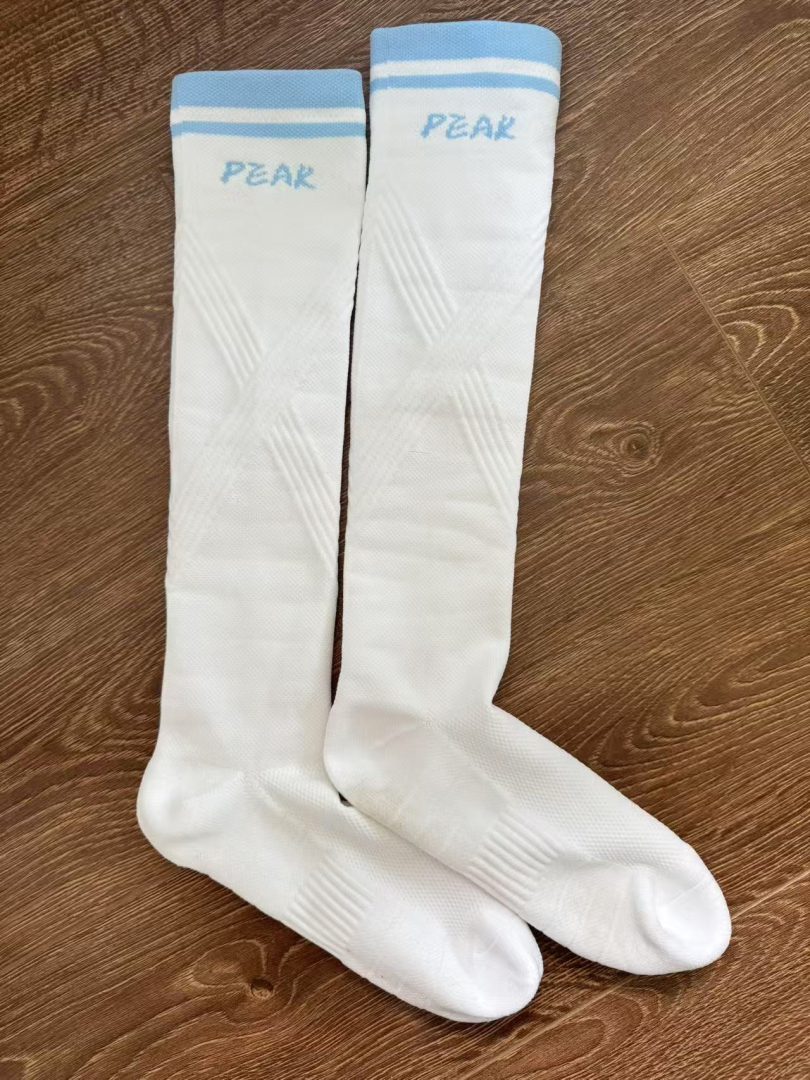
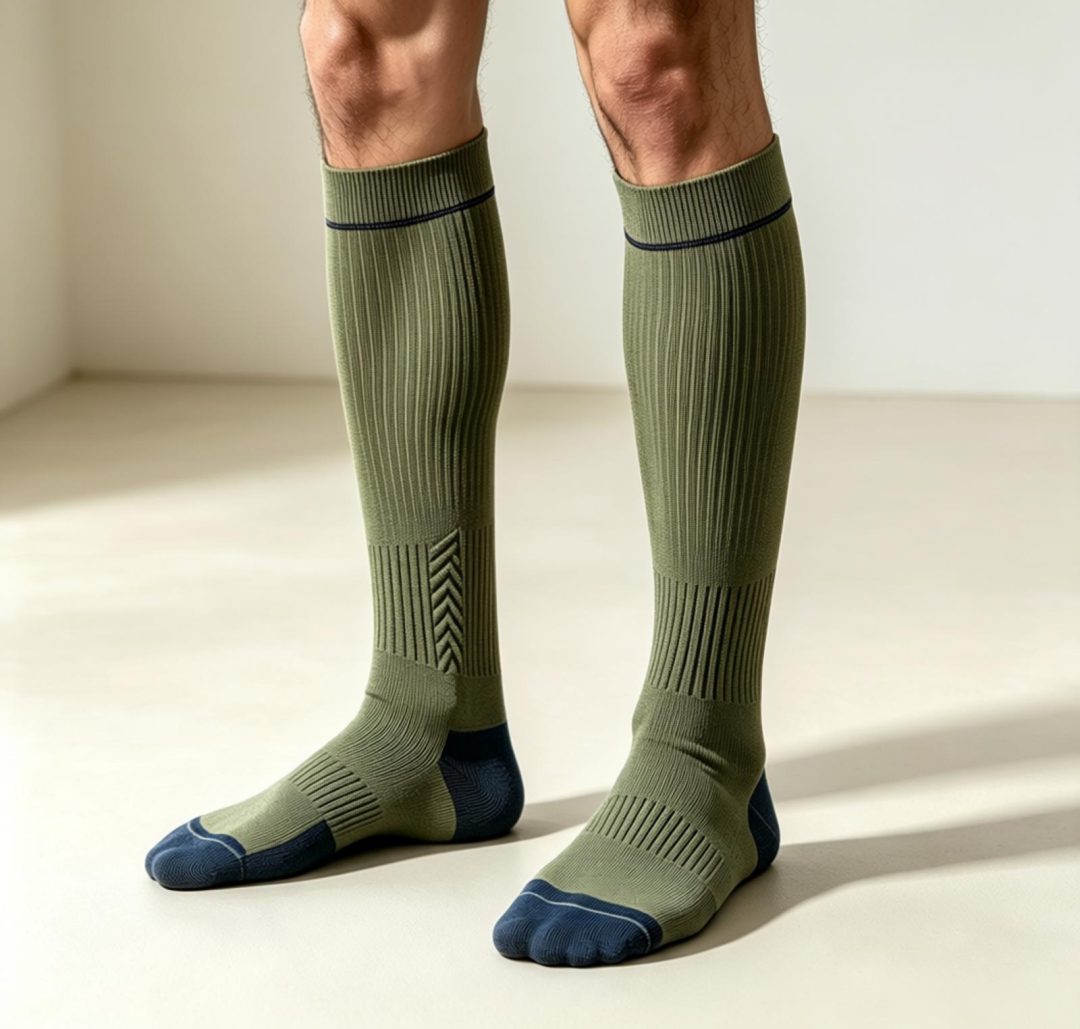
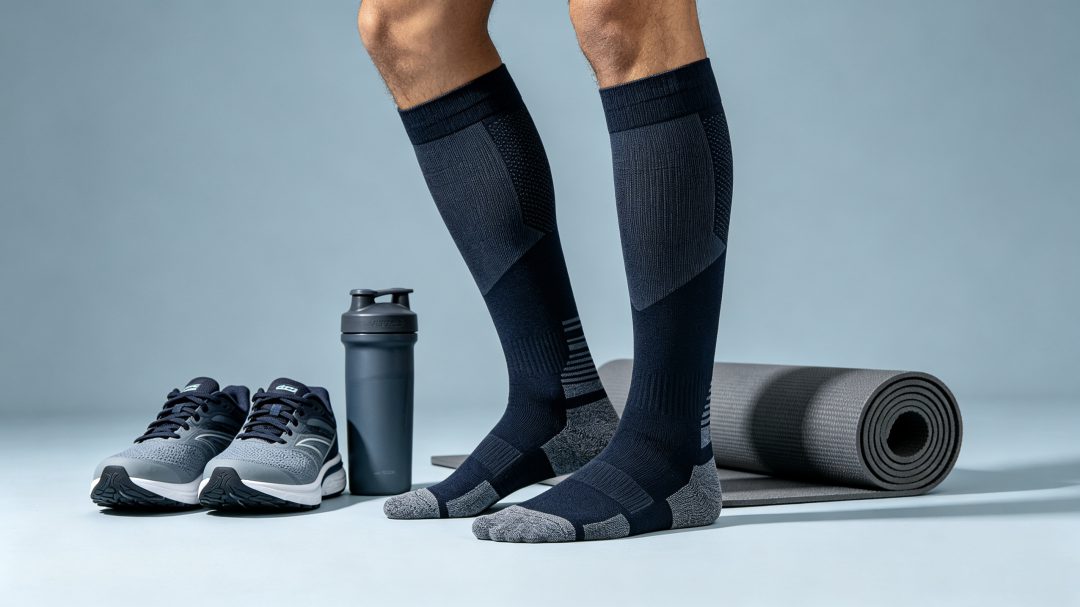
Buyers searching for custom compression socks with logo usually want three things settled before they write to anyone: the specification, the minimum and the calendar. Logo placement is where most rework happens, because artwork problems are usually file problems rather than printing problems.
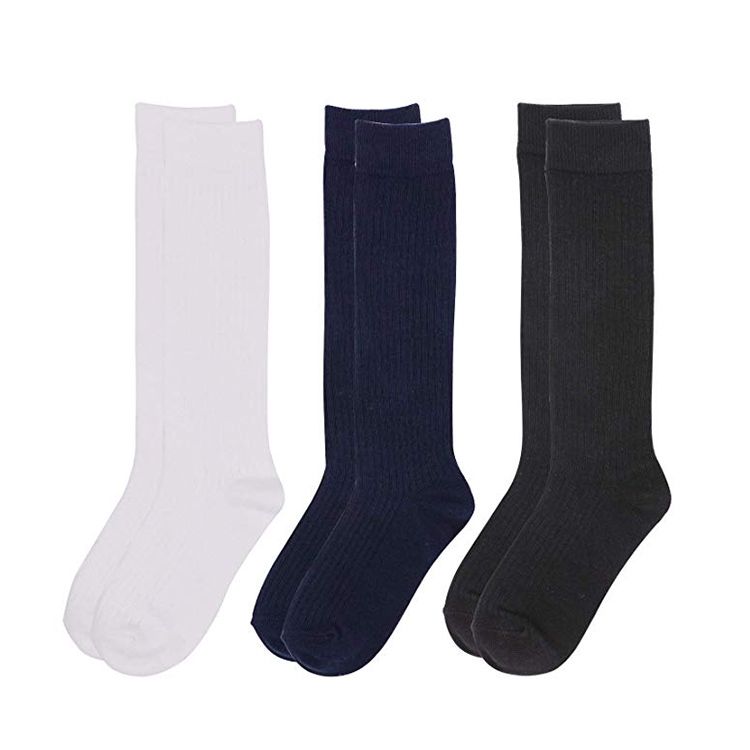
If you landed here by searching custom compression socks, you are probably one of two people: someone building a buying brief, or someone checking whether a quote already received makes sense. Either way the reference points are the same – MOQ of 300 pairs per color, 3-7 days to sample, 5-25 days to produce – because buyers who want the specification and the commercial terms settled before asking anyone for a quote all run into the same four cost lines.
Note those down with compression level, gradient direction and elastane brand and share before you send anything out.
What this covers:
- QC: the checks to ask for before the shipment leaves
- Four things that decide your unit price
- Additional checks for repeat orders
If that is not the wording you used, these are the common alternatives: compression socks wholesale; compression socks manufacturer; custom compression socks manufacturer.
QC: the checks to ask for before the shipment leaves
AQL 2.5 is the common default for apparel, and many European and US buyers additionally require zero tolerance for critical defects. AQL 4.0 suits promotional goods, and AQL 1.0 is used for high-value or medical channels. Then the product-specific checks:
| Check | Method |
|---|---|
| Left and right pairing | Graduated socks with L/R construction must ship as pairs. |
| Measured pressure | Test at ankle, calf and below knee on a pressure tester. |
| Pressure after washing | Re-test after 20 cycles of AATCC 135. |
| Broken elastane | Stretch and inspect against light for exposed yarn. |
Agree in writing what happens to rejected goods: rework, replacement or credit. Without that clause, an inspection report is just a document. Process and test references: sock resources.
Nearly every sourcing dispute traces back to a spec that was never written down. Put these on your enquiry sheet and most of the risk disappears.
| Spec | What to write | Why it matters |
|---|---|---|
| Elastane brand and share | Branded or generic elastane at 18-25%. | Decides how much pressure survives 20 washes. |
| Compression level | 15-20 mmHg daily / 20-30 mmHg sport and travel / 30-40 mmHg regulated channels only. | The number must appear on the label and be backed by a test report. |
| Gradient direction | Highest at the ankle, decreasing upwards. | A sock without a gradient cannot be called compression. |
Finally, agree the tolerance: size ±0.5 cm, weight ±5%, colour ΔE within an agreed range. Without tolerance, “close enough” becomes an argument. Related reading: custom sock manufacturer.
Four things that decide your unit price
Every quote you receive for compression socks comes back to the same four variables.
1. Fibre system. Polyester / elastane – Lower cost, but the pressure decays faster than a nylon system.; Nylon 75-80% / elastane 20-25% – Elastane share is what holds the pressure value after washing.; Nylon / elastane / cotton three-layer – Abrasion outside, moisture transport inside, next-to-skin comfort.
2. Construction time. Higher gauges knit more loops per pair, and every added zone, band or colour slows the machine down further. This is usually 20 to 30 percent of what you pay.
3. Fixed setup cost. Programming, screens and machine changeovers are charged per design, not per pair. This is why the first step up from the minimum moves the price far more than doubling an already large order.
4. Everything after knitting. Washing, boarding, pairing, labels and cartons add another 8 to 12 percent and are frequently forgotten in comparisons.
Cost concentrates in elastane and testing: every 2 points of added elastane raises yarn cost by roughly 3-5%, and third-party pressure testing is a fixed fee that hurts small orders most.
Ask for the quote broken into those lines. A supplier who can split it will; one who cannot usually has not costed it. The commercial route is explained on ODM sock manufacturing.
Additional checks for repeat orders
QC: the checks to ask for before the shipment leaves
AQL 2.5 is the common default for apparel, and many European and US buyers additionally require zero tolerance for critical defects. AQL 4.0 suits promotional goods, and AQL 1.0 is used for high-value or medical channels. Then the product-specific checks:
| Check | Method |
|---|---|
| Left and right pairing | Graduated socks with L/R construction must ship as pairs. |
| Measured pressure | Test at ankle, calf and below knee on a pressure tester. |
| Pressure after washing | Re-test after 20 cycles of AATCC 135. |
| Broken elastane | Stretch and inspect against light for exposed yarn. |
Agree in writing what happens to rejected goods: rework, replacement or credit. Without that clause, an inspection report is just a document. Process and test references: sock resources.
The numbers to put in your enquiry
Copy this block into your first email. It is the difference between a real quote and a placeholder.
| Line | Your value | Why the factory needs it |
|---|---|---|
| Yarn composition | e.g. Nylon 75-80% / elastane 20-25% | Sets the largest single cost line |
| Gauge | 168N-200N fine gauge | Determines knitting time and machine availability |
| Sizes needed | foot length in cm plus quantities | Sizing drives grading and waste |
| Artwork route | jacquard, print or embroidery | Each route carries a different setup minimum |
| Quantity per color | including the size split | Sets the unit price you are quoted |
| Target in-stock date | a real calendar date | Lets the factory quote honestly or decline |
Two lines are most often left blank, and they are the ones that cause the most trouble: the per-colour quantity and the real in-stock date. Without the first, the MOQ is quoted as one figure and your order may not qualify; without the second, nobody can tell you the truth about capacity. Reference route: custom compression socks.
Where this decision actually sits in the buying process
Most programmes move through the same four gates, and each one has its own failure mode.
| Gate | The decision | What usually goes wrong |
|---|---|---|
| Concept | Is compression socks right for the range at all | Buyers commit before checking whether the channel wants it |
| Specification | Writing down what is actually being made | Vague briefs turn into repeated sample rounds |
| Supplier | Choosing who makes it | Comparison without a written spec is meaningless |
| Commitment | Quantities, dates, payment | Freight and lead time discover the date has already passed |
Work out which gate you are actually at before asking for anything else. Most wasted conversations happen because a buyer asks a commitment-stage question while still at the specification gate. Commercial terms start from ODM sock manufacturing.
FAQ
Can you provide a pressure test report?
Ask before you place the order. Testing adds cost and time and is quoted separately.
Does the pressure disappear after washing?
A good elastane system holds 80% or more of its pressure after 20 washes. Put that in the contract rather than accepting a verbal promise.
Can we make a normal sock that just looks the same?
Yes, but then it cannot be sold as compression socks, and no pressure grade may appear on the packaging or the page.
What is the fastest way to get an accurate quote?
Send a specification sheet — yarn composition, needle count, size set, construction, artwork route, quantity and packing. A quote built from that is usually within a few percent of final; a quote built from a photo is not.
If you are still deciding, these pages help: custom sports socks.
Where to go from here
Ready to move? Put the spec sheet together first — yarn, needle count, sizes, construction, artwork, quantity, packing. Then custom compression socks and custom sock manufacturer will get you a number you can plan against.