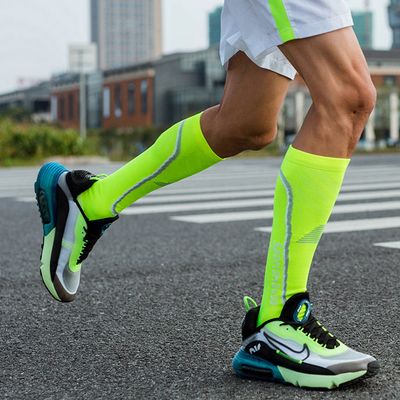
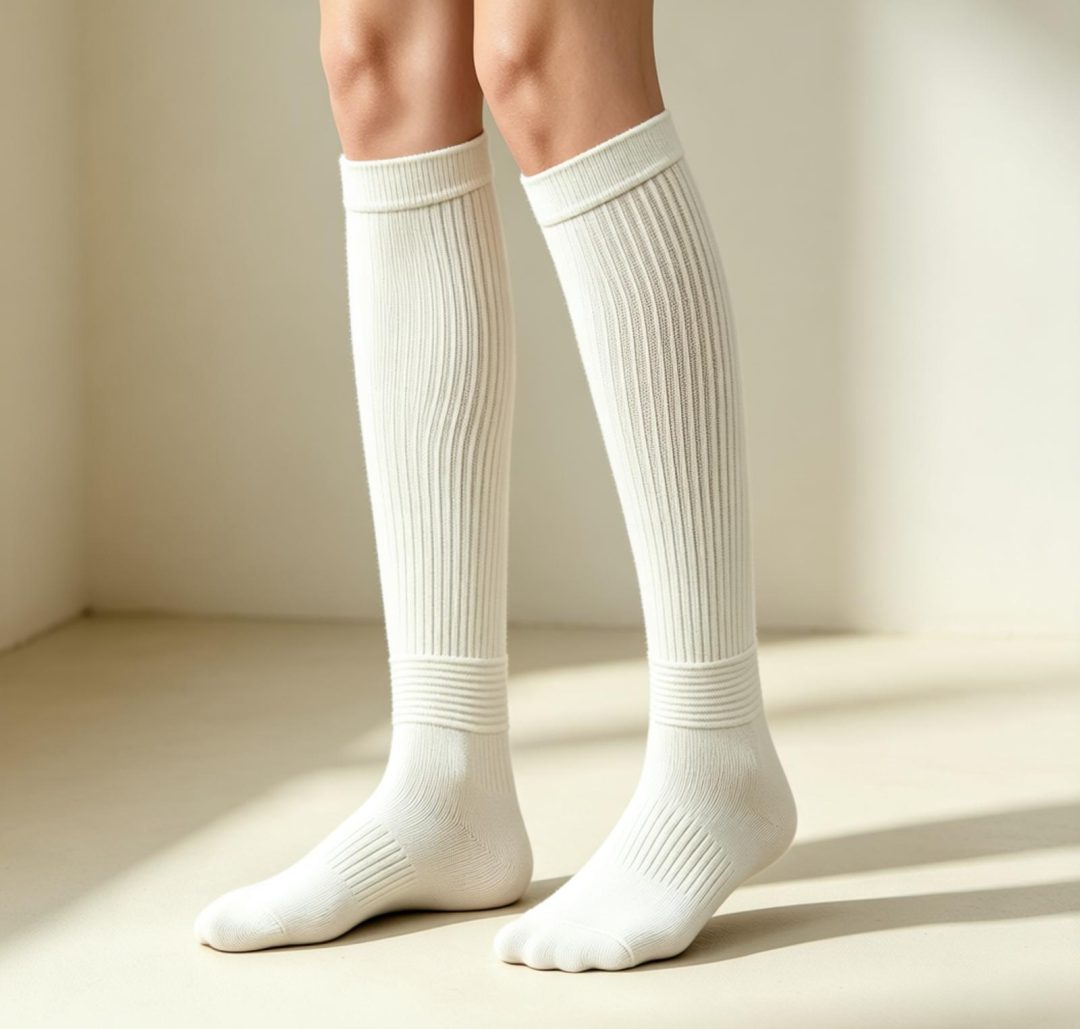
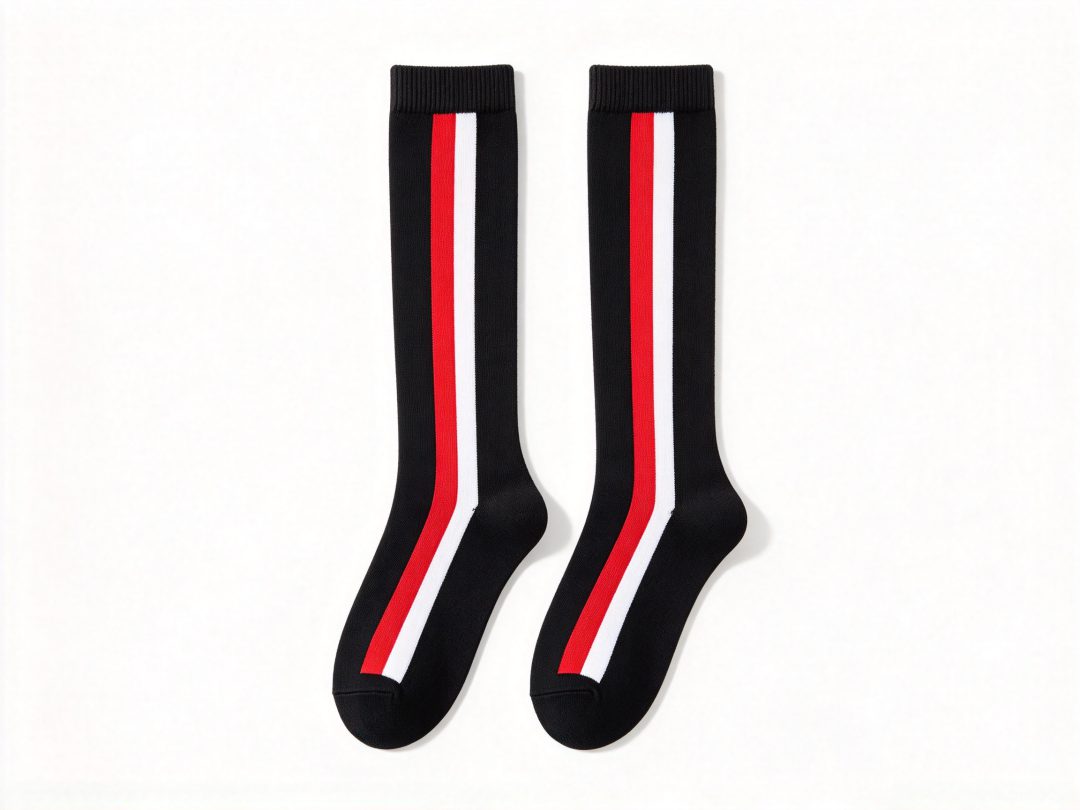
If you are sourcing custom knee-high socks, the most common mistake is asking for a price before there is a specification. A quote built without yarn composition, gauge and a size set is a guess, and guesses turn into disputes several weeks later. What follows covers the specification, the cost structure, the minimum per design and the calendar. The product route starts at custom knee-high socks.
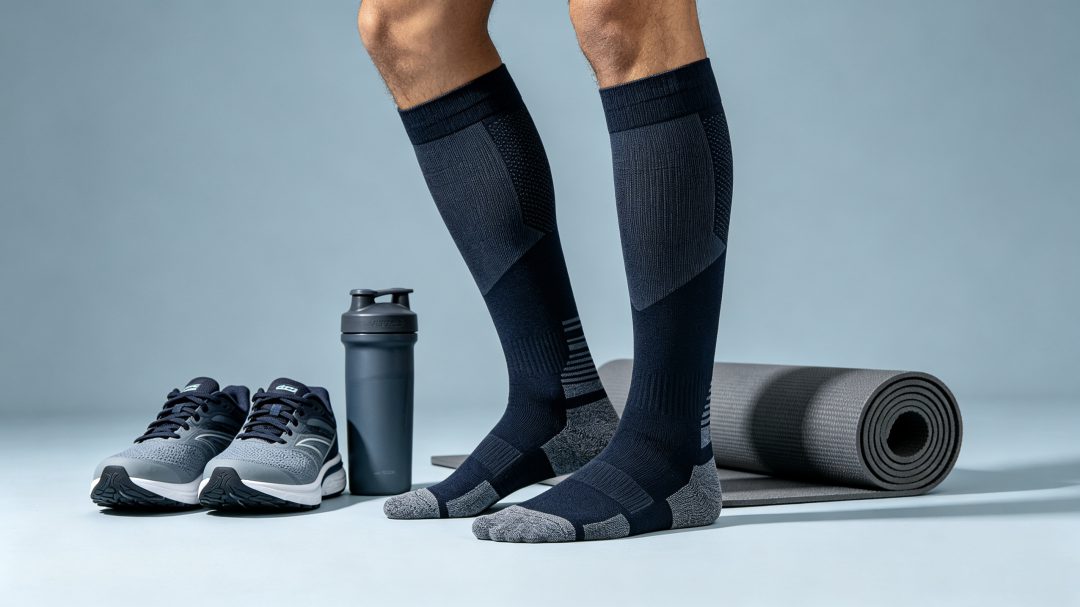
In plain terms: if you are buying custom knee-high socks, plan on 50 pairs minimum per design, 3-7 days for samples and 5-25 days for a bulk run. Searches like this usually come from buyers who want the specification and the commercial terms settled before asking anyone for a quote, which is why this page goes straight to numbers rather than marketing copy.
Three specifications decide both the outcome and the price: leg height, stay-up cuff and arch support. Get those on your enquiry sheet and quotes become comparable.
On this page:
- How knee-high socks are made, step by step
- Which yarn blend actually performs
- QC: the checks to ask for before the shipment leaves
- Where your money actually goes
Search variants worth knowing about: custom thigh-high socks; custom over-the-knee socks; thigh-high socks wholesale – they cover the same ground from a different starting point.
How knee-high socks are made, step by step
Understanding the production sequence tells you where delays and defects come from.
1. Yarn preparation. Cones are inspected and, if the programme needs it, dyed to a confirmed shade. Custom dyeing adds 7–14 days and carries a mill minimum.
2. Knitting. Socks are knitted as tubes on circular sock machines. 84N-96N coarse gauges serve terry and heavy socks, 108N-120N is the workhorse for everyday styles, 144N-168N carries fine jacquard and athletic structure, and 200N tops the range for dress socks and very fine jacquard.
3. Toe closing. There are three toe closures: standard overlock, the cheapest and the one that leaves a seam ridge; Rosso linking, which is substantially flat; and hand-linked seamless, the most comfortable and the most expensive per pair.
4. Washing and boarding. Washing removes knitting oils and sets dimensions; boarding (heat-setting on forms) gives the final shape and smoothness.
5. Inspection and pairing. Each pair is checked for defects, matched by size and shade, and paired.
6. Packing. Hang tags, polybags, inner boxes and cartons per the packing specification.
The bottleneck for knee-high socks is rarely knitting capacity; it is finishing and packing, which is where most schedule slips actually happen. Full process notes: yarn color options.
Which yarn blend actually performs
| Blend | What it gives you |
|---|---|
| Polyester / cotton / elastane | Athletic long styles with better recovery. |
| Wool blend | Winter weight. |
| Combed cotton 78% / nylon 19% / elastane 3% | Everyday and schoolwear styles. |
Beyond the blend, three things decide the outcome more than the fibre name does:
- Staple quality. Combed cotton sheds short fibres, which is why it pills noticeably less than carded.
- Elastane share. Below about 3% the cuff will not recover; above 8% the sock feels tight and costs more.
- Reinforcement yarn. Nylon in the heel and toe is the cheapest durability you can buy.
Test the blend in the real use case before committing to bulk. A blend that performs in a showroom and one that performs after a month of wear are frequently not the same blend. Cross-category comparison: custom no-show socks.
QC: the checks to ask for before the shipment leaves
AQL 2.5 is the common default for apparel, and many European and US buyers additionally require zero tolerance for critical defects. AQL 4.0 suits promotional goods, and AQL 1.0 is used for high-value or medical channels. Then the product-specific checks:
| Check | Method |
|---|---|
| Slip-down test | 30 minutes of real wear. |
| Leg length after washing | Dimensional change rate. |
| Leg height and symmetry | Left/right difference within 0.5 cm. |
| Cuff recovery | Returns after 20 stretches. |
For the first order, add a pre-production sample and an in-line check. Two checkpoints cost very little compared with finding a defect at final inspection. Process and test references: yarn color options.
Where your money actually goes
Take a typical first order of a few hundred pairs. Four lines decide almost everything.
| Cost line | Typical share | What moves it |
|---|---|---|
| Yarn | 35 to 50 percent | fibre type, staple quality, whether it is custom-dyed |
| Knitting and labour | 20 to 30 percent | gauge, structure complexity, number of colours |
| Technique and setup | 5 to 15 percent | artwork route, screens, machine set-up |
| Finishing and packing | 8 to 12 percent | washing, boarding, labelling, cartons |
Note that only one of those four is negotiable through quantity alone. The technique line is fixed per design, so it either gets spread across many pairs or it sits heavily on few.
The hidden cost in knee-high socks is the number of size bands: more bands mean more yarn waste and a more complex production plan.
If two quotes differ by more than a few percent, the difference is usually the specification rather than the supplier. The commercial route is explained on OEM socks.
FAQ
What is the minimum order?
50 pairs per design.
How long is sampling?
3-7 days.
How do we stop knee-highs sliding down?
Widen the cuff, lower the pressure and add a silicone strip; raise the elastane share to improve recovery at the same time.
What is the fastest way to get an accurate quote?
Send a specification sheet — yarn composition, needle count, size set, construction, artwork route, quantity and packing. A quote built from that is usually within a few percent of final; a quote built from a photo is not.
Where to go from here
If you take one thing from this: the cheapest quote is usually the one with the loosest spec. Write the spec first and the quotes become comparable. custom knee-high socks is the place to begin; Sockmader covers the commercial terms.