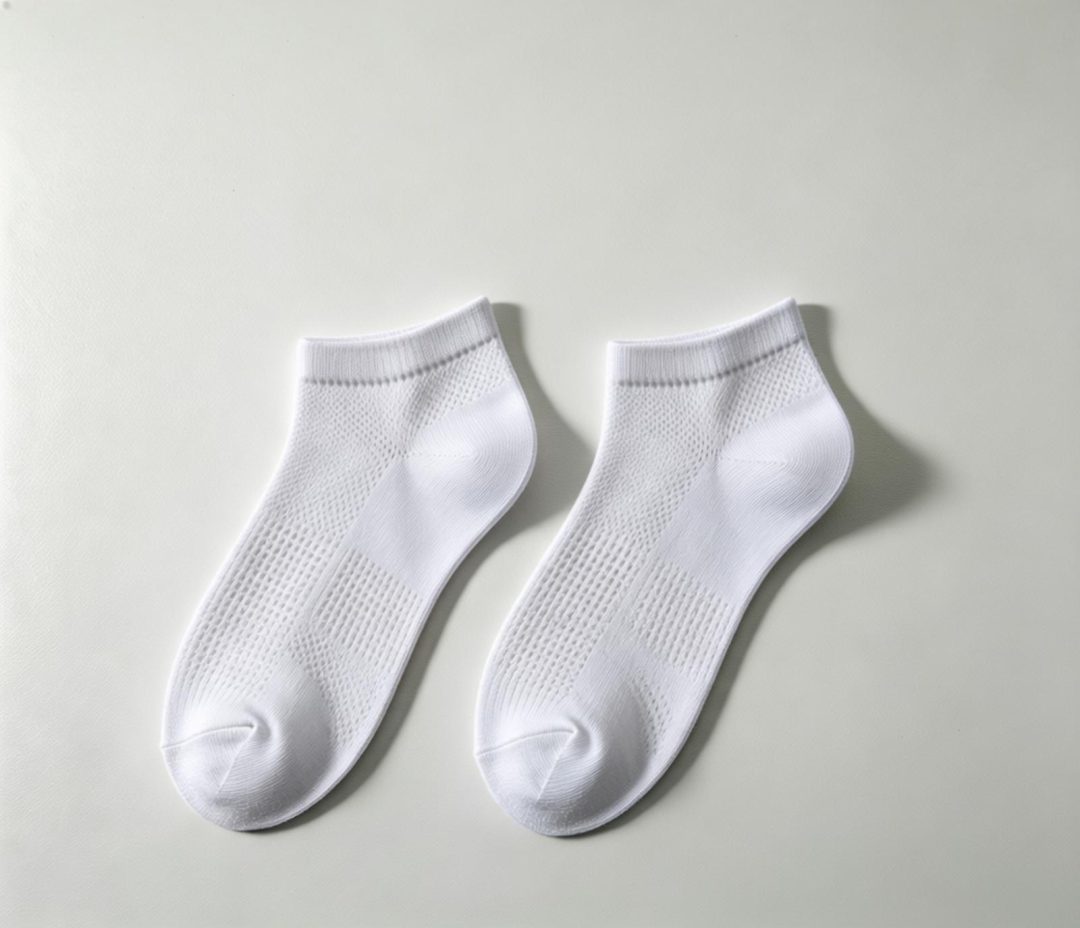
Most buyers select a custom no-show socks manufacturer on unit price and spend the next two seasons dealing with the consequences. Before you compare quotes it is worth knowing which parts of the process actually run in-house, because knitting, finishing and packing are frequently split across sites. Begin with custom no-show socks manufacturer and ask that first.
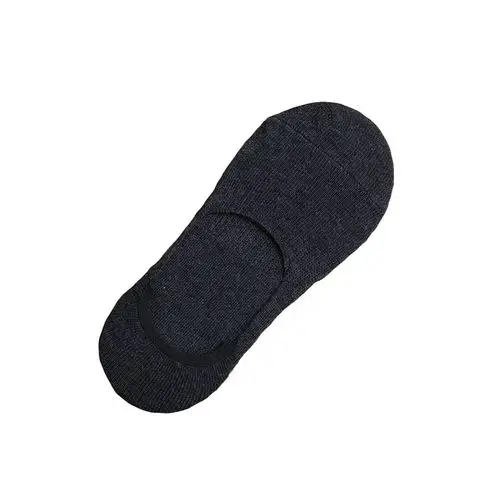
In plain terms: a custom no-show socks manufacturer will usually quote against a 50-pair minimum per design, take 3-7 days on samples and 5-25 days on production. Searches like this usually come from buyers who are shortlisting production partners rather than shopping for a single pair, which is why this page goes straight to numbers rather than marketing copy.
Ask three things first: heel grip, cuff height and forefoot coverage. Suppliers who answer all three without coming back for clarification are usually the ones worth shortlisting.
On this page:
- Where your money actually goes
- Minimum per design, and why the number is what it is
- Which yarn blend actually performs
- QC: the checks to ask for before the shipment leaves
If that is not the wording you used, these are the common alternatives: custom no-show socks; no-show socks wholesale; no-show socks manufacturer.
Where your money actually goes
Take a typical first order of a few hundred pairs. Four lines decide almost everything.
| Cost line | Typical share | What moves it |
|---|---|---|
| Yarn | 35 to 50 percent | fibre type, staple quality, whether it is custom-dyed |
| Knitting and labour | 20 to 30 percent | gauge, structure complexity, number of colours |
| Technique and setup | 5 to 15 percent | artwork route, screens, machine set-up |
| Finishing and packing | 8 to 12 percent | washing, boarding, labelling, cartons |
Note that only one of those four is negotiable through quantity alone. The technique line is fixed per design, so it either gets spread across many pairs or it sits heavily on few.
The cost in no-show socks sits in the heel silicone and the fine-gauge knitting time. Cut either and you buy a heel-slip problem.
If two quotes differ by more than a few percent, the difference is usually the specification rather than the supplier. The commercial route is explained on bulk custom socks.
Minimum per design, and why the number is what it is
Buyers often treat MOQ as a negotiating position. It is not: it is arithmetic done by the production planner. Three costs have to be covered before the first pair is worth knitting.
- Machine programming and set-up. Fixed per design, regardless of how many pairs follow.
- Yarn minimum. A dyelot has a floor, which is why custom shades raise the entry point.
- Changeover labour. Every swap of yarn, needle setting or programme costs machine hours.
The standard minimum is 50 pairs per design, which suits a trial order or a first drop. What raises it is not the design but the way it is split: five colourways of one design are five set-ups, and each size block is knitted and paired on its own.
If you are unsure about size split, ask what the minimum is per size rather than per design; it is the number that actually constrains the order. Terms and sampling rules are set out on bulk custom socks.
Which yarn blend actually performs
| Blend | What it gives you |
|---|---|
| Bamboo / cotton blend | The cool handfeel for summer. |
| Polyester / elastane | Athletic invisible socks that dry fast. |
| Combed cotton 80% / nylon 17% / elastane 3% | Soft and breathable against skin. |
Beyond the blend, three things decide the outcome more than the fibre name does:
- Staple quality. Combed cotton sheds short fibres, which is why it pills noticeably less than carded.
- Elastane share. Below about 3% the cuff will not recover; above 8% the sock feels tight and costs more.
- Reinforcement yarn. Nylon in the heel and toe is the cheapest durability you can buy.
Test the blend in the real use case before committing to bulk. A blend that performs in a showroom and one that performs after a month of wear are frequently not the same blend. Cross-category comparison: sock material guide.
Nearly every sourcing dispute traces back to a spec that was never written down. Put these on your enquiry sheet and most of the risk disappears.
| Spec | What to write | Why it matters |
|---|---|---|
| Cuff height | 3-5 mm below the shoe opening. | Each shoe shape needs its own verification. |
| Forefoot coverage | Shallow cut versus full foot. | Decides whether the sock edge shows. |
| Heel grip | Silicone strip, silicone dots or a high-recovery bound edge. | Slipping off the heel is the number one complaint. |
Also pin down the packing method (pairing, folding, hang tag, polybag, carton count) — it is the last step and the one that most often gets assumed rather than specified. Related reading: custom socks.
QC: the checks to ask for before the shipment leaves
AQL 2.5 is the common default for apparel, and many European and US buyers additionally require zero tolerance for critical defects. AQL 4.0 suits promotional goods, and AQL 1.0 is used for high-value or medical channels. Then the product-specific checks:
| Check | Method |
|---|---|
| Symmetry | Left and right cuff height identical. |
| Heel slip wear test | Real shoes, real movement. |
| Cuff recovery | Still elastic after 20 stretches. |
| Silicone adhesion | Inspect after washing. |
For the first order, add a pre-production sample and an in-line check. Two checkpoints cost very little compared with finding a defect at final inspection. Process and test references: ODM sock manufacturing.
FAQ
How long is sampling?
3-7 days, plus 2-4 days if you include wear testing.
Why do no-show socks slip off?
Usually a mismatch between the heel wrap angle and the silicone position. Change the shoe shape and you need to re-validate.
Do they need left and right versions?
Normally not, but where there is arch support structure an L/R version is worth doing.
What is the fastest way to get an accurate quote?
Send a specification sheet — yarn composition, needle count, size set, construction, artwork route, quantity and packing. A quote built from that is usually within a few percent of final; a quote built from a photo is not.
Where to go from here
If you take one thing from this: the cheapest quote is usually the one with the loosest spec. Write the spec first and the quotes become comparable. custom no-show socks manufacturer is the place to begin; custom socks covers the commercial terms.