Custom socks cost is decided by five things, in roughly this order of impact: the yarn you pick, the gauge you knit at, how much construction work the style needs, how many pairs you order, and what happens to the socks after knitting. Everything else – freight terms, packaging, labelling – moves the number at the margins.
If you are building a budget rather than comparing two quotes that already arrived, the useful part is knowing which lever does what, so that a request that costs less is *actually* cheaper and not just thinner. This guide walks through the five drivers with the reference numbers we quote against: MOQ from 50 pairs per style, 3-7 days for sampling, 5-25 days for production after sample approval.
The five drivers, ranked by how much they move price
| Driver | What changes | Typical effect on unit cost |
|---|---|---|
| 1. Yarn | Fibre type, blend ratio, whether it is dyed to order | Largest single swing |
| 2. Gauge | Needle count (needles per inch of cylinder) | Changes knitting time per pair |
| 3. Construction | Terry foot, arch band, reinforced toe, seamless closing | Adds machine time and labour per pair |
| 4. Run size | Pairs per style – setup and sampling spread thinner | Falls meaningfully at higher volumes |
| 5. Finishing | Custom dye lots, branded packaging, barcode labelling | Separate line items, not always per-pair |
1. Yarn is where most of the cost sits
A 75-85% combed cotton with 12-20% nylon and 2-5% elastane blend is the everyday workhorse: it washes well, holds shape and is easy to source. Swap in mercerised cotton, bamboo viscose or merino and the fibre cost per pair climbs before a single stitch is knitted.
There is a second, less obvious cost: dyeing. If your colour can be matched from an existing shade card, there is no mill minimum to clear. Ask for a custom dyed-to-order shade and you inherit the mill’s minimum lot plus the development time. Buyers who can accept a near-hit from our yarn color options almost always save both money and a week.
2. Gauge decides both appearance and knitting time
Coarse gauges (84N-96N) run fast and suit terry and heavy socks. Fine gauges (168N-200N) produce a smooth face that takes logos and fine detail well, but the machine spends longer on each pair. There is no “better” gauge – there is only the gauge that suits what you are making. A dress sock wants a fine gauge; a crew sock built for grip and cushioning does not need one, and paying for it would be waste.
3. Construction is the part buyers forget to specify
Every extra operation is time on the machine or hands at the linking bench. The additions that most often move a quote:
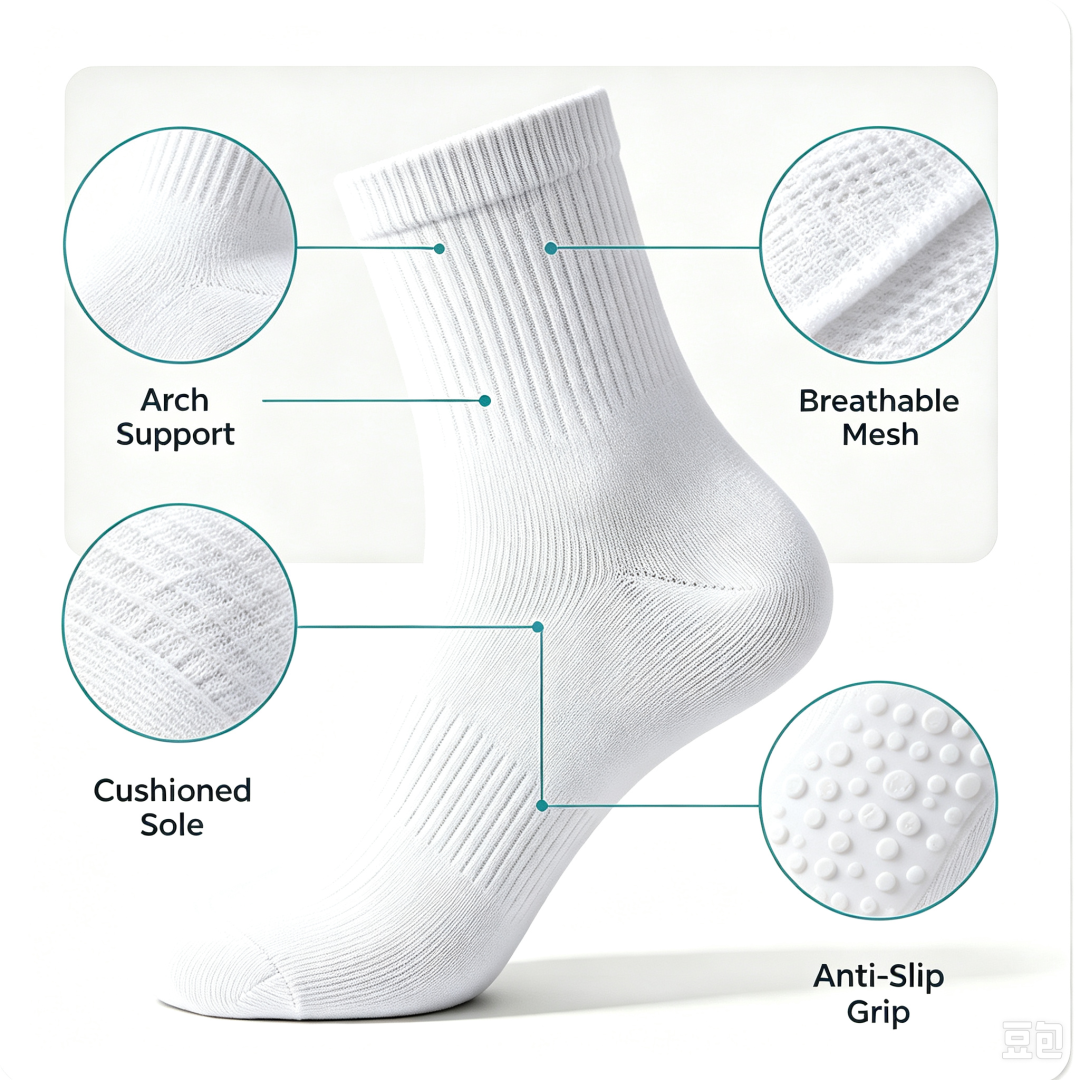
- Terry cushioning in the foot or shin – more yarn, more machine time
- Arch compression band – extra elastane and a second yarn feed
- Reinforced heel and toe – durability, and a real cost add
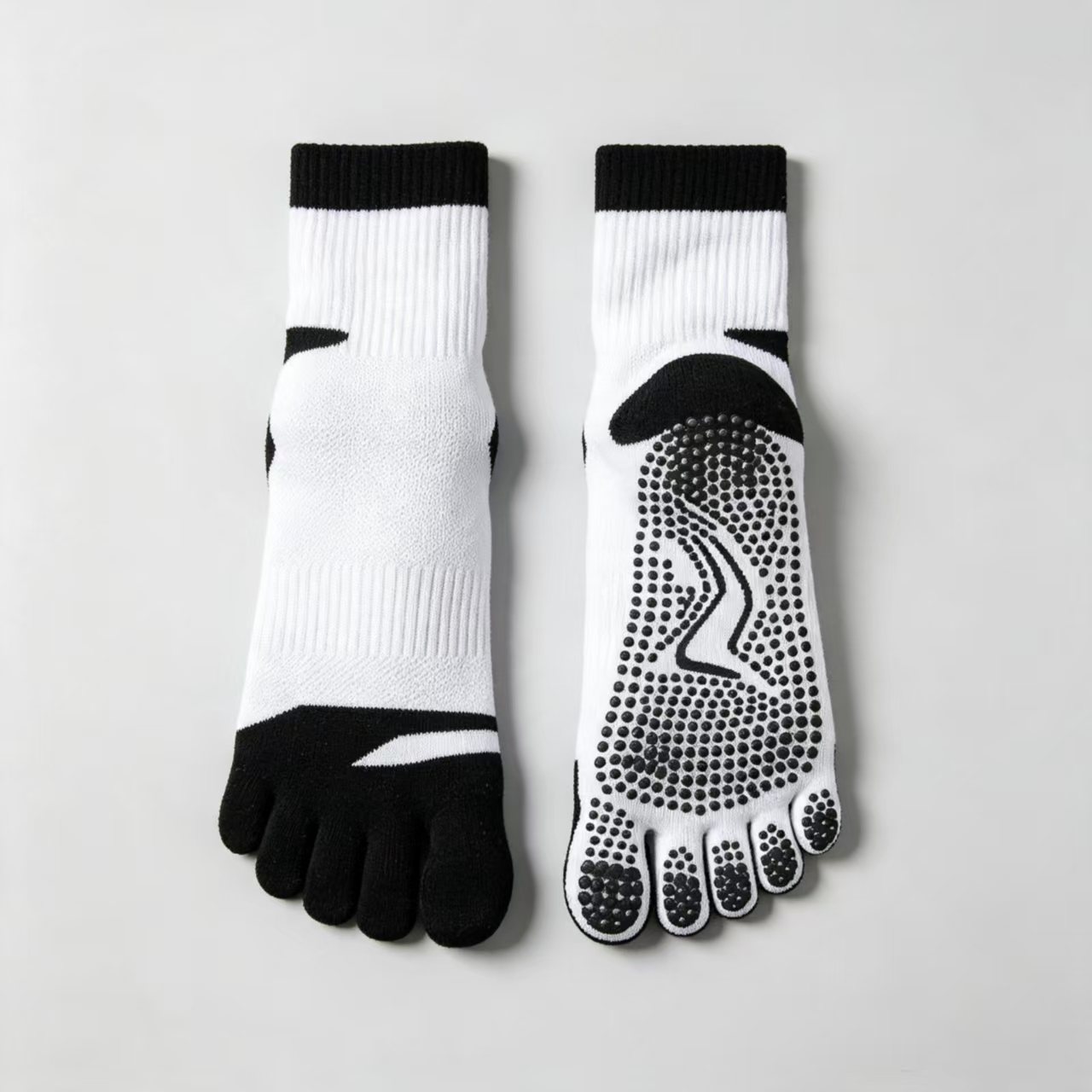
- Seamless toe closing – slower than standard linking, better comfort perception
- Turned-and-stitched versus knitted-in cuff – affects both cost and how the cuff holds up
This is why two quotes for “crew socks” can differ by a lot. They were probably not quoting the same sock.
4. Run size: what actually changes
There are fixed costs attached to every style regardless of how many pairs you order: machine setup, programming the pattern, sampling, and inspection setup. Spread those over 50 pairs and they carry real weight per unit; spread them over a larger run and their share drops. Unit cost therefore falls as volume rises – but it does not fall linearly, and there are natural floors set by yarn cost and machine time.
At 50 pairs per style you are paying for a genuine production run, not a sample – that is the honest reading of a small-batch quote, not a penalty.
5. The line items that sit outside the pair price
Compare two quotes by asking what each includes, because these are frequently, and legitimately, billed separately:
- Sampling and its shipping
- Custom dyed-to-order lots above a near-stock colour
- Branded packaging – hangtags, belly bands, boxes, printed polybags
- Barcode or SKU labelling and carton markings
- Inspection reports beyond the standard in-line checks
A cheaper per-pair number with sampling and packaging missing from it is not cheaper. Ask for one quote on identical terms before comparing.
Where a budget usually goes wrong
Three patterns account for most unpleasant surprises:
Designing before choosing a gauge. A very fine detail can only be knitted at a fine gauge, and a fine gauge costs more minutes per pair. Decide the construction first, then the artwork.
Assuming every colour is free. One custom shade can add the mill minimum to a small order. Working from an existing card avoids this entirely.
Sampling too late. Sampling takes 3-7 days, and production does not start until you approve the sample – it takes 5-25 days after that. Iterating artwork before you request a sample is far cheaper than iterating after.
Our OEM sock manufacturing route suits buyers arriving with complete artwork and specs; [ODM](/odm-socks/) suits those starting from a rough idea.
Getting a quote you can actually compare
Send the same six details to every factory and the numbers come back comparable:
1. Yarn composition, or target handfeel and end use
2. Gauge, or the look you are going for
3. Construction list – every operation, not just “crew sock”
4. Sizes and total pairs per style and per colour
5. Colour references – Pantone, physical swatch, or accept-close
6. Packaging and labelling requirements
You can send the whole brief through custom socks cost or start from the Sockmader homepage if you are still working out what you need. Work that needs subtle pattern detail, such as custom jacquard socks, should be told apart from simple logo placement early – it belongs to a different budgeting conversation.
FAQ
How many pairs do I need for the unit cost to make sense?
Fifty pairs per style clears real production. Unit production cost keeps improving as the fixed setup is spread wider, but there is no cliff edge at any specific number – ask for two quantities on the same spec.
Why do two factories quote different prices for “the same” sock?
Usually they are not quoting the same sock. Check gauge, yarn blend and every construction line item before comparing.
Can I lower cost without making the sock worse?
Often yes – by taking a colour from an existing card, dropping an operation the end use does not need, or simplifying artwork so it knits cleanly at a coarser gauge.
Does sampling cost extra, and does approval affect production start?
Sampling takes 3-7 days and production waits on approval, then runs 5-25 days. Revisions before the first sample are the cheapest revisions you will get.
Is branded packaging included in the per-pair price?
Usually quoted separately. Specify it in the first enquiry so the comparison is like for like.
—
*Parameter note: MOQ, sampling and production windows above reflect Sockmader’s own shop-floor figures. Any certification references should be confirmed against current, valid documents before publication.*