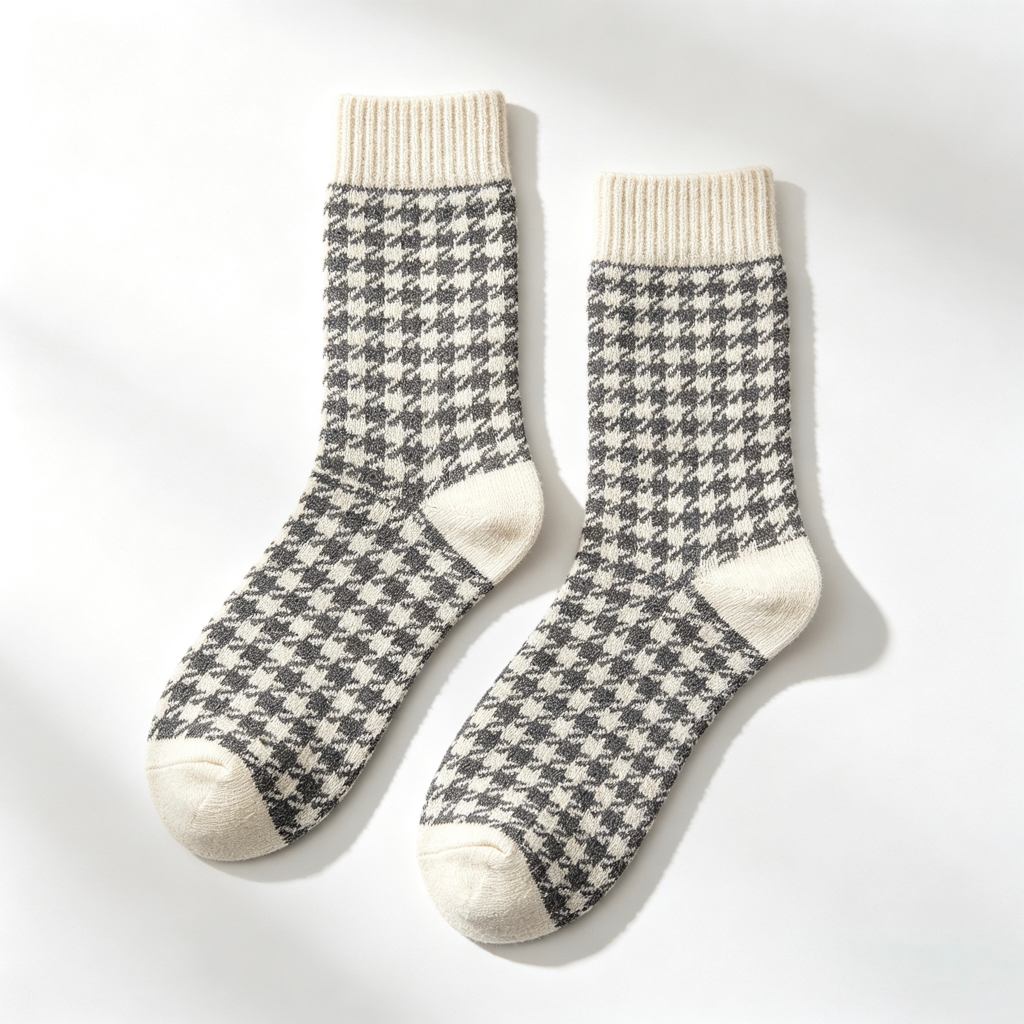
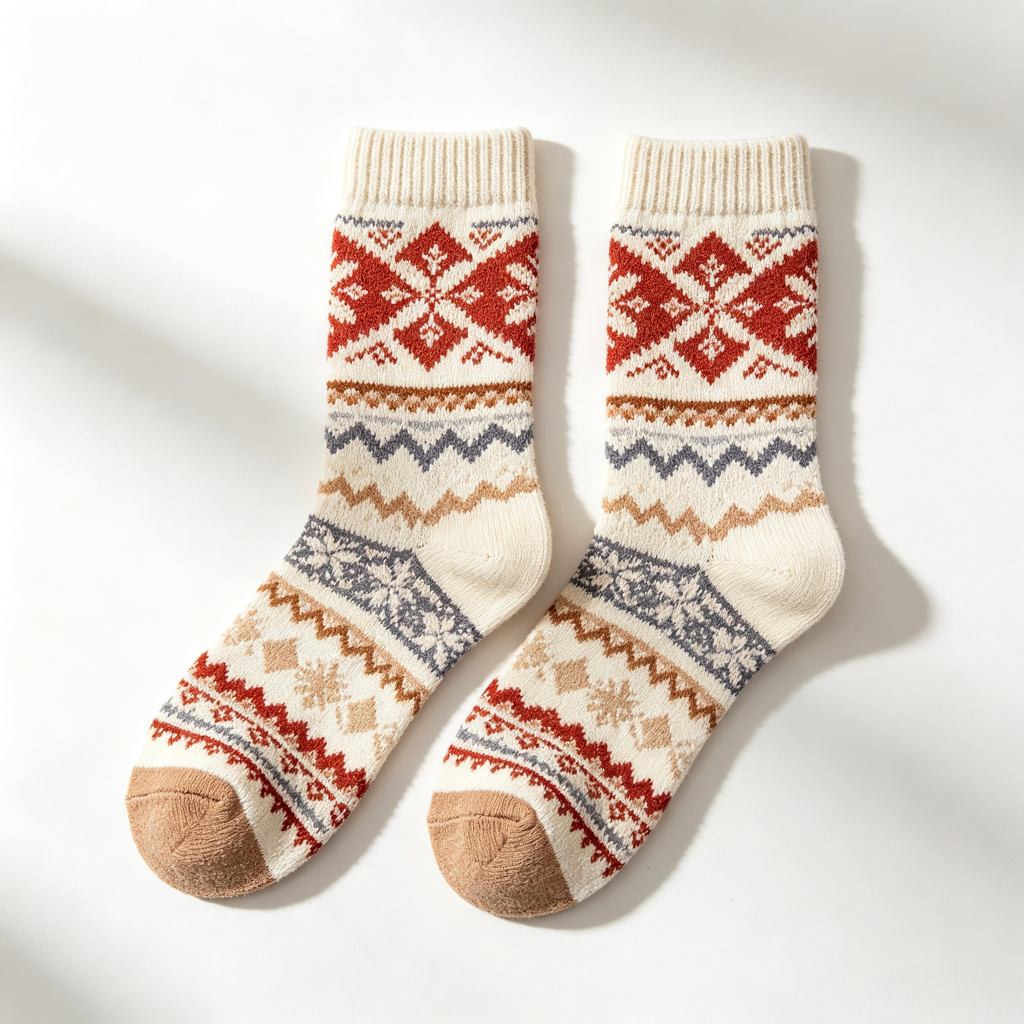
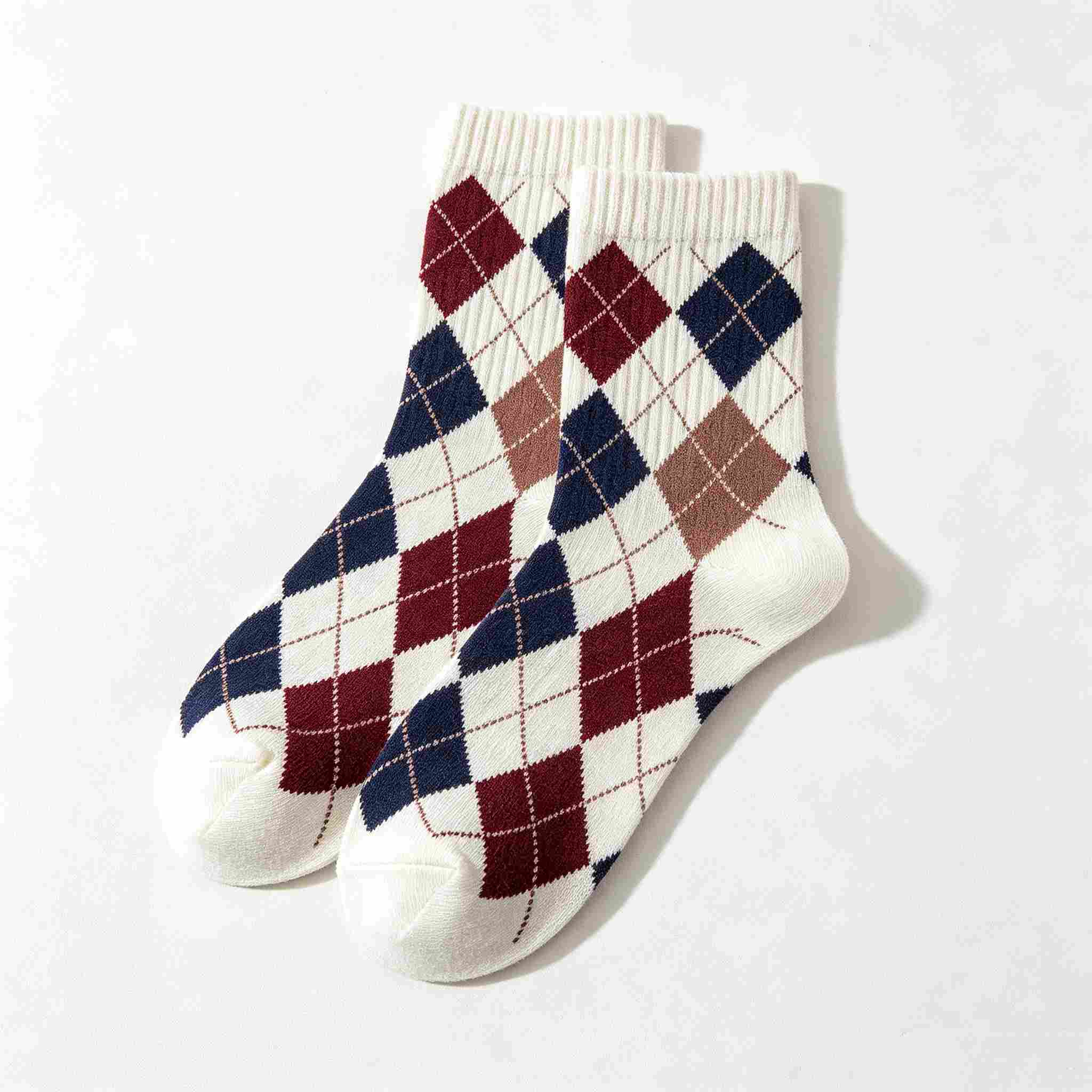
Most jacquard artwork comes back for revision at least once, and nearly every revision traces to the same three assumptions: that the design can have as many colours as the designer wants, that fine detail will survive, and that the pattern can go anywhere on the sock.
Fix those three things before you open a design file and you will usually approve on the first sample.
Every idea below can be produced through jacquard sock manufacturing, including jacquard, printing and retail-ready packaging.
H2 Start With the Colour Count
Decide the number of colours first, not last. Two colours is the safest and cheapest. Three is comfortable. Four is workable with care. Five and above starts to create float problems that no amount of engineering fully solves, and the machine slows because every additional colour is another pass of the feeder.
Write the colour count into the brief as a hard limit. A designer given “up to four” will use four; a designer told “two, and here is why” will produce something better.
H2 Understand the Grid
Your canvas is the needle count wide by the number of courses tall. On a 168-needle machine, that is 168 stitches around the leg. A motif twelve stitches wide will repeat fourteen times around the circumference.
Designing directly on this grid — or at least checking the design against it — prevents the classic disappointment of a motif that looks right on screen and arrives as a busy stripe. Most brand designers find it helpful to see one repeat tiled at actual stitch resolution before approving.
H2 Minimum Feature Sizes
As working rules: lettering should be at least five stitches tall to be legible, any solid block should stay under about six stitches in any direction unless you want floats, and gaps between motifs should be at least two stitches.
These are not arbitrary. They come directly from float length and from how the eye reads a knitted motif at arm’s length. Smaller detail does not knit as finer detail — it knits as mush.
H2 Choose Placement or All-Over
Placement means one motif in a defined position, usually above the ankle on the outer leg, or running vertically up the back. All-over means a repeat covering the whole leg.
Placement is easier to engineer, cheaper, and more wearable, and it has become the default for corporate and team programmes. All-over pattern suits fashion and gift ranges where the sock is the statement. Decide which you are making before you design, because the artwork is not interchangeable.
H2 Keep It Off the Sole
Floats on the inside of the sock catch toes. If the design must continue onto the foot, keep it on the instep and stop it before the sole, or ask for a plated ground yarn so the floats are sandwiched away from the skin.
The same logic applies to the heel. A pattern across the heel pouch wears unevenly and looks distorted once the sock is on.
H2 File Formats and Handoff
Send vector artwork where possible — AI, SVG or PDF — with colours named and Pantone or lab-dip references attached. If the design originated as a raster, supply it at high resolution and be prepared for the colour count to be reduced during conversion.
Include a note on which colours are negotiable. When a float problem appears, knowing which shade you are willing to drop saves a round trip.
H2 The Pre-Flight Check
Before submitting: count your colours. Check the smallest letter height against the grid. Confirm the pattern does not cross the sole. Confirm the repeat tiles cleanly at the needle count. Confirm the yarn count you want is available in every colour specified.
Five minutes here typically saves ten days.
If that is settled, the next question is usually answered in Jacquard Socks Buying Guide.
FAQ
Q: Can you match a Pantone exactly? A: We match to the closest available shade in the specified yarn and send a lab dip for approval. Exact matches are rarely possible across different fibre types.
Q: Can I use a gradient? A: Not in true jacquard. Apparent gradient can be suggested with dithering between two colours, but it reads as texture rather than a smooth blend.
Q: What if my logo has a registered symbol? A: At five stitches tall, a ® will not be legible. Either enlarge the whole lockup or drop the mark and put it on the packaging instead.
CONCLUSION
Design for the machine: fix the colour count, respect the grid, keep detail above the minimum, and keep the pattern off the sole. The constraints are real, but they are also what gives jacquard its characteristic crisp, durable look.
Ready to price this out? Start with a sample from the Sockmader custom sock factory, or send your artwork and target quantity for a quote.
If you are planning your own line, our custom jacquard socks program covers sampling, MOQ and lead times in one place.