A sock worn on a construction site, a warehouse floor or a factory line is not the same product as a sock worn to an office, even when they look identical in the packet. The difference is measured in hours and abrasion cycles. An office sock is worn for maybe nine hours with moderate movement. A work sock is worn for ten or twelve hours, inside a heavy boot, under load, on concrete, often in heat, five or six days a week. Designing for that means prioritising durability and moisture control over softness, and it means reinforcement in exactly the places that fail first.
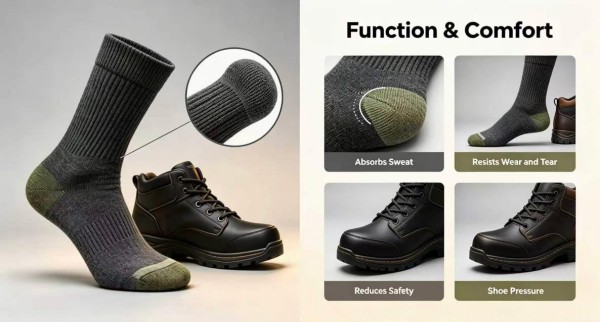
You get these same benefits through custom work sock range, with yarn and construction tuned to your target price point.
Abrasion Resistance Where Socks Fail Socks fail at the heel and the toe, in that order, because those are the points where the foot grinds against the inside of the boot. A work sock reinforces both, either with a higher-tenacity nylon blended into the yarn or, for genuinely abrasive environments, with aramid fiber. Aramid is expensive but it can extend the life of a sock three or four times over. For anyone replacing socks monthly, that is a real saving rather than a marketing claim.
Moisture Management Across a Full Shift Feet have more sweat glands per square centimetre than almost anywhere else on the body, and a boot holds all of it. Damp socks macerate skin, raise blister risk and create the conditions for fungal problems. Work socks move moisture away from the skin using synthetic wicking yarns or merino, and they use mesh or vented panels across the instep to let vapor escape. Cotton-rich socks do the opposite, which is why they are the wrong choice despite being the most common.
Cushioning for Hard Surfaces Concrete, steel decking and grating do not give. Standing on them for a full shift concentrates load at the heel and the ball of the foot, and fatigue shows up in the lower back as much as in the feet. A cushioned sole — usually terry loops of medium density — spreads that load and reduces the end-of-shift ache that most workers simply accept as normal.
Safety-Related Features Some work socks carry functional requirements beyond comfort. High-visibility colors or reflective yarns matter for roadside and rail work. Flame-resistant fibers are specified in welding, foundry and electrical utility environments. Anti-static yarns are used in electronics assembly and around sensitive equipment. Non-slip silicone soles appear in some safety footwear programmes. If your workforce has a safety specification, the sock is part of it and should be procured as such.
Total Cost of Ownership A cheap cotton multipack looks economical and is not. If a sock wears through in six weeks and a reinforced version lasts six months, the reinforced sock is cheaper even at four times the unit price — before counting the cost of discomfort, blisters and lost time. Procurement teams that evaluate socks on unit price alone almost always spend more over a year.
Fit Inside Safety Footwear Steel-toe boots have a defined internal volume, and a sock that is too thick reduces it, causing pressure and cold. Work socks should be specified alongside the boot, not independently. Medium cushioning is the safe default; heavy cushioning only if the boot is sized for it.
Boot Socks Size Chart picks up where this article leaves off.
FAQ
Q: Should work socks be thick?
A: Medium is usually right. Too thick inside a safety boot causes pressure and reduces circulation.
Q: Merino or synthetic for industrial work? A: Synthetic for hot, high-output environments; merino for cold or for multi-day wear where odour matters.
Q: Are reinforced toes worth the extra cost? A: Almost always, if the alternative is replacing socks every few weeks.
Q: Do safety-rated socks exist? A: Yes — flame-resistant, anti-static and high-visibility variants are all produced for specific industries.
CONCLUSION
Work socks exist because a ten-hour shift in a boot is a harsher environment than any office. The benefits that matter are abrasion resistance at the heel and toe, moisture control across the whole shift, cushioning for hard surfaces, and safety features where the job requires them. Judge them on cost per month of wear rather than cost per pair, and the specification writes itself.
When you are ready to produce, Sockmader’s custom work socks team covers sampling, MOQ and lead times in one place.