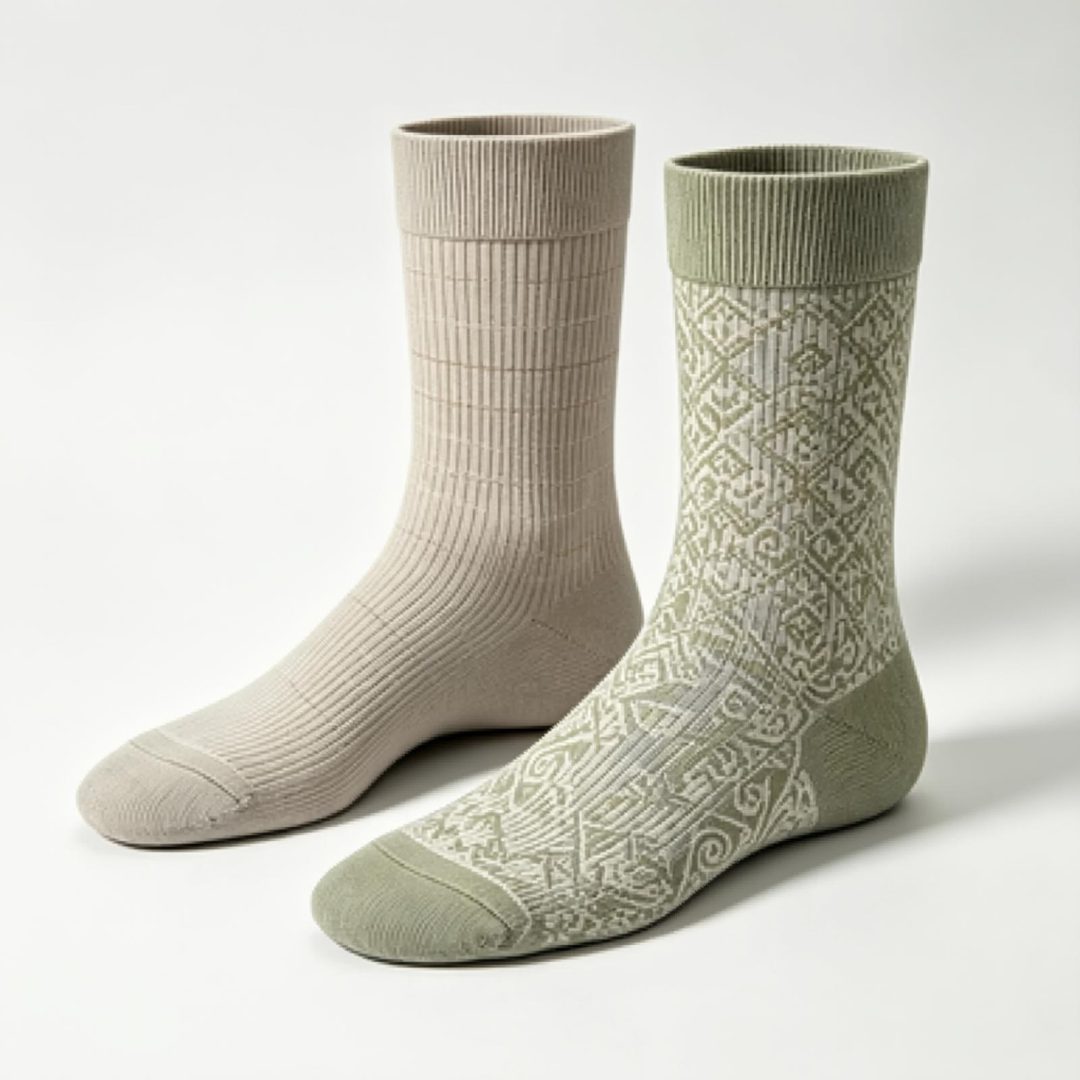
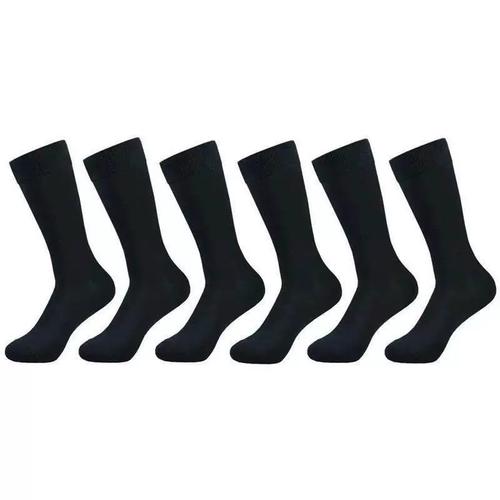
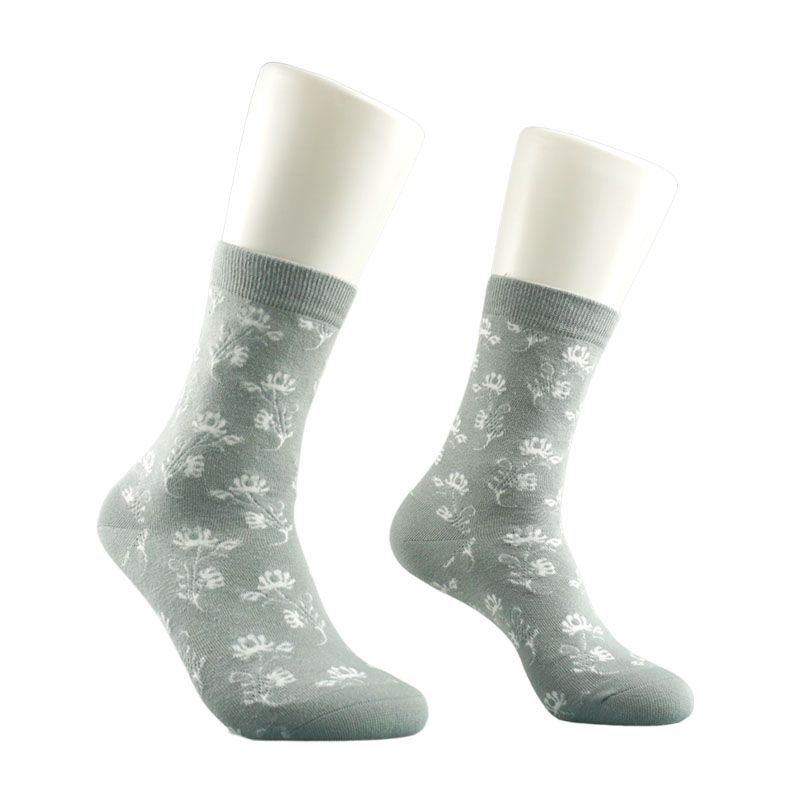
A dress sock is defined less by what it has than by what it does not. It has no cushioning, no terry loops, no bulky reinforcement and no visible branding. What it has instead is a fine gauge, a smooth surface and a length that keeps the leg covered when the wearer sits down. That combination is what lets it sit under a tailored trouser without adding bulk or showing skin. Everything else — the yarn, the sheen, the pattern — is a variation within that definition.
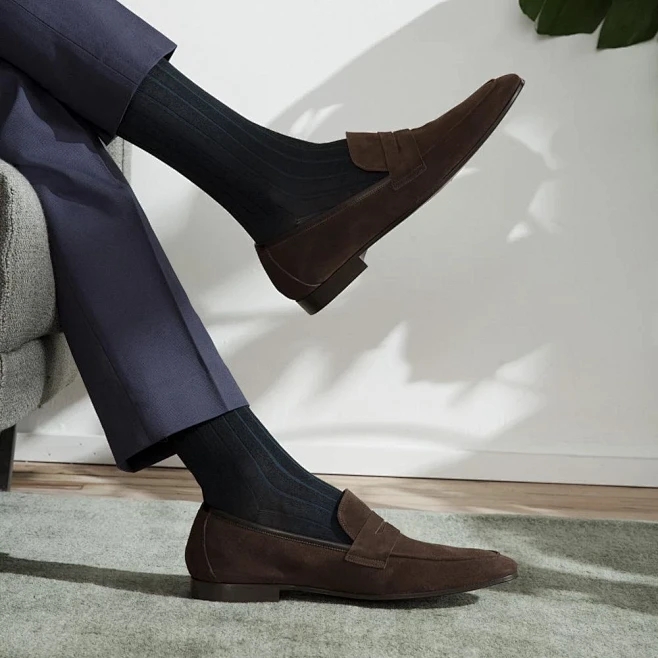
The yarn, gauge and MOQ options for this style are listed on the custom dress sock range page.
Gauge: The Defining Specification Gauge, expressed as “N” or needle count, is the number of needles around the knitting cylinder. A casual crew sock is typically 96 to 144N. A dress sock runs 168 to 240N, with 200N being the common quality standard. More needles mean finer yarn and a tighter, smoother fabric. This is the specification that separates a dress sock from everything else, and it is the number to ask for when comparing suppliers — a sock described only as “fine” tells you nothing.
Length: Over the Calf True dress socks are over-the-calf, finishing below the knee. The reason is practical: when a man sits down and the trouser hem rises, a mid-calf sock exposes a band of bare leg. An over-the-calf sock stays covered. Mid-calf dress socks exist and sell, but they are a compromise, and anyone who has been caught showing shin in a meeting knows why the longer version persists.
Yarn: Fine, Smooth and Often Blended Common dress sock yarns include fine merino, mercerised cotton, silk blends and, at the value end, filament nylon. Mercerisation — a treatment that swells the cotton fibre — adds lustre and improves dye uptake, which is why it appears on better cotton dress socks. Silk is blended in small percentages for sheen and softness. Nylon appears everywhere for durability, since a fine-gauge knit in a short-staple fibre alone would wear through quickly at the heel.
What a Dress Sock Does Not Have No terry cushioning in the sole. No reinforced heel beyond a small nylon patch. No elasticated arch band. No ribbed cushion zones. These omissions are deliberate — every one of them adds bulk, and bulk is the enemy of a sock that has to disappear under tailored cloth. If a sock has visible cushioning, it is not a dress sock regardless of how it is marketed.
Dress Socks vs Formal Hose There is a further distinction worth knowing. Formal hose — the silk or fine-gauge socks worn with white tie or morning dress — is smoother and finer still, sometimes knitted on 260N machines, and traditionally plain black or grey. Dress socks sit between formal hose and casual socks in the range. For most commercial purposes the term “dress sock” covers anything fine-gauge and over-the-calf intended for tailoring.
How to Judge One Quickly Turn it inside out. A good dress sock has short, tidy yarn floats with no long loops that will snag on a toe. Stretch the cuff: it should recover fully and immediately. Hold it to the light: the knit should be dense and even, with no visible variation. Then look at the toe seam — on a fine-gauge sock it should be hand-linked or rosso closed and almost impossible to feel.
How to Choose Dress Socks for Your Brand picks up where this article leaves off.
FAQ
Q: Are dress socks the same as formal socks? A: Close, but formal hose is finer and plainer still. Dress socks cover most tailored wear.
Q: Why are dress socks so thin? A: So they add no bulk under a trouser and fit inside a leather shoe without changing its fit.
Q: Is over-the-calf really necessary? A: If the wearer sits down in public, yes. It is the only way to guarantee no bare leg appears.
Q: Do fine-gauge socks wear out faster? A: They are less abrasion-resistant than heavy socks, which is why nylon is blended in at the heel and toe.
CONCLUSION
A dress sock is a fine-gauge, over-the-calf sock with no cushioning, built to disappear under tailoring. Gauge is the specification that defines it, length is what makes it work in practice, and the absence of bulk is what separates it from every other sock in the drawer. Ask for the needle count, check the toe seam, and you will know exactly what you are buying.
To move from plan to order, send artwork, size range and quantity through Sockmader’s custom dress socks team.