Animal print is the most durable pattern in fashion and one of the more interesting challenges in sock manufacturing, because it can be made two completely different ways. Knitted jacquard puts the pattern into the structure, where it cannot fade. Digital printing puts it onto the surface, where unlimited colour is available but the ink sits on top of the fabric. Which method is correct depends less on cost than on the specific animal and the scale of the pattern.
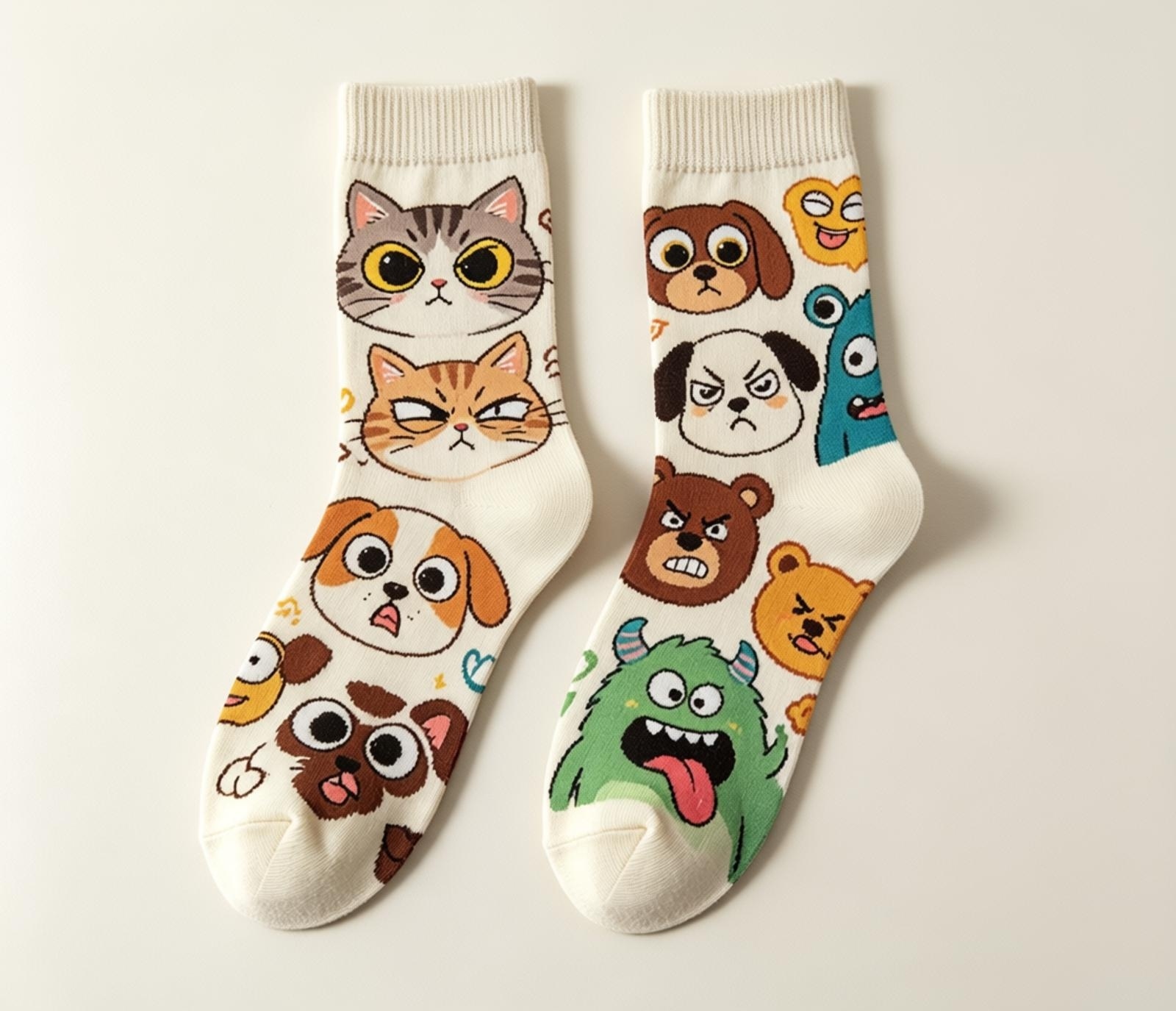
You will see every step below in custom printed socks, where sampling runs before bulk production and MOQ starts at 300 pairs per design.
Leopard:
Graduated Tones A leopard print is made of irregular rosettes with soft, graduated edges in two or three tones over a base. Knitted jacquard handles it awkwardly, because jacquard colours have hard boundaries at stitch level — there is no way to blend one stitch into the next. Digital print handles it perfectly, because it can lay down continuous tone exactly like a photograph. If the design is a realistic leopard, print is the right answer.
Zebra:
Hard Edges and High Contrast Zebra is the opposite problem. It is a two-tone pattern with hard, irregular, high-contrast edges. Jacquard knits this beautifully — two yarns, hard boundaries, no blending needed — and the result is crisp and permanent. Printing also works, but it offers no advantage, and the printed version will soften at the edges with washing. For zebra, knitting is usually better.
Cow, Giraffe and Dalmatian Cow print is irregular organic blocks in two tones:
it knits well, though large blocks create long floats that need managing. Giraffe is closer to leopard in behaviour, with soft-edged polygons — it prints better. Dalmatian spots are small, hard-edged and two-tone, and they knit very well in a repeating or engineered pattern. The general rule holds: hard edges and two tones knit well, soft edges and many tones print better.
Digital Printing:
How It Works In digital sock printing, the sock is knitted first — usually in white or a pale base, in polyester or a high-polyester blend — then mounted on a flat form and passed through a printer that deposits dye or pigment directly onto the fabric. The ink is fixed with heat or steam. Because the sock is a tube, the printer has to manage both sides without the ink striking through, which is why high-polyester content is specified: the ink bonds to synthetic fibre far better than to cotton.
Knitted Jacquard:
How It Works In jacquard, the pattern is created by selecting needles to take one of several yarn feeds at each stitch. The animal print is programmed as a repeat and the machine reproduces it around the leg. Colour count is limited to four or so by the float problem, and the pattern must repeat cleanly around the cylinder. It is slower to set up but produces a pattern that is structurally part of the fabric and cannot fade.
Choosing Between Them Choose print when the design needs photographic realism, many colours, or placement artwork. Choose jacquard when the design is two or three tones with hard edges, when the sock will be heavily washed, or when the range needs a long production life with repeat orders. Many brands do both: print for the statement piece, jacquard for the core colourways that restock for years.
We go deeper on Printed Socks Design Ideas in a separate guide.
FAQ
Q: Does printed animal print fade? A: Gradually. Reactive and disperse inks bond well but soften over dozens of washes. Knitted pattern cannot fade.
Q: Can animal print be knitted in more than three colours? A: Technically yes, practically no — the floats become unmanageable. Print instead.
Q: Why do printed socks need polyester? A: The inks used in digital sock printing bond to synthetic fibre. High-cotton socks print poorly.
Q: Which is cheaper? A: Print for short runs and complex artwork; jacquard for long runs of a simple two-tone pattern.
CONCLUSION
Animal print socks are made either as knitted jacquard or as digital print on a synthetic-rich blank, and the right choice follows from the animal. Leopard and giraffe, with their graduated tones, print better. Zebra, cow and dalmatian, with hard edges and few colours, knit better and last longer. Decide on the pattern’s geometry rather than on price, and the result will look right and stay right.
Ready to price this out? Start with a sample from Sockmader, or send your artwork and target quantity for a quote.
If you are planning your own line, our custom printed socks program covers sampling, MOQ and lead times in one place.