The worst printed sock designs are the ones that try to look knitted. If a design is two or three flat colours in a simple repeat, it will look better and last longer knitted as jacquard. Printing earns its cost when the idea needs something knitting cannot deliver: photographic detail, smooth gradients, unlimited colour, or artwork placed on a specific part of the sock. These twelve ideas are all built around that principle.
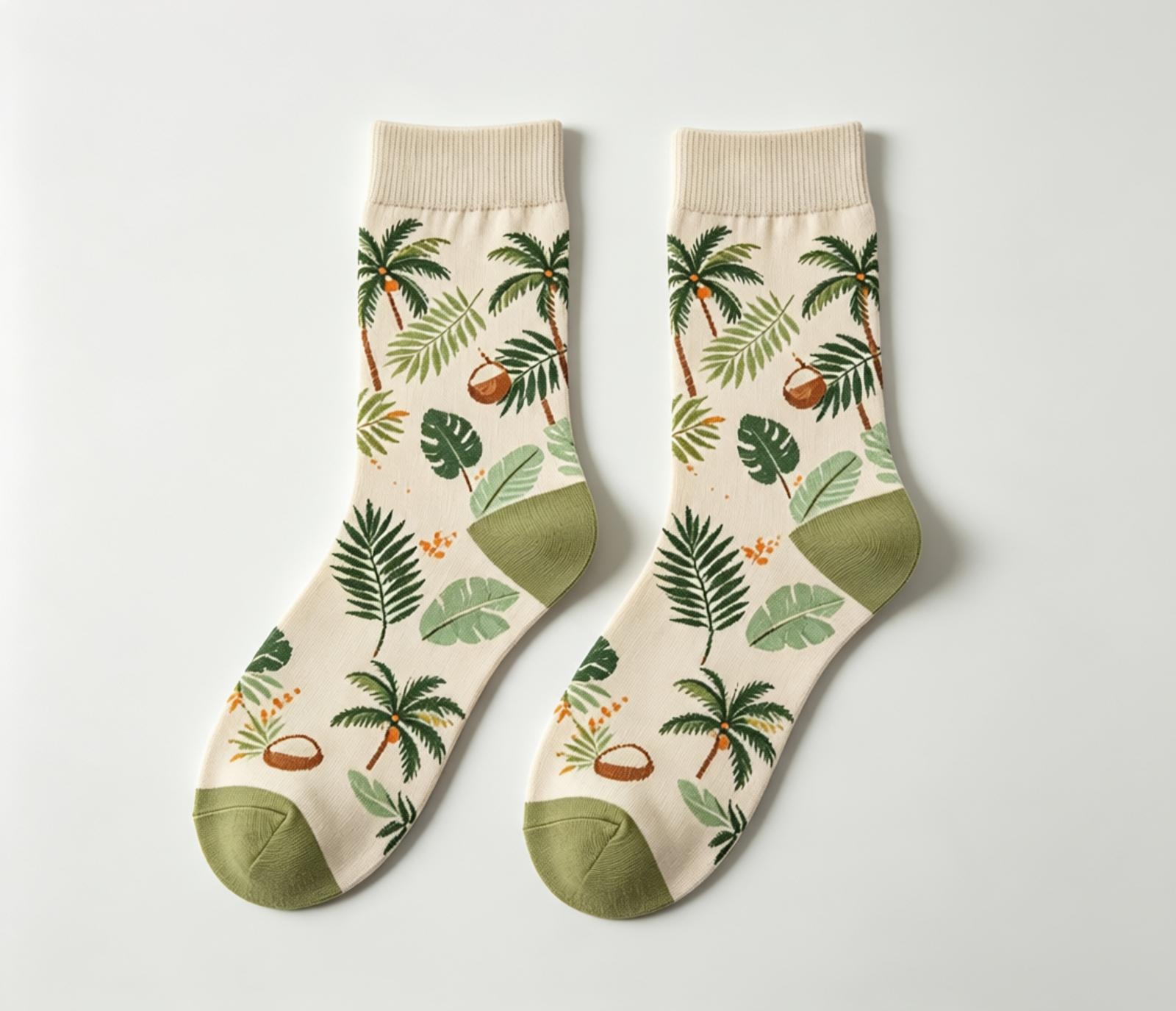
Every idea below can be produced through printed sock manufacturing, including jacquard, printing and retail-ready packaging.
Photographic and Illustrative Ideas
1. Pet portraits.
A photograph of a customer’s dog or cat, repeated or placed on the ankle. The single most commercially successful printed sock idea, because it is personal and unprice-sensitive.
2. Food prints. Avocado, pizza, doughnut or coffee motifs in full colour. Reliable novelty sellers with strong gifting appeal.
3. Landscape or cityscape bands. A horizon, skyline or mountain range wrapped around the leg. Uses print’s ability to render continuous tone.
4. Character faces. A face placed on the ankle so it reads when the shoe and trouser hem frame it.
Gradient and Colour Ideas
5. Ombré fade. A smooth colour transition up the leg. Impossible in jacquard, trivial in print.
6. Tie-dye simulation. Printed swirls that mimic hand-dyeing with consistent, repeatable results.
7. Watercolour washes. Soft, painterly colour fields. Reads as premium rather than novelty.
8. Neon and saturated colour. Print reaches colours that are hard to match in yarn, and holds saturation better after washing.
Placement Ideas
9. Sole print. Artwork on the sole only, revealed when the foot lifts. Highly shareable and genuinely surprising.
10. Ankle medallion. A single circular motif placed over the ankle bone, with the rest of the sock plain.
11. Cuff-to-toe narrative. Artwork that runs the full length of the sock and only makes sense when the whole thing is seen — effective for storytelling and licensed designs.
12. Inside joke text. A short phrase printed on the sole or the inner cuff, visible only to the wearer.
Production Notes Printed socks need a synthetic-rich blank — typically 90 per cent polyester or a polyester-cotton blend with high polyester content — because the inks bond to synthetic fibre. Artwork should be supplied at 300 dpi at actual size, in a colour profile the printer specifies. Very dark artwork on a light sock can show a visible seam line where the tube passes under the print head, so ask for a proof before production.
Designing for the Tube A sock is a three-dimensional tube, and flat artwork distorts when wrapped around it. Keep critical elements away from the centre-back seam region, avoid text that crosses the full circumference, and remember that the pattern will compress on the leg and stretch over the calf. A design that works on a flat mock-up often fails on a leg — which is why a physical proof is not optional.
If that is settled, the next question is usually answered in What Are Printed Socks?.
FAQ
Q: What file format should artwork be in? A: High-resolution raster at 300 dpi actual size, or vector for flat graphics. Ask your printer for their profile.
Q: Can printed socks be cotton-rich? A: Not for quality printing. Polyester content is what makes the ink bond and the colour hold.
Q: Does print crack when stretched? A: Modern inks flex well, but heavy coverage on a high-stretch area can show slight cracking. Avoid solid coverage over the heel.
Q: How many pairs can I print? A: Digital printing has low minimums — often 50 to 100 pairs — which makes it ideal for testing designs.
CONCLUSION
Printed sock design should exploit what print does uniquely: photographic detail, gradients, unlimited colour and precise placement. Avoid designs that knitting could do better, keep critical artwork away from the seam, and always approve a physical proof on a leg. Do that and print becomes a genuine design tool rather than a cheaper way to make a bad jacquard.
To move from plan to order, send artwork, size range and quantity through the Sockmader custom sock factory.
When you are ready to source, the Sockmader custom printed socks team can quote sampling, MOQ and lead times for your quantity.