If you are sourcing custom hiking socks, the most common mistake is asking for a price before there is a specification. A quote built without yarn composition, gauge and a size set is a guess, and guesses turn into disputes several weeks later. What follows covers the specification, the cost structure, the minimum per color and the calendar. The product route starts at custom hiking socks.
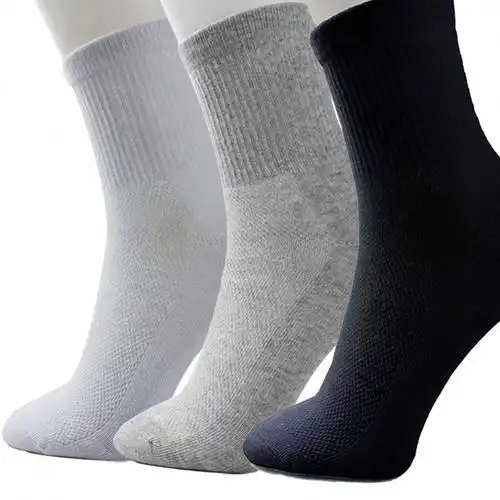
Three specifications decide both the outcome and the price: fibre fineness, zoned cushioning and leg height. Get those on your enquiry sheet and quotes become comparable.
On this page:
- Where your money actually goes
- Minimum per color, and why the number is what it is
- Which yarn blend actually performs
- QC: the checks to ask for before the shipment leaves
Related terms in the same decision: custom waterproof socks; hiking socks wholesale; custom hiking socks manufacturer.
Where your money actually goes
Take a typical first order of a few hundred pairs. Four lines decide almost everything.
| Cost line | Typical share | What moves it |
|---|---|---|
| Yarn | 35 to 50 percent | fibre type, staple quality, whether it is custom-dyed |
| Knitting and labour | 20 to 30 percent | gauge, structure complexity, number of colours |
| Technique and setup | 5 to 15 percent | artwork route, screens, machine set-up |
| Finishing and packing | 8 to 12 percent | washing, boarding, labelling, cartons |
Note that only one of those four is negotiable through quantity alone. The technique line is fixed per design, so it either gets spread across many pairs or it sits heavily on few.
Pricing power in hiking socks sits in the wool: content, fineness and whether it carries RWS certification stack into the yarn cost.
If two quotes differ by more than a few percent, the difference is usually the specification rather than the supplier. The commercial route is explained on sock packaging options.
Minimum per color, and why the number is what it is
Buyers often treat MOQ as a negotiating position. It is not: it is arithmetic done by the production planner. Three costs have to be covered before the first pair is worth knitting.
- Machine programming and set-up. Fixed per design, regardless of how many pairs follow.
- Yarn minimum. A dyelot has a floor, which is why custom shades raise the entry point.
- Changeover labour. Every swap of yarn, needle setting or programme costs machine hours.
The standard minimum is 300 pairs per color. What shapes the order is not the design but the way it is split: each colourway is its own production run, and each size block is knitted and paired separately.
If you are unsure about size split, ask how the 300 pairs are distributed across sizes within one colourway; that is the number that actually constrains the order. Terms and sampling rules are set out on sock packaging options.
Which yarn blend actually performs
| Blend | What it gives you |
|---|---|
| Wool / polyester blend | The value outdoor option. |
| Polyester with elastane | Light summer hiking. |
| Merino wool 50-70% with nylon and elastane | Temperature control, odour resistance and durability. |
Beyond the blend, three things decide the outcome more than the fibre name does:
- Staple quality. Combed cotton sheds short fibres, which is why it pills noticeably less than carded.
- Elastane share. Below about 3% the cuff will not recover; above 8% the sock feels tight and costs more.
- Reinforcement yarn. Nylon in the heel and toe is the cheapest durability you can buy.
Test the blend in the real use case before committing to bulk. A blend that performs in a showroom and one that performs after a month of wear are frequently not the same blend. Cross-category comparison: custom cotton socks.
Nearly every sourcing dispute traces back to a spec that was never written down. Put these on your enquiry sheet and most of the risk disappears.
| Spec | What to write | Why it matters |
|---|---|---|
| Zoned cushioning | Thicker at heel and forefoot, ventilated across the instep. | The main factor in blister rate over distance. |
| Leg height | Mid-calf to over-the-calf to clear the boot. | Prevents the boot collar rubbing. |
| Fibre fineness | 17.5-21.5 microns. | Finer means less itch and a higher price. |
Also pin down the packing method (pairing, folding, hang tag, polybag, carton count) — it is the last step and the one that most often gets assumed rather than specified. Related reading: custom socks.
QC: the checks to ask for before the shipment leaves
AQL 2.5 is the common default for apparel, and many European and US buyers additionally require zero tolerance for critical defects. AQL 4.0 suits promotional goods, and AQL 1.0 is used for high-value or medical channels. Then the product-specific checks:
| Check | Method |
|---|---|
| Shrinkage | Dimensional change within 5%. |
| Abrasion | Martindale cycles. |
| Zone placement | Does the padding sit on the load points. |
| Fibre content and fineness | Third-party testing. |
For the first order, add a pre-production sample and an in-line check. Two checkpoints cost very little compared with finding a defect at final inspection. Process and test references: sock resources.
FAQ
Do hiking socks need zones?
For any real distance, yes. Zoning is the main reason two socks of the same weight produce different blister rates.
What is the minimum order?
300 pairs per color; custom merino yarn has its own mill minimum, so confirm it before costing.
How long is sampling?
3-7 days.
What is the fastest way to get an accurate quote?
Send a specification sheet — yarn composition, needle count, size set, construction, artwork route, quantity and packing. A quote built from that is usually within a few percent of final; a quote built from a photo is not.
Where to go from here
If you take one thing from this: the cheapest quote is usually the one with the loosest spec. Write the spec first and the quotes become comparable. custom hiking socks is the place to begin; custom socks covers the commercial terms.