No-show socks live on a fit knife-edge: too loose and they slip; too tight and the cuff digs. Because they lack a tall cuff, sizing and the heel grip work together to keep them on. This chart covers no-show and low-cut sizing, and explains why a size that would be fine on a crew sock can fail on a no-show. For wholesale and brand buyers, getting the band right is the cheapest insurance against the returns and complaints that plague this category.
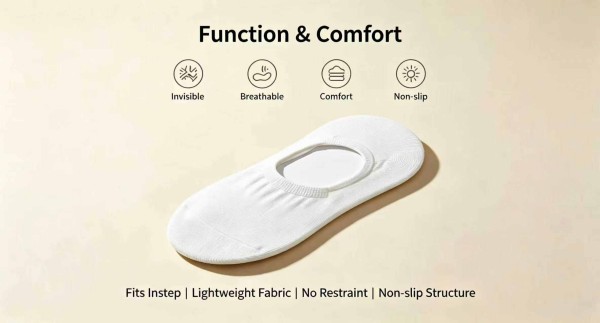
Sizes in this chart are available through custom no-show sock range, and every size run can be graded and sampled before bulk production.
Size Bands We use the same standard shoe bands as the rest of the line: – S: EU 35–38 – M: EU 39–42 – L: EU 43–46 – XL: EU 47+ The bands are standard, but no-shows fit snug by design. Because there is no cuff to correct drift, a slightly small no-show stays put better than a slightly large one. We advise buyers to bias toward true-to-size or a hair snug rather than sizing up, which is the opposite of the advice given for thick boot socks and worth stating explicitly to avoid a misread.
Fit and Grip Together Sizing alone will not hold a no-show — the silicone heel strip does the work. Spec both: correct band plus heel grip. A well-sized no-show without grip still slips; a gripped one in the wrong band rides up or bunches. The two are not alternatives; they are a system. We review the grip and the band together at sampling, because approving one and assuming the other is the classic path to a sock that tests fine on the form and fails on the foot.
Brand and Wholesale Split Everyday low-cut programs: weight to M/L for men, or M for women-led ranges. No-show dressy lines: similar split. Add 10% M for replacement, because low-cut socks are easy to lose and easy to outgrow within a household. Because fit is tight, avoid over-ordering XL (rare in this category) and under-ordering M, which is where most demand concentrates. A size spreadsheet from actual wearer data beats a guess and prevents a pile of unwanted extremes.
Stretch and Wash Elastane (8–12%) gives high stretch; a band covers 3–4 sizes, so four bands serve almost any market. Pre-shrunk boarding keeps the worn size stable after the first wash. Wash cold, no softener — softener degrades the heel silicone and is the leading cause of “my no-shows stopped staying up” reports that are actually laundry failures. We print the care note on the pack because the grip is only as durable as the wash it receives.
Common Fit Problems Two problems dominate no-show returns. The first is a too-large band: the sock bags at the heel and the grip loses contact, so it slips — fix by biasing true-to-size or a hair snug. The second is a weak or missing heel strip, which no amount of correct sizing will save. We screen both at sampling with a wear test, not just a form check. A third, subtler issue is shade drift between batches that makes a “replacement” pair look off next to the original, which is why we lock a master shade for the whole run.
Ankle vs No-Show vs Low-Cut picks up where this article leaves off.
FAQ
Q: Size up or down for no-shows? A: True-to-size; a touch snug is better than loose since the grip does the holding, not the fabric tension.
Q: Why do mine still slip? A: Likely weak or missing heel silicone, not size — check the strip before changing the band.
Q: Unisex? A: Yes, sized by band; the grip and the cut are the same for any foot.
CONCLUSION
Size no-shows by shoe band and pair with a real heel grip. Snug fit plus silicone is the formula that keeps them on and invisible, and stating that formula clearly to the end buyer is half the battle against returns.
When you are ready to produce, Sockmader’s custom no-show socks team covers sampling, MOQ and lead times in one place.