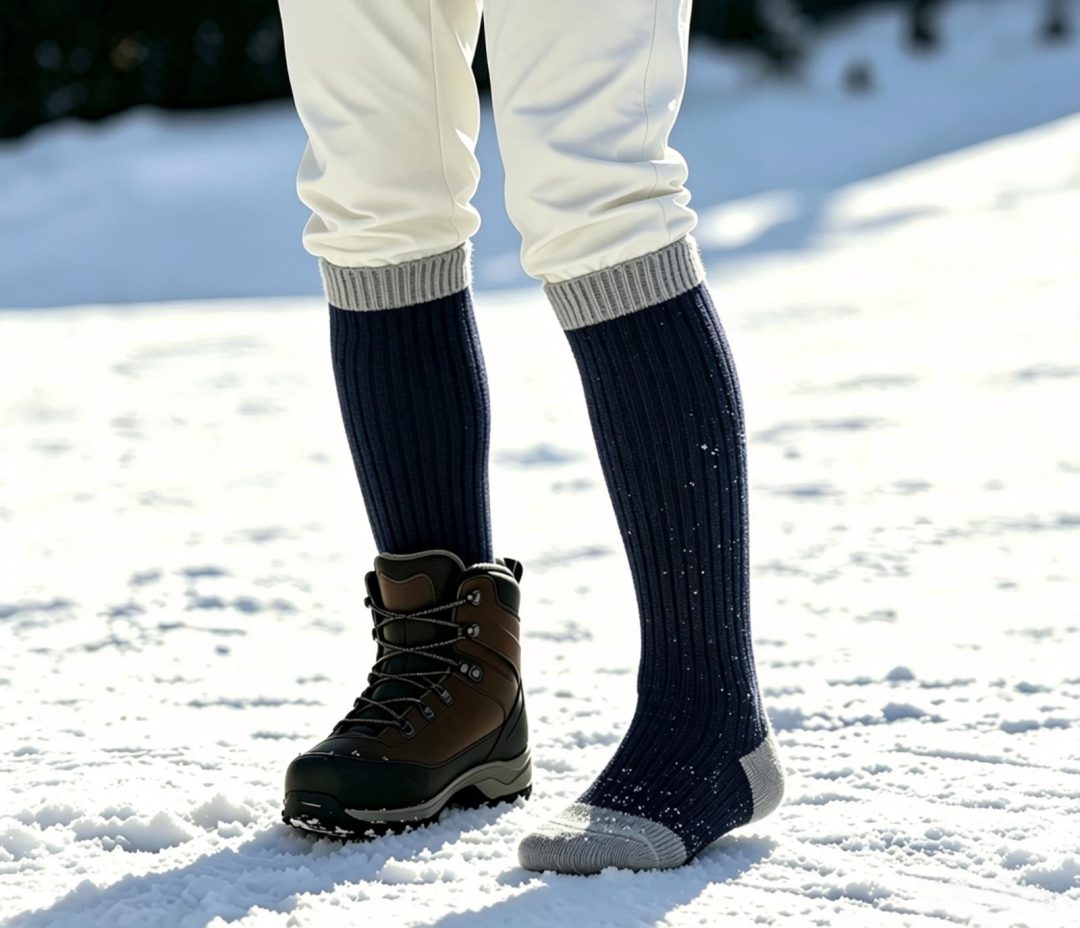
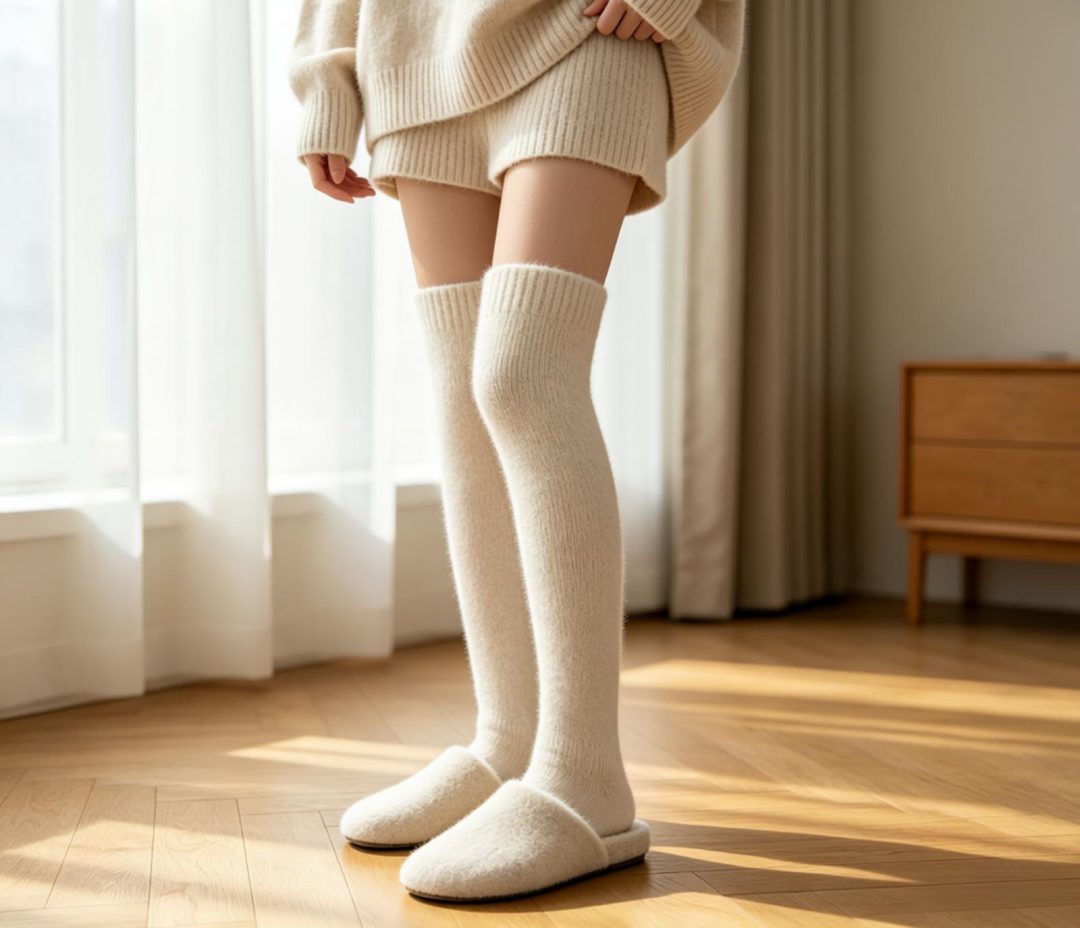
Choosing a thigh-high socks manufacturer is less about the catalogue than about what you confirm on the first call. Before comparing prices, establish the minimum per color, how long sampling takes, and what happens when a shipment lands outside tolerance. Everything else – yarn, gauge, artwork – can be tuned later. Start the conversation here: thigh-high socks manufacturer.
Timeline, stage by stage
| Stage | Duration | What happens |
|---|---|---|
| Enquiry and quotation | 1 to 3 days | spec sheet confirmed, yarn availability checked |
| Sampling | 3 to 7 days | programming, trial knitting, finishing, sample shipped |
| Sample revision | 2 to 4 days per round | each change restarts part of the loop |
| Bulk production | 5 to 25 days | knitting, closing, washing, boarding, inspection |
| Packing and export | 3 to 7 days | pairing, packing, cartons, documentation |
| Shipping | 3 to 45 days | A full sea container takes roughly 30-40 days to the US West Coast and 35-45 days to major European ports. Air freight takes 5-8 days but usually costs four to six times the sea rate per unit, and courier shipments for small trial orders arrive in 3-5 days. |
The biggest avoidable delay is a vague sample brief. Every clarification round costs three to five days. Process detail is documented under OEM sock manufacturing.
How knee-high socks are made, step by step
Understanding the production sequence tells you where delays and defects come from.
1. Yarn preparation. Cones are inspected and, if the programme needs it, dyed to a confirmed shade. Custom dyeing adds 7–14 days and carries a mill minimum.
2. Knitting. Socks are knitted as tubes on circular sock machines. 84N-96N coarse gauges serve terry and heavy socks, 108N-120N is the workhorse for everyday styles, 144N-168N carries fine jacquard and athletic structure, and 200N tops the range for dress socks and very fine jacquard.
3. Toe closing. There are three toe closures: standard overlock, the cheapest and the one that leaves a seam ridge; Rosso linking, which is substantially flat; and hand-linked seamless, the most comfortable and the most expensive per pair.
4. Washing and boarding. Washing removes knitting oils and sets dimensions; boarding (heat-setting on forms) gives the final shape and smoothness.
5. Inspection and pairing. Each pair is checked for defects, matched by size and shade, and paired.
6. Packing. Hang tags, polybags, inner boxes and cartons per the packing specification.
For knee-high socks the step that most often needs extra attention is finishing — Leg height and symmetry. Full process notes: OEM sock manufacturing.
Minimum order: what actually sets the number
MOQ is not a policy number a factory invents. It is the point at which machine set-up, yarn minimums and finishing labour stop losing money, and that point moves with construction.
| What changes | How MOQ moves |
|---|---|
| Number of colours in one design | each extra colourway is a separate knitting run |
| Whether yarn comes from stock or is dyed | custom dyeing carries a mill minimum per shade |
| Technique | jacquard and complex structures need longer machine programming |
| Size range | each size block is knitted and paired separately |
| Packing | retail-ready packing has its own minimum per carton |
A first order close to the minimum is a legitimate way to test quality and communication before committing volume – most programmes start there. Terms and sampling rules are set out on custom socks wholesale.
QC: the checks to ask for before the shipment leaves
AQL 2.5 is the common default for apparel, and many European and US buyers additionally require zero tolerance for critical defects. AQL 4.0 suits promotional goods, and AQL 1.0 is used for high-value or medical channels. Then the product-specific checks:
| Check | Method |
|---|---|
| Leg length after washing | Dimensional change rate. |
| Leg height and symmetry | Left/right difference within 0.5 cm. |
| Cuff recovery | Returns after 20 stretches. |
| Slip-down test | 30 minutes of real wear. |
Ask for the inspection report before the balance payment, not after. Once the container is on the water, every remedy gets slower and more expensive. Process and test references: OEM sock manufacturing.
FAQ
How long is sampling?
3-7 days.
How do we stop knee-highs sliding down?
Widen the cuff, lower the pressure and add a silicone strip; raise the elastane share to improve recovery at the same time.
How should sizes be graded?
S/M/L is not enough because leg length varies so much. Use at least four bands with a leg-length chart.
What is the fastest way to get an accurate quote?
Send a specification sheet — yarn composition, needle count, size set, construction, artwork route, quantity and packing. A quote built from that is usually within a few percent of final; a quote built from a photo is not.
If you are still deciding, these pages help: extra custom options.
Where to go from here
The short version: fix the specification, then the quantity, then the date. Everything else is negotiable; those three are not. If you want the full route, start at thigh-high socks manufacturer and keep custom sock manufacturer open while you write your spec sheet.