Most riders blame cold feet on the boot. In the factory, we blame the sock. A ski sock is not a thicker version of a casual sock — it is a zone-engineered garment where every square centimeter of knit density is mapped to a different job: padding the shin against the tongue, wicking the instep where the shell clamps, and insulating the toe without bunching inside a tight liner. Understanding how ski socks are made explains why two socks that look identical on the shelf can perform worlds apart on a January chairlift. For a custom sock brand serving ski resorts, rental fleets or pro shops, this manufacturing knowledge is also what lets you specify a product that actually keeps customers out all day instead of sending them in at lunch.
You will see every step below in sports sock manufacturing, where sampling runs before bulk production and MOQ starts at 100 pairs per design.
The Yarn Foundation: Merino Blends, Not 100% Wool Ski socks are almost never 100% merino, despite the marketing. Pure merino lacks the recovery and abrasion resistance a boot demands, so mills blend 60–70% merino with 25–35% nylon and 2–5% elastane. The nylon carries the structural load and lets the sock survive hundreds of wash cycles; the elastane holds the arch and cuff in place. A common mistake among first-time buyers is specifying “all natural” — the result pills and sags within a season. We recommend a 64/32/4 merino-nylon-elastane mix as the baseline for mid-weight resort socks, pushing merino to 70% only for premium cold-weather lines where cost is secondary.
Terry-Loop Cushioning: The Warmth Engine The signature of a ski sock is the terry loop — a raised yarn loop knitted into the inner layer that traps air and creates insulation. Cushioning is not uniform. The shin and heel get a full-density terry loop (often 3–4 mm); the instep gets a flat or half-density knit so the boot’s pressure points don’t create hot spots. This zoning is programmed into the knitting machine’s stitch pattern, not added later. Lightweight race socks drop the terry almost entirely for a second-skin feel; all-mountain socks use medium density; freeride and rental socks use heavy density for maximum padding. Getting the zone wrong — too much terry at the instep — is the single most common cause of boot-pressure complaints we see in returns.
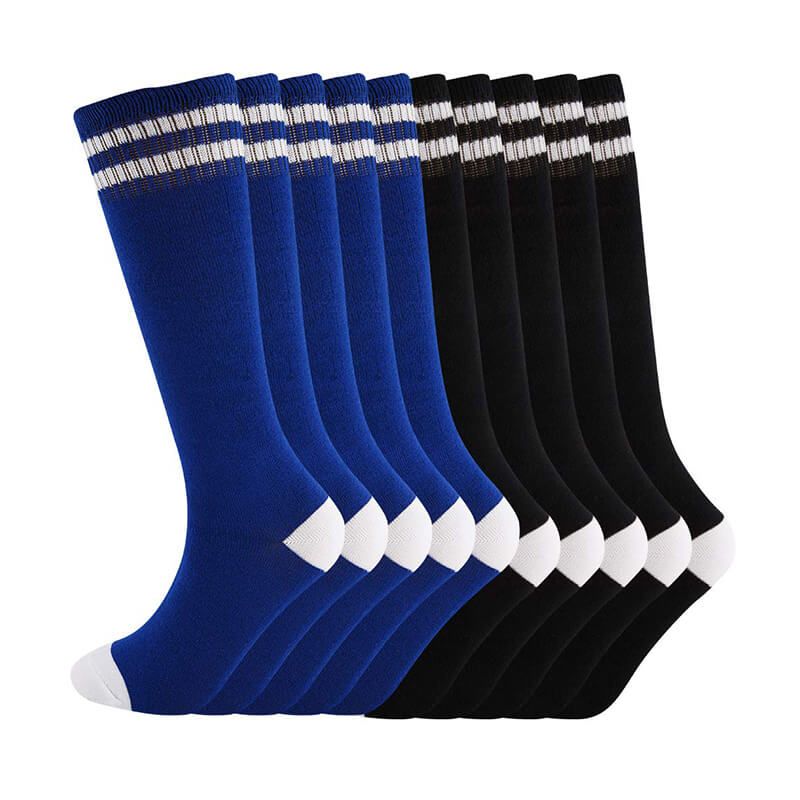
Height, Toe Closure and the Boot Interface Ski socks are over-the-calf by design — the top must sit above the boot cuff to prevent the shell from chafing bare skin. The toe is closed with a linked (rosso) seam or a fully knit toe to avoid a ridge inside a tightly laced boot. A poorly linked toe is the #1 comfort complaint we see in returns. The cuff uses a taller, tighter rib with a silicone-free comfort band — silicone can shred in a boot dryer, so premium lines avoid it. The leg knit transitions from dense terry at the calf to a lighter rib at the top so the sock stays up without cutting circulation during a long morning.
Moisture Management and the One-Sock Rule Cotton is forbidden in ski construction: it holds water and freezes. Merino wicks, but the nylon blend does the heavy lifting moving vapor to the outer surface. We coach buyers on the “one-sock rule” — a single engineered sock outperforms a thin liner plus a thick sock, because the liner creates a friction layer that causes blisters. The sock’s job is to move moisture out, not to add a layer. For rental operations that wash socks constantly, the nylon content also matters for shape retention wash after wash.
Manufacturing Flow The process runs: yarn winding → dial-set circular knitting on a 96–200 needle machine → toe closing (linking) → boarding (heat-shaped on a steel form) → pair matching → quality check for loop density and seam integrity → polybag. Boarding matters: a ski sock that leaves the form misshapen will never sit right in a boot. Rental-grade socks get an extra boarding pass to lock shape against industrial washing.
If that is settled, the next question is usually answered in How Are Running Socks Made?.
FAQ
Q: Should ski socks have compression? A: Light graduated compression in the calf is common in performance lines and aids circulation on long lifts, but full medical-grade compression is unnecessary and can feel restrictive in a stiff boot. Specify light compression only for your high-end lines.
Q: What denier or weight should a resort sock be? A: Mid-weight (around 260–320 g/m² fabric density) suits most resorts; lightweight for warm days or tight race boots, heavyweight for sub-zero freeride. Match weight to the boot’s internal volume.
Q: How long do merino ski socks last? A: A 64/32/4 blend at proper wash temperature (≤40°C, no fabric softener) typically lasts 150–200 wear days. Rental-grade with higher nylon lasts longer but feels less soft.
CONCLUSION
A ski sock is engineered around the boot, not the foot alone. Specify the merino-nylon blend, demand zone terry cushioning, and insist on a linked toe — those three decisions separate a sock that keeps riders out all day from one that ends the trip at lunch. For a brand, getting these right turns a commodity into a product customers re-order every season.
When you are ready to produce, the Sockmader custom sock factory covers sampling, MOQ and lead times in one place.
Start your next order with custom sports socks from Sockmader — send artwork, size range and target quantity for a quote.