Hiking socks are a good category for a focused founder and a bad one for a generalist. The customers are knowledgeable, they read specifications, and they will return a product that blisters them. That sounds like a disadvantage, but it is actually the opportunity: outdoor buyers reward genuine performance and will pay for it repeatedly. The brands that succeed here are built by people who know the terrain they are designing for, and who specify accordingly.
Sampling, production and retail packaging for a first line all run through custom work socks.
Choose Your Terrain and Climate First “Hiking socks” covers desert day hikes and winter expeditions, and those are different products. Decide which you are making. Hot-climate hiking needs light cushioning, synthetic or lightweight merino, vented insteps and fast drying. Cold and multi-day use needs heavier merino, denser cushioning and taller shafts. Three-season temperate hiking — the largest market — sits in between. Naming your terrain makes every subsequent specification decision easier and gives your marketing something concrete to say.
Specify Yarn Deliberately Merino is the default for a reason: it manages moisture, insulates when wet and resists odour, which matters on multi-day trips. It is expensive and dries slowly. Synthetic blends wick faster, dry quicker, cost less and wear longer, but they smell after a few days. Blends with a nylon core and a merino face are the compromise most brands land on. Whatever you choose, specify the merino micron count — 17 to 19 micron is soft next to skin, 21 to 23 is noticeably coarser and cheaper.
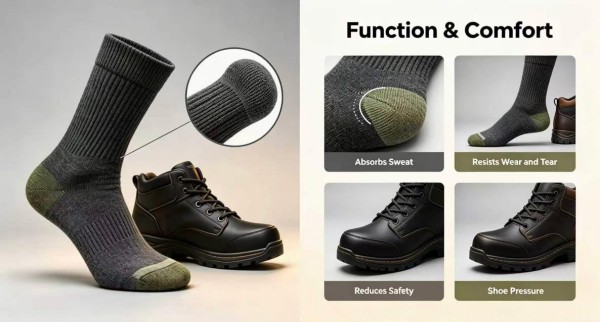
Get Fit Right Before Anything Else Fit beats thickness in this category, and it is where new brands most often fail. A hiking sock must not bunch, must not slip at the heel, and must hold its shape after washing. Specify a shaped heel pocket, an elasticated arch band and a flat toe seam, then wear-test the sample for a full day on real terrain. Ask five people with different foot shapes to do the same. Every fit complaint is a future return, and returns destroy margin in a category where shipping is a meaningful share of cost.
Unit Economics Custom hiking socks in merino blends typically start at around 300 pairs per design, with the yarn cost dominating — fine merino can be several times the cost of synthetic. Landed cost should sit at or below a quarter of retail price to leave room for marketing and wholesale margin. The temptation is to drop to a cheaper yarn to hit a price point; resist it, because outdoor customers detect a coarse sock immediately and it is the single fastest way to earn a bad review.
Channels That Convert Outdoor retail works, but it demands wholesale margins and a sell-in story. Direct online works if you can demonstrate the difference — close-up photography of cushioning zones, honestly shot wear tests, and specific claims about terrain. Hiking clubs, guiding companies and trail organisations offer credible partnership routes. Corporate and team kit orders are an underrated channel: walking clubs, conservation volunteer groups and outdoor education providers all buy matching socks in bulk.
Build for Reorder Hiking socks wear out, and hikers own several pairs. Structure the range so the core styles stay in production permanently and seasonal colors rotate around them. Hold the yarn and construction specs on file so reorders do not require re-sampling, and keep size runs matched to actual demand rather than to a standard split.
We go deeper on Boot Socks Size Chart in a separate guide.
FAQ
Q: Merino or synthetic to start? A: Merino blend for a premium position, synthetic for a value or hot-climate line. Decide before you sample, not after.
Q: How many styles should a launch range have? A: Two or three — usually a light, a medium and a heavy cushioning option in one yarn family.
Q: Is private label a reasonable starting point? A: Yes. It validates demand quickly. Move to a custom specification once you know what sells.
Q: What is the biggest risk? A: Fit. Everything else can be fixed on the next run; a bad fit generates returns immediately.
CONCLUSION
A hiking sock brand is built on specification, not decoration. Choose your terrain, commit to a yarn and a micron count, get the fit right through real wear-testing, and price for a reorder business. Outdoor customers are demanding, but they are also loyal to a product that performs — which makes this one of the more rewarding categories to build in.
Ready to price this out? Start with a sample from Sockmader, or send your artwork and target quantity for a quote.
If you are planning your own line, our custom work socks program covers sampling, MOQ and lead times in one place.