“Printed socks” usually means a sock that is first knitted plain, then printed with a design — distinct from jacquard socks, where the pattern is knitted in from the start. The method decides durability, cost and MOQ, and it decides how the sock ages in the wash. This article explains how printed socks are made and where printing genuinely beats knitting, so a brand can choose the method deliberately rather than defaulting to whichever the factory happens to offer.
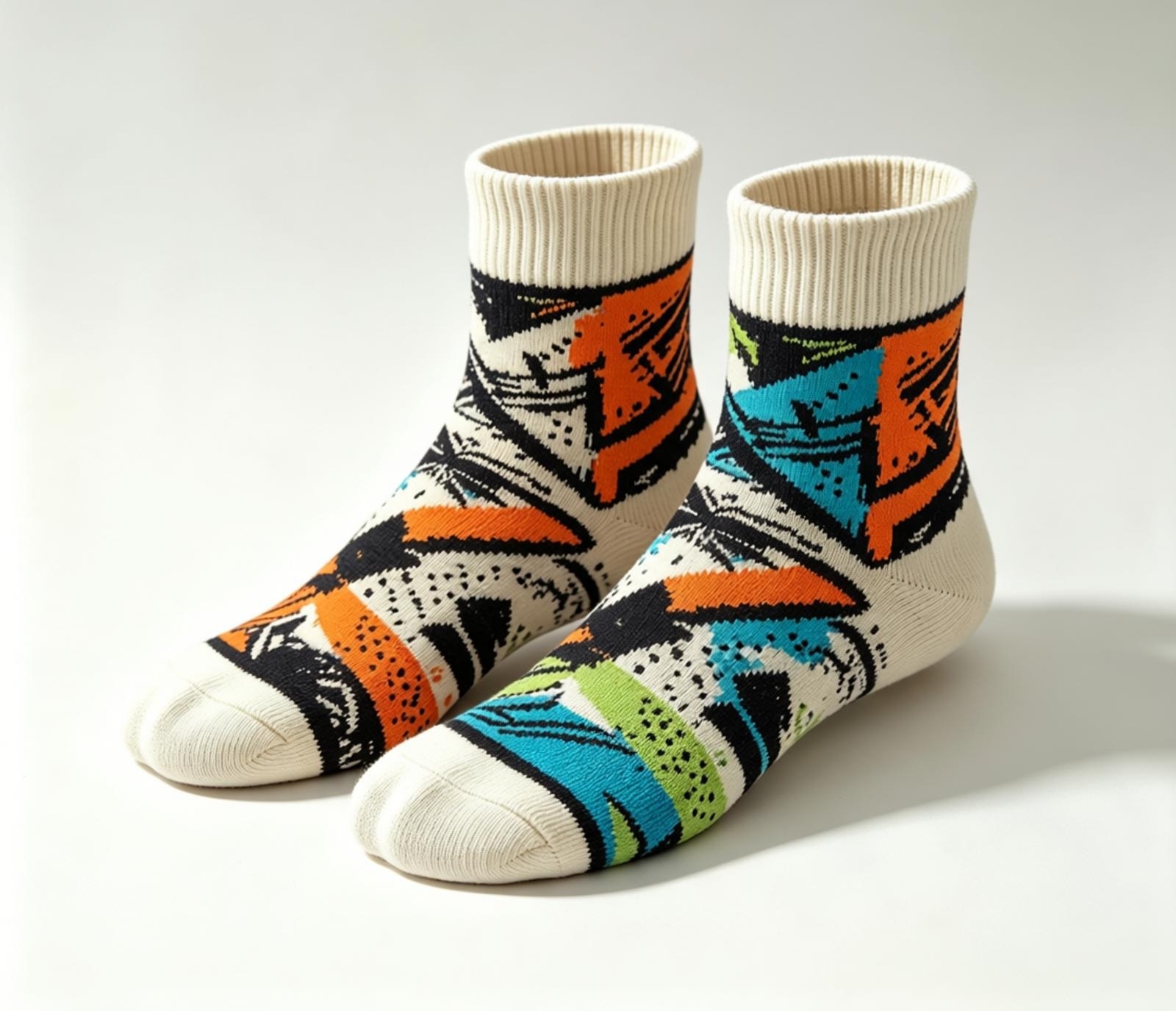
Both options are available through wholesale printed socks, and we can sample each one for side-by-side testing.
The Print Process A printed sock is knitted as a solid base (white or light), boarded, then printed — typically by sublimation, where dye infuses the polyester face, or by digital inkjet with pigment. Sublimation needs a poly-rich base to take the dye; cotton bases use pigment ink that sits on the surface. After printing, the sock is cured (heat-set) and finished. The boarded shape matters here: printing on a sock that is not properly formed produces a design that distorts the moment the sock is worn on a curved foot.
Print vs Jacquard – Print: fast, low MOQ (≈200), unlimited color and photo detail, but the design sits on the surface and can fade or crack with wear and washing. – Jacquard: the pattern is knitted in with colored yarn, effectively indestructible and reversible, but a higher MOQ (≈500+) and limited to the yarn colors on hand. Neither is better in the abstract — they serve different needs, and most mature sock ranges end up running both for different SKUs.
Durability Reality Sublimation on polyester holds well, because the dye is inside the fiber rather than on it. Pigment on cotton fades faster, because it sits as a layer that abrades. Both survive fewer wash cycles than jacquard, where the pattern is structural and cannot fade at all. For a promotional item or a one-season fashion drop, print is fine. For a repeating brand pattern that must still look right after a year of wear, jacquard is the only real answer, and the higher MOQ is the price of that permanence.
Design Freedom Print wins decisively on complexity — photographs, gradients, fine text and unlimited colorways are all achievable. Jacquard is limited to clean shapes and the yarn palette the mill stocks, though it excels at crisp repeating motifs, stripes and logos. In practice, brands use print for art and novelty socks where the image is the product, and jacquard for logos and repeating marks where the sock is the product and the mark is decoration.
Registration and Colour Two technical issues shape the result. Registration — the print must align with the sock’s shape, and on an all-over print a miscue shows most visibly at the toe join. And color: sublimation shifts slightly from screen, so a printed proof is essential, not optional. We always produce a physical proof on the actual base yarn before bulk, because a digital mockup cannot show how the dye sits in the knit or how the pattern behaves on a curved foot.
Sourcing Notes Printed socks: MOQ ~200 pairs per design (low setup) and lead time 20–30 days, which makes them the fastest customisation route. Require a wash test for fade and crack, and confirm the base yarn matches the print method — polyester for sublimation, cotton only for pigment. Sample the actual print before bulk, and keep the approved proof as the master for every reorder.
We handle the adjacent decision in Printed vs Knitted Socks.
FAQ
Q: Print or jacquard for a brand logo? A: Jacquard for a repeating, durable mark; print for a detailed one-off art sock or a low-volume test.
Q: Why does print fade? A: The design is surface-applied; pigment on cotton fades fastest, sublimation on polyester slowest.
Q: Which has the lowest MOQ? A: Print — around 200 pairs versus jacquard’s 500 or more, plus a much shorter lead time.
CONCLUSION
Printed socks apply the design after knitting; jacquard knits it in. Use print for low-MOQ, high-detail art and fast drops, and jacquard for durable repeating marks. Match the method to how long the sock must look right, and the choice becomes straightforward.
Ready to price this out? Start with a sample from Sockmader’s custom sock manufacturing team, or send your artwork and target quantity for a quote.
If you are planning your own line, our custom printed socks program covers sampling, MOQ and lead times in one place.