For a custom sock brand, the first production decision is print or knit (jacquard). They are not interchangeable — cost, MOQ, durability and design freedom all differ, and the choice shapes everything downstream from sampling to reorder. This comparison helps a brand choose the method that fits its stage and its product, and explains why most successful ranges end up using both rather than committing to one.
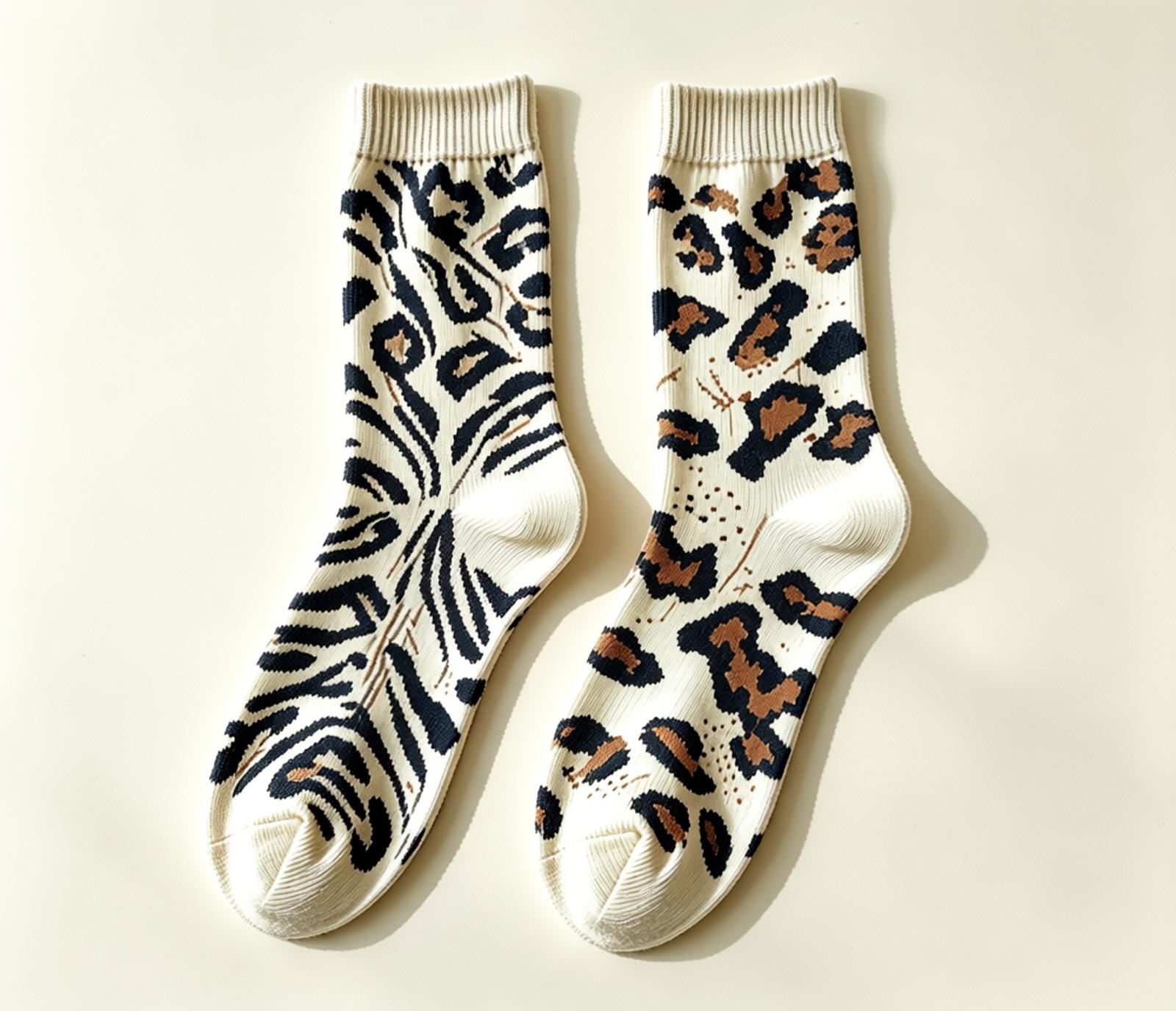
Both options are available through custom printed sock range, and we can sample each one for side-by-side testing.
The Four Axes – Cost per pair: print is lower at low volume; jacquard becomes cheaper at scale, because there is no per-pair print step. – MOQ: print around 200; jacquard 500 or more. – Durability: jacquard wins decisively, since the pattern is structural and cannot fade or crack. – Design freedom: print wins, handling photographs and gradients that jacquard simply cannot reproduce. Read together, these four axes point the same way: print is the tool for learning and for complexity, jacquard is the tool for commitment and for permanence.
When to Print – Launching a new brand, where a low MOQ lets you test designs without betting the budget. – Art and novelty socks with photographic or fine detail. – One-season drops and promotional items where longevity genuinely does not matter. Print is also the right answer when the design is the product — a buyer purchasing an art sock wants the image, not a lifetime guarantee, and print delivers that image at the best price.
When to Knit (Jacquard) – Established repeating brand marks and patterns that will be reordered for years. – Products meant to survive many washes, such as uniforms and everyday lines. – Volume high enough to absorb the MOQ and amortise the setup. Jacquard is the right answer when the sock is the product and the mark is secondary, because the pattern will outlast the fabric around it and never needs re-approval.
Hybrid Strategy Many brands start with print to test demand, then move hero and repeating designs to jacquard once volume justifies the setup. This de-risks design choices before committing to jacquard tooling, and it means the MOQ is only paid on designs already proven to sell. We recommend exactly this path for new lines: print three to five designs, watch which one outsells the others, then knit that one and retire the rest. The cost of the test is small compared with the cost of committing 500 pairs to a jacquard design that turns out to have no market, and the sales data you gather is worth more than any focus group.
Making the Switch The move from print to jacquard is not simply a re-order. The artwork must be simplified to clean shapes and a limited yarn palette, colors must be matched to stock yarns rather than to a digital swatch, and the design must be re-approved as a knit. Budget for one extra sampling round, and expect the jacquard version to look slightly different — crisper edges, fewer shades — which is the trade for a pattern that will never fade. Plan the switch well ahead of your selling season, because that extra round and the higher MOQ both need calendar room that a last-minute decision simply will not have.
How Are Animal Print Socks Made? picks up where this article leaves off.
FAQ
Q: Start a brand with print or jacquard? A: Print — the lower MOQ lets you test several designs, then move the winner to jacquard.
Q: Which lasts longer? A: Jacquard, by a wide margin — the pattern is knitted in rather than sitting on the surface.
Q: Can print do photographs? A: Yes — print handles photos, gradients and fine text; jacquard is limited to flat shapes and stock yarn colors.
CONCLUSION
Print for low-MOQ testing and high-detail art; jacquard for durable, repeating brand marks at volume. Most brands sensibly use both — print to learn what sells, jacquard to lock in the winners for the long run.
To move from plan to order, send artwork, size range and quantity through Sockmader’s custom printed socks team.