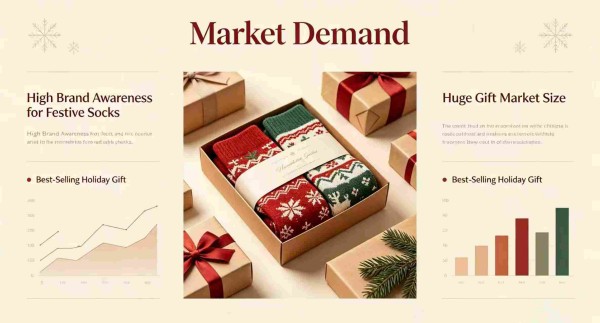
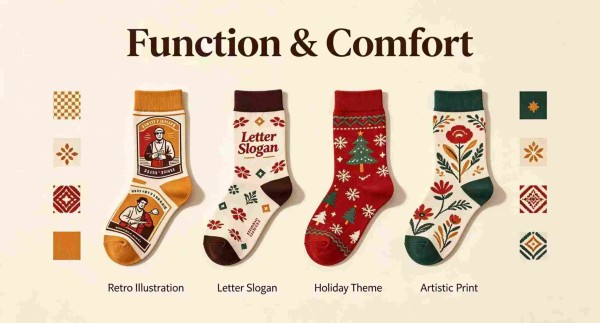
Christmas socks occupy a unique design space: they must be instantly festive, giftable without personalization risk, and appealing enough that adults willingly wear them at family gatherings. The difference between a design that sells through December and one that gets marked down on December 26 is usually visible in a handful of design decisions. Here is how professionals approach the category.
Every idea below can be produced through Christmas sock manufacturing, including jacquard, printing and retail-ready packaging.
Start With the Wearer, Not the Holiday
Every Christmas sock design answers one question first: who receives it? Kids’ designs can be loud, character-driven and colorful. Adult designs increasingly favor sophisticated festivity — Nordic minimalism, tonal palettes, witty text — because the biggest buyers (adults self-treating and gifting to other adults) want festive without infantilism. Corporate gift designs need restrained elegance with room for a logo. Define the recipient before touching a motif.
Build the Color System
The category’s palette is broader than red and green. The commercial color families: classic red/green/white (traditionalists), Scandinavian cream/oatmeal/forest green (the premium growth segment), icy blue/silver/white (winter-wonderland gifting), and blush/rose-gold (feminine gifting). Two disciplined rules: keep each design to 3–4 colors (each extra jacquard color adds cost and stiffness), and design the range so colorways coordinate — gift-set bundling depends on it.
Choose Motifs With Longevity
Christmas motifs sort by design lifespan. Evergreen themes (snowflakes, stars, Nordic patterns, reindeer, snowmen) sell year after year — inventory that doesn’t date. Trend themes (memes, current characters, novelty slogans) spike fast and die fast; use them sparingly, in small batches. Witty text (“Merry Christmas Ya Filthy Animal” style) is a reliable middle ground. A healthy assortment is roughly 70% evergreen motifs, 20% witty text, 10% trend bets.
Knit, Print, or Embellish?
Decoration method drives both look and durability. Jacquard knitting integrates motifs into the fabric — the premium, wash-proof choice for repeat-wear designs. Prints (heat transfer) enable photographic and complex artwork on lighter socks, at lower cost but fading over washes. Embellishments — pom-poms, bells, appliqué patches, sequins — add shelf magnetism and gift appeal; they require attachment-strength QC, but they are proven conversion drivers at retail. Premium programs combine jacquard bodies with selective embellishment.
Design the Cuff and the Fold
On Christmas socks, the cuff is prime real estate: the fold-over roll cuff is the first thing seen in packaging and on the mantel. Contrast-color cuffs, striped cuff bands, and pom-pom trims create identity at a glance. Design your hero motif so it remains visible both flat-packed on shelf and folded on a leg — two very different framings that both matter for sales.
Tech Pack and Production Reality
Production-ready Christmas sock design specifies: colorway files with Pantone references per size, motif placement (and its stretch behavior — motifs elongate 30–50% worn), cuff construction, yarn types (chenille for plush, metallic Lurex for sparkle — used sparingly, since it complicates knitting), embellishment positions, and packaging artwork. Christmas is also the season of kitting: specify design mixes for pre-assorted packs precisely, because factory kitting errors surface in December when they cannot be fixed.
If that is settled, the next question is usually answered in 15 Christmas Socks Design Ideas That Sell Every Season.
FAQ Q: How many colors should a Christmas sock design use? A: Three to four: each additional jacquard color raises cost and stiffens the fabric, with diminishing visual returns. Q: Are trend-based Christmas designs worth producing? A: In small batches, yes — they create urgency and social sharing. Cap them at roughly 10% of your assortment. Q: What makes a Christmas sock design “premium”? A: Sophisticated palettes (Scandinavian tones), jacquard or texture-led motifs, quality yarns like chenille, and considered packaging — the combination lets the product sit at gift-set price points.
CONCLUSION
Designing winning Christmas socks means designing for the recipient, disciplining the palette, leaning on evergreen motifs, and using the cuff as your billboard. Get those right, wrap it in giftable packaging, and your designs will sell through the season — and repeat next year without redesign.
Ready to price this out? Start with a sample from the Sockmader custom sock factory, or send your artwork and target quantity for a quote.
If you are planning your own line, our custom christmas socks program covers sampling, MOQ and lead times in one place.