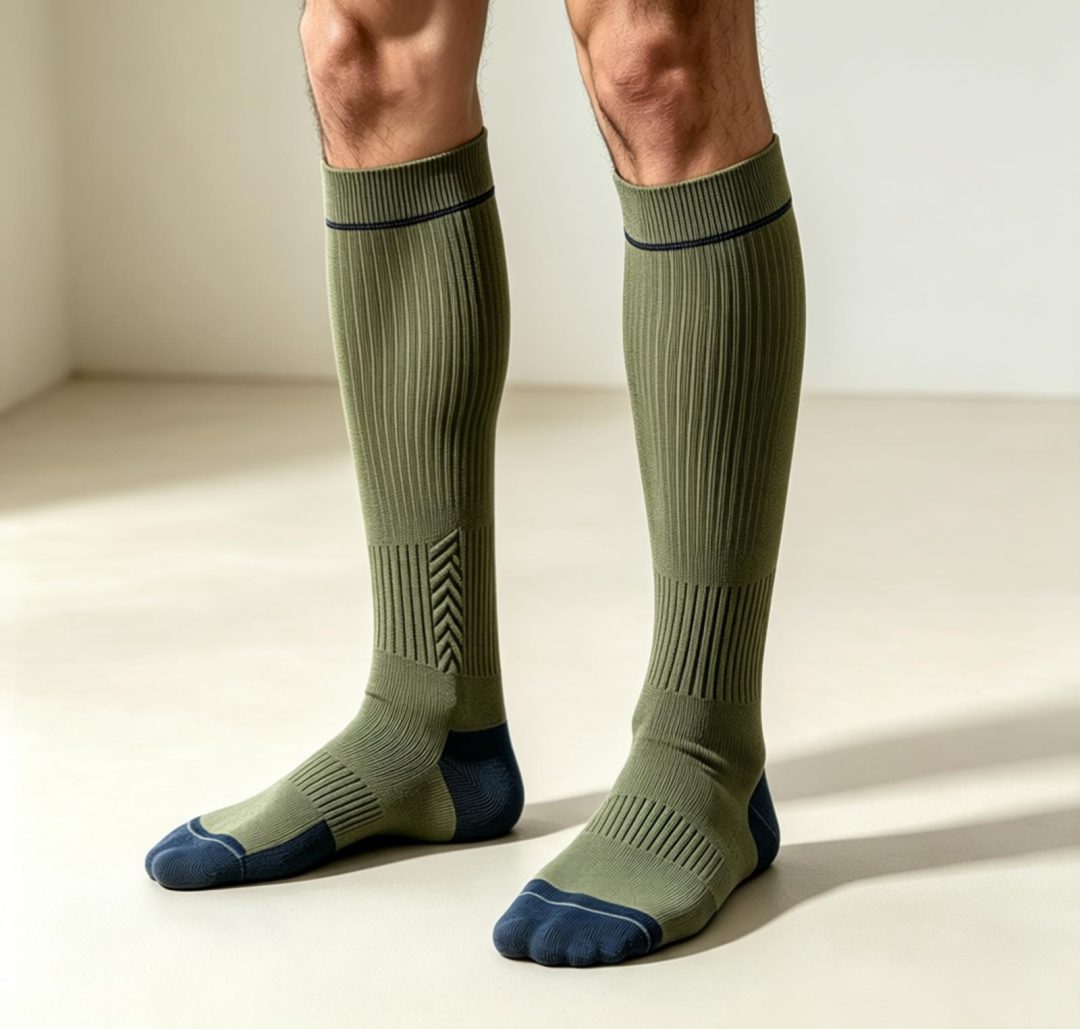
Compression socks have moved from pharmacy shelves to airport lounges, gyms and office dressers — but their actual function is still widely misunderstood. For anyone selling, buying or simply curious about the product, here is a clear explanation of what compression socks are, how they work, and what the numbers on the packaging mean.
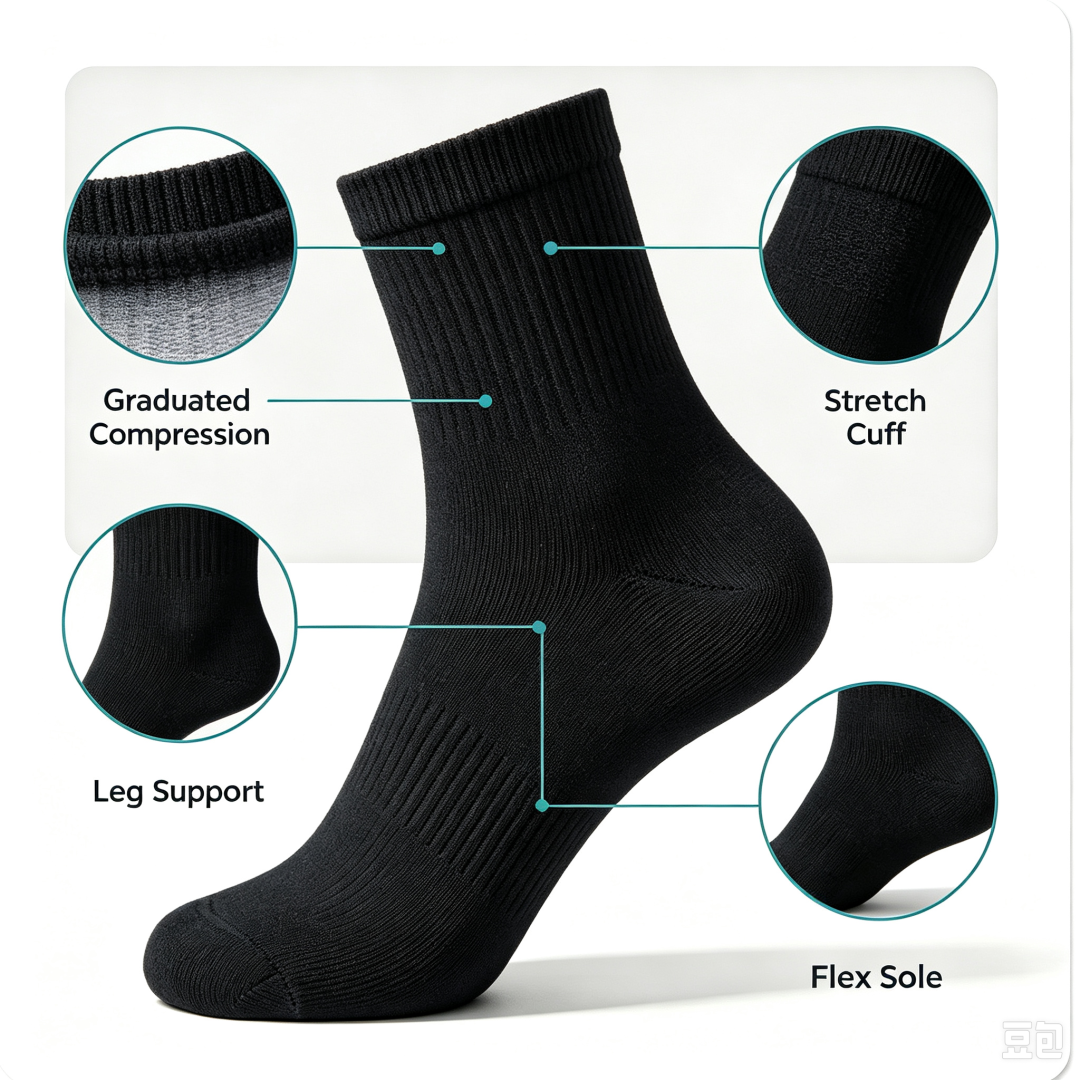
The yarn, gauge and MOQ options for this style are listed on the custom compression socks page.
The Simple Definition
A compression sock is a graduated-pressure garment for the lower leg: an elastic knit tube engineered to squeeze most firmly at the ankle and progressively less firmly up the calf. That “graduated” structure is what distinguishes true compression socks from ordinary tight socks, and it is achieved through computer-controlled knitting with elastane-rich yarns — not simply by making a sock smaller.
How Graduated Pressure Works
The mechanism is straightforward circulatory physics. Muscles in the leg help pump blood back toward the heart through veins; the external pressure of the sock assists that return flow, particularly from the lower leg where blood must travel furthest against gravity. Firmest pressure at the ankle, easing upward, supports this upward flow rather than restricting it. This is why pressure that is uniform (or reversed — tight at the top) is a construction error, and why quality matters: a poorly made sock can have exactly the wrong pressure profile.
Understanding mmHg Levels
Compression strength is measured in millimeters of mercury (mmHg), the same unit as blood pressure. The commercial map: 8–15 mmHg is light support, mostly a comfort product. 15–20 mmHg is the standard wellness tier — travel, standing professions, sports recovery, pregnancy comfort — sold without medical claims in most markets. 20–30 mmHg is medical class I, used for diagnosed circulation conditions and usually sold through medical channels. 30–40 mmHg (class II) is therapeutic-grade, prescribed and fitted. For brands, 15–20 mmHg is where the mass market lives.
Who Uses Them and Why
Four broad groups drive demand. Travelers on long flights use them to reduce swelling and discomfort. Occupational standers and sitters — nurses, teachers, retail and office workers — use them to fight end-of-day fatigue and swelling. Athletes and fitness enthusiasts use them for recovery after hard training. And people managing diagnosed circulatory conditions use medical grades under medical guidance. Each group buys the same mechanism for different promises, which is why marketing positioning varies so widely across the category.
How They Differ From Regular Socks
Three differences matter. First, construction: regular socks prioritize comfort and appearance; compression socks are engineered around a measured pressure profile. Second, materials: compression socks use high-elastane blends (typically 70–80% nylon, 20–30% spandex) that maintain recovery through months of wear and washing. Third, sizing: regular socks size by shoe length; compression socks size primarily by ankle and calf circumference, because pressure depends on limb dimensions. A “tight sock” without these characteristics is not a compression sock.
What Compression Socks Are Not
Honesty builds brands in this category. Compression socks are not a weight-loss product, not a cure for varicose veins, and not a substitute for medical care of serious circulatory conditions. Reputable brands stick to supportable claims — comfort, swelling reduction, that tired-leg feeling — and win long-term customer trust precisely by being conservative.
We go deeper on How to Buy Compression Socks Wholesale in a separate guide.
FAQ
Q: Do compression socks actually work? A: For their intended purposes — reducing swelling, supporting circulation during long static periods, and aiding athletic recovery — yes; the mechanism and benefits are well documented for healthy users at wellness-grade pressure.
Q: Are compression socks the same as tight socks? A: No. True compression socks apply engineered graduated pressure and are sized by limb circumference; tightness alone provides none of the graduated benefit.
Q: Which pressure level should a first-time buyer choose? A: 15–20 mmHg is the recommended starting point for wellness use — effective for swelling and fatigue without medical fitting requirements.
CONCLUSION
Compression socks are a genuinely functional product wrapped in increasingly stylish design: engineered graduated pressure, measured in mmHg, sized by limb dimensions, serving travelers, workers, athletes and patients. Understanding that engineering — and communicating it honestly — is exactly how brands build durable trust in this growing category.
When you are ready to produce, Sockmader covers sampling, MOQ and lead times in one place.
Start your next order with custom compression socks from Sockmader — send artwork, size range and target quantity for a quote.