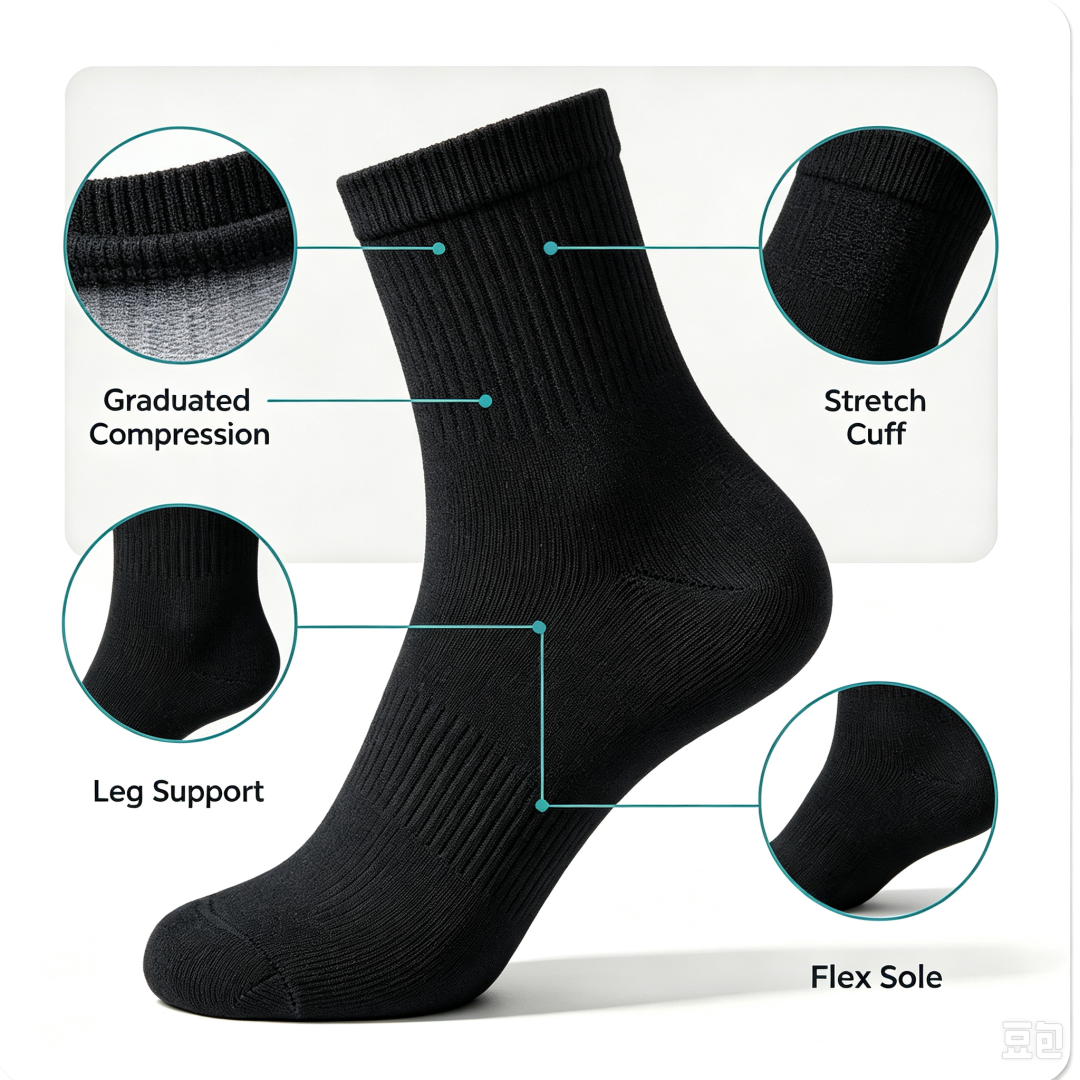
Buying compression socks wholesale is a margin game with a verification problem. The category’s pricing spans a wide range, quality differences are invisible in photos, and the functional claims pressure levels, sizing accuracy — are exactly the things trading intermediaries cannot prove. Buyers who source well follow a repeatable process; here it is.
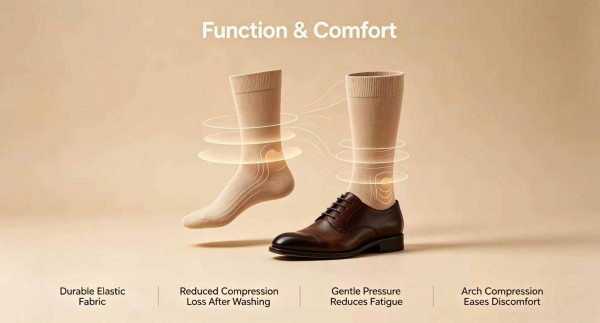
MOQ, lead times and bulk pricing for this category are set out on the compression sock manufacturing page.
Step 1: Decide What Kind of Wholesale Program You Want
Three models dominate. Private label on stock: the factory’s existing verified compression styles carry your logo and packaging — lowest MOQ (often 200–500 pairs), fastest launch, proven fit. Semi-custom: stock construction with your colorways, cuff designs or print placement on a moderate MOQ. Full custom knit: your pressure profile, patterns, sizing and branding — highest MOQ (1,000+ pairs) and deepest differentiation. Most successful brands launch private label, learn their market, then graduate key SKUs to custom.
Step 2: Find the Actual Factory
The compression category is full of trading companies presenting as manufacturers. Signals of a real factory: they discuss knitting programs, elastane percentages and mmHg testing without hesitation; they can show pressure test equipment in photos or video calls; they offer to arrange third-party inspection; and their price for identical specs is usually 10–20% below traders. Verification matters more here than in fashion hosiery because the product’s core value — true graduated pressure — exists only if the producer controls the knitting engineering.
Step 3: Evaluate Pricing in Tiers
Wholesale pricing moves in volume steps: expect meaningful breaks at 1,000, 3,000, and 10,000 pairs. A realistic FOB range for quality 15–20 mmHg private-label pairs runs roughly $1.80–4.50 depending on fiber (nylon-spandex standard, merino premium), knitting complexity, and packaging inclusion. Quotes far below that range almost always mean single-covered elastane, unverified pressure, or both — the most expensive cheap socks you will ever buy.
Step 4: Run a Professional Sample Protocol
Before any bulk commitment: order pre-production samples to your spec; wash-test five cycles and re-check pressure feel and dimensions; verify the stated fiber blend (a burn test or third-party fiber analysis costs little); and confirm the size chart against actual measurements. For medical-grade product, request lot-dated pressure test reports as a condition of order. This two-to-three-week diligence window routinely prevents five-figure mistakes.
Step 5: Negotiate the Terms That Actually Matter
Beyond unit price, the terms that protect wholesale buyers: payment structure (30% deposit / 70% after pre-shipment inspection is standard protection); pre-shipment third-party inspection rights written into the order; repeat-order pricing locked for 6–12 months; and agreed repeat-order lead times. Also negotiate packaging inclusion — header cards, hang tags, and barcode application at the factory save meaningful per-unit cost versus repackaging domestically.
Step 6: Plan Logistics and Compliance Documents
Compression socks ship as standard textile freight (25–45 days production, then sea or air). Require: commercial invoice with HS code, fiber content declarations, OEKO-TEX certificates covering the production lot, and pressure test reports where applicable. If you sell into markets with labeling laws (fiber content, country of origin), have the factory apply compliant labels in production — retro-labeling in your warehouse is the most avoidable cost in the whole process.
If that is settled, the next question is usually answered in Compression Socks Packaging Ideas That Build Trust and Lift Sales.
FAQ
Q: What MOQ do I need to start buying compression socks wholesale?
A: Private-label programs start around 200–500 pairs per design; custom knitting typically requires 1,000+ pairs per design.
Q: How do I verify a compression sock supplier is a real factory?
A: Ask for pressure-testing capabilities, video facility tours, third-party inspection acceptance, and technical fluency on elastane specs — traders consistently fail these tests.
Q: Is buying wholesale direct from China cheaper than through a distributor?
A: Significantly — typically 30–50% below distributor pricing — provided you invest in the sampling and inspection discipline described above.
CONCLUSION
Wholesale compression sock sourcing rewards process over price-hunting: choose your program model, verify you are dealing with the factory, sample with wash tests, and lock the protective terms. Follow that sequence and the category’s healthy wholesale margins — 50% and up for disciplined brands — are reliably yours.
Ready to price this out? Start with a sample from the Sockmader custom sock factory, or send your artwork and target quantity for a quote.
If you are planning your own line, our custom compression socks program covers sampling, MOQ and lead times in one place.