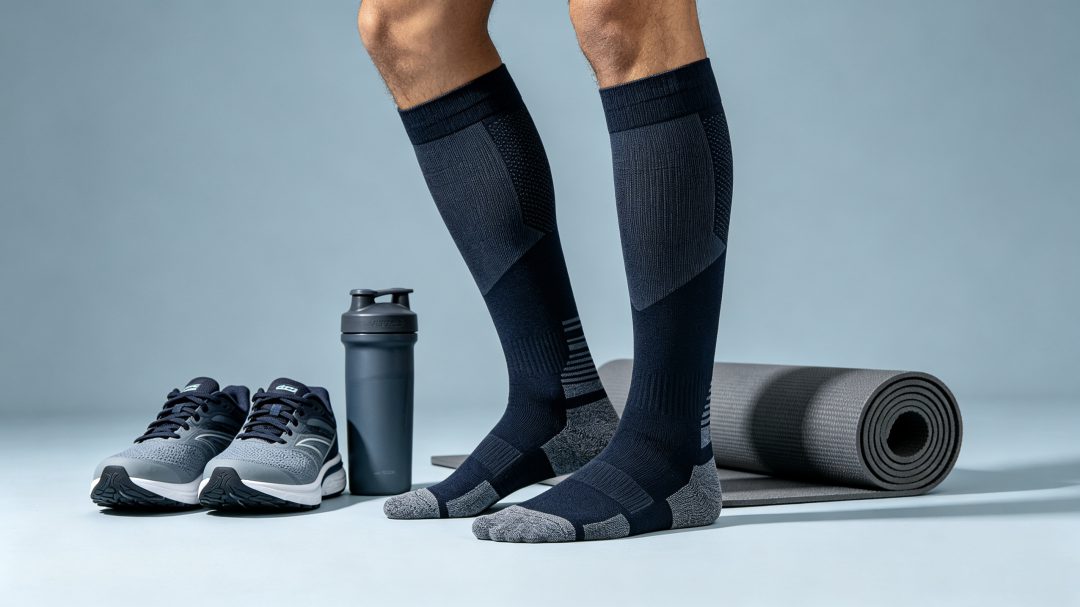
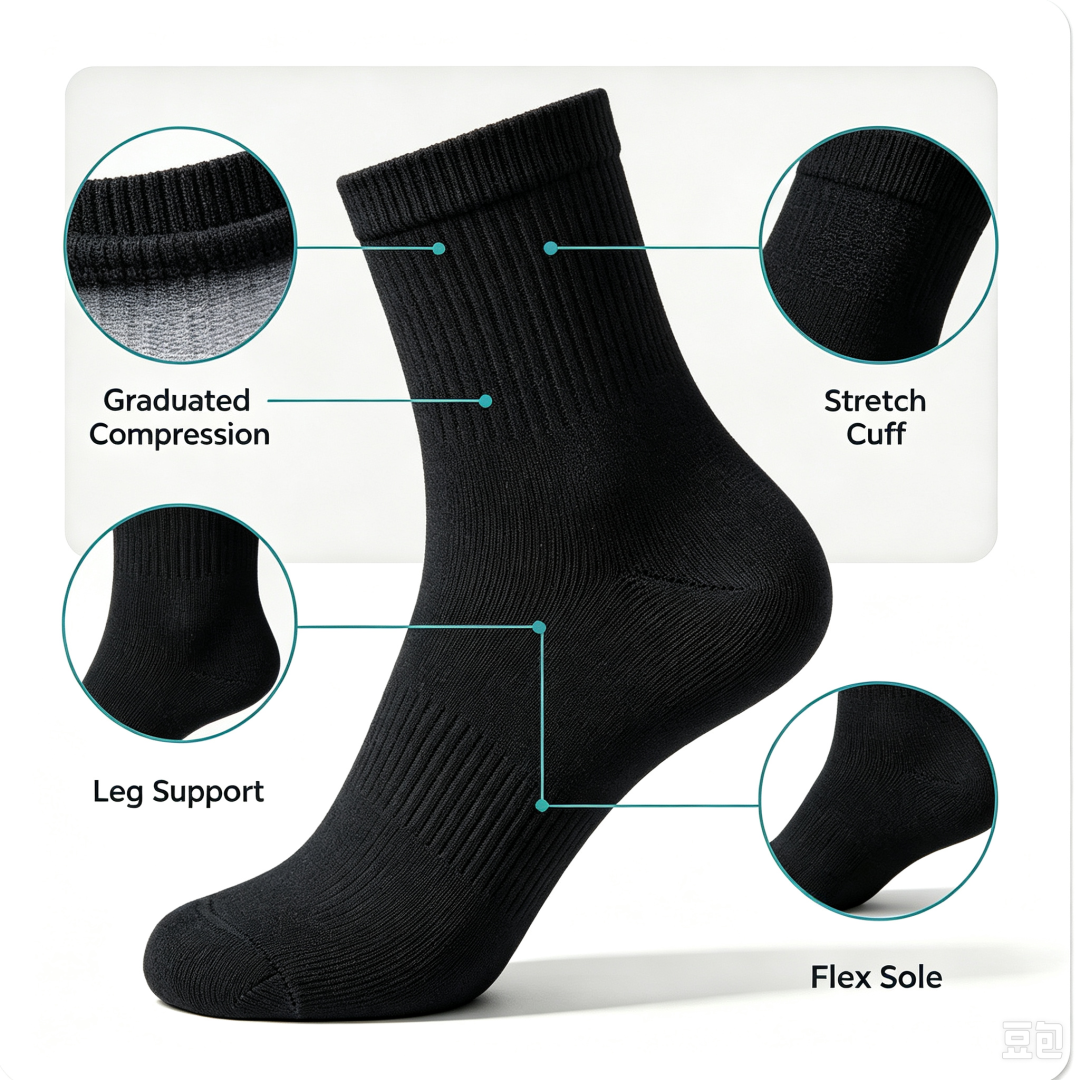
Buyers searching for custom compression socks bulk usually want three things settled before they write to anyone: the specification, the minimum and the calendar. The unit price is not one figure: it is a fixed setup cost spread across whatever quantity you order, which is why the per-pair number moves so sharply between a short run and a long one.
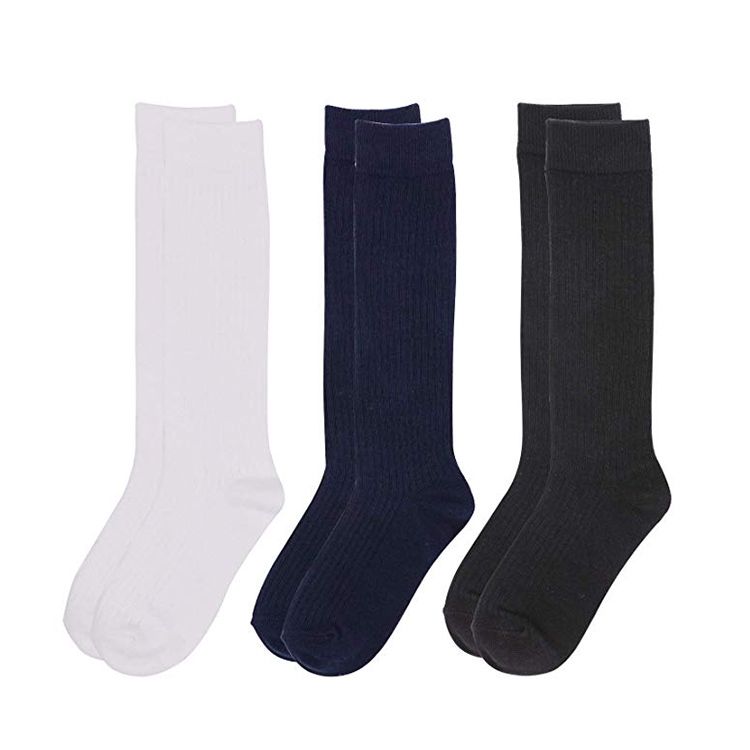
Buyers also arrive here searching: compression socks wholesale; compression socks manufacturer; custom compression socks manufacturer. They are the same question asked from different angles.
4 mistakes buyers make with compression socks
1. Judging pressure by appearance
Why it happens: Knitted tight is not the same as a measured gradient.
What to do instead: Require a pressure curve measured at ankle, calf and below knee.
2. Ignoring wash decay
Why it happens: Pressure can drop 15-25% after 20 washes.
What to do instead: Write ‘retains 80% of pressure after 20 washes’ into the contract.
3. Too few size bands
Why it happens: S/M/L cannot cover calf circumference variance.
What to do instead: At least four bands with a calf and ankle measurement chart.
4. Claiming therapeutic effects
Why it happens: A regulated medical claim in most markets.
What to do instead: Describe construction and measured values only.
None of these are exotic. They are the ordinary failure modes of a programme that moved too fast from idea to purchase order without a written spec in between. The commercial terms that prevent most of them: custom socks wholesale.
QC: the checks to ask for before the shipment leaves
AQL 2.5 is the common default for apparel, and many European and US buyers additionally require zero tolerance for critical defects. AQL 4.0 suits promotional goods, and AQL 1.0 is used for high-value or medical channels. Then the product-specific checks:
| Check | Method |
|---|---|
| Measured pressure | Test at ankle, calf and below knee on a pressure tester. |
| Pressure after washing | Re-test after 20 cycles of AATCC 135. |
| Broken elastane | Stretch and inspect against light for exposed yarn. |
| Left and right pairing | Graduated socks with L/R construction must ship as pairs. |
Ask for the inspection report before the balance payment, not after. Once the container is on the water, every remedy gets slower and more expensive. Process and test references: white label sock program.
Nearly every sourcing dispute traces back to a spec that was never written down. Put these on your enquiry sheet and most of the risk disappears.
| Spec | What to write | Why it matters |
|---|---|---|
| Compression level | 15-20 mmHg daily / 20-30 mmHg sport and travel / 30-40 mmHg regulated channels only. | The number must appear on the label and be backed by a test report. |
| Gradient direction | Highest at the ankle, decreasing upwards. | A sock without a gradient cannot be called compression. |
| Elastane brand and share | Branded or generic elastane at 18-25%. | Decides how much pressure survives 20 washes. |
Two more that buyers forget: the needle count and the toe closure. 84N-96N coarse gauges serve terry and heavy socks, 108N-120N is the workhorse for everyday styles, 144N-168N carries fine jacquard and athletic structure, and 200N tops the range for dress socks and very fine jacquard. There are three toe closures: standard overlock, the cheapest and the one that leaves a seam ridge; Rosso linking, which is substantially flat; and hand-linked seamless, the most comfortable and the most expensive per pair. Related reading: Sockmader.
Timeline, stage by stage
| Stage | Duration | What happens |
|---|---|---|
| Enquiry and quotation | 1 to 3 days | spec sheet confirmed, yarn availability checked |
| Sampling | 3 to 7 days | programming, trial knitting, finishing, sample shipped |
| Sample revision | 2 to 4 days per round | each change restarts part of the loop |
| Bulk production | 5 to 25 days | knitting, closing, washing, boarding, inspection |
| Packing and export | 3 to 7 days | pairing, packing, cartons, documentation |
| Shipping | 3 to 45 days | A full sea container takes roughly 30-40 days to the US West Coast and 35-45 days to major European ports. Air freight takes 5-8 days but usually costs four to six times the sea rate per unit, and courier shipments for small trial orders arrive in 3-5 days. |
The biggest avoidable delay is a vague sample brief. Every clarification round costs three to five days. Process detail is documented under white label sock program.
Where this decision actually sits in the buying process
Most programmes move through the same four gates, and each one has its own failure mode.
| Gate | The decision | What usually goes wrong |
|---|---|---|
| Concept | Is compression socks right for the range at all | Buyers commit before checking whether the channel wants it |
| Specification | Writing down what is actually being made | Vague briefs turn into repeated sample rounds |
| Supplier | Choosing who makes it | Comparison without a written spec is meaningless |
| Commitment | Quantities, dates, payment | Freight and lead time discover the date has already passed |
Work out which gate you are actually at before asking for anything else. Most wasted conversations happen because a buyer asks a commitment-stage question while still at the specification gate. Commercial terms start from custom socks wholesale.
The numbers to put in your enquiry
Copy this block into your first email. It is the difference between a real quote and a placeholder.
| Line | Your value | Why the factory needs it |
|---|---|---|
| Yarn composition | e.g. Nylon 75-80% / elastane 20-25% | Sets the largest single cost line |
| Gauge | 168N-200N fine gauge | Determines knitting time and machine availability |
| Sizes needed | foot length in cm plus quantities | Sizing drives grading and waste |
| Artwork route | jacquard, print or embroidery | Each route carries a different setup minimum |
| Quantity per color | including the size split | Sets the unit price you are quoted |
| Target in-stock date | a real calendar date | Lets the factory quote honestly or decline |
Two lines are most often left blank, and they are the ones that cause the most trouble: the per-colour quantity and the real in-stock date. Without the first, the MOQ is quoted as one figure and your order may not qualify; without the second, nobody can tell you the truth about capacity. Reference route: custom compression socks.
FAQ
Does the pressure disappear after washing?
A good elastane system holds 80% or more of its pressure after 20 washes. Put that in the contract rather than accepting a verbal promise.
Can we make a normal sock that just looks the same?
Yes, but then it cannot be sold as compression socks, and no pressure grade may appear on the packaging or the page.
What is the minimum order?
Standard MOQ is 300 pairs per color. Because compression needs machine set-up and testing, a first order above the per-colour minimum spreads that cost sensibly.
What is the fastest way to get an accurate quote?
Send a specification sheet — yarn composition, needle count, size set, construction, artwork route, quantity and packing. A quote built from that is usually within a few percent of final; a quote built from a photo is not.
Related reading across the range: sock resources.
Where to go from here
The short version: fix the specification, then the quantity, then the date. Everything else is negotiable; those three are not. If you want the full route, start at custom compression socks and keep Sockmader open while you write your spec sheet.