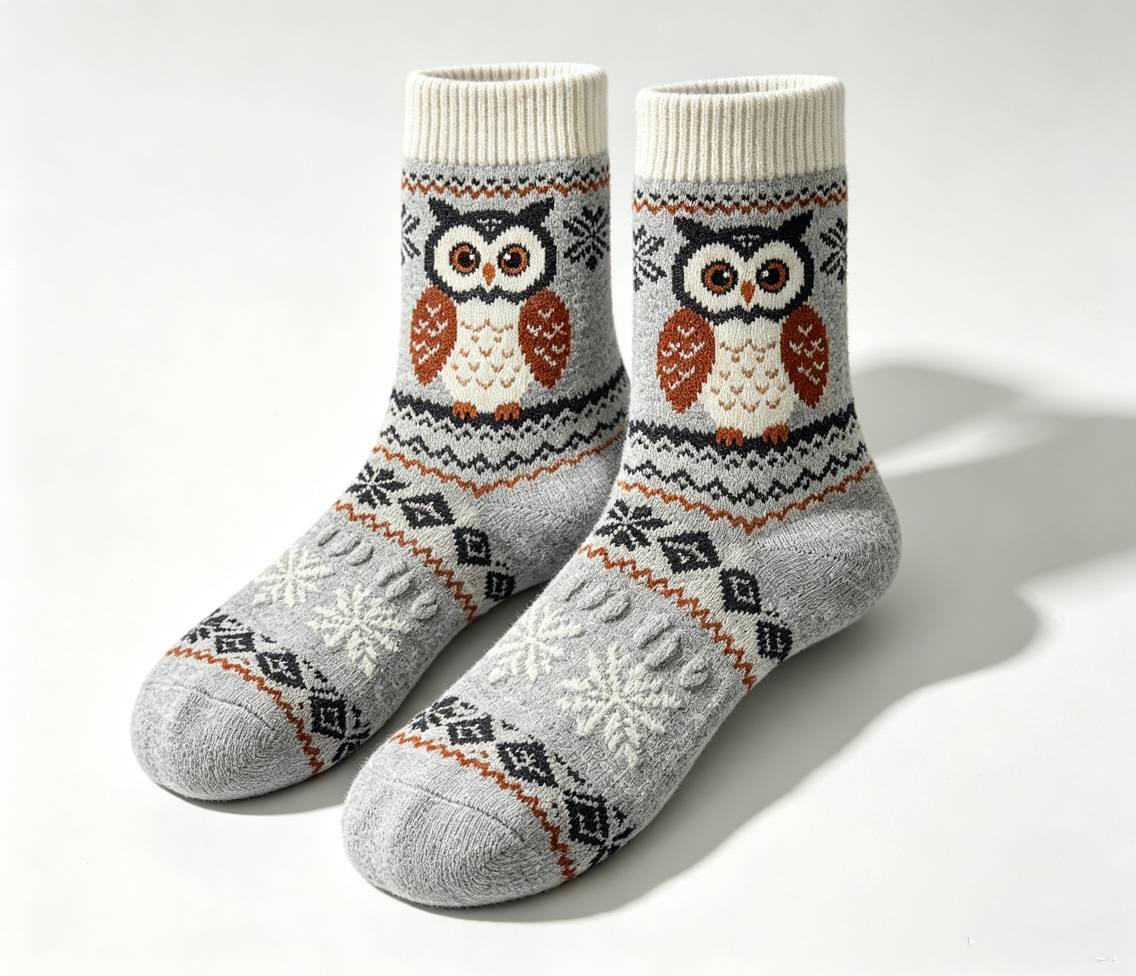
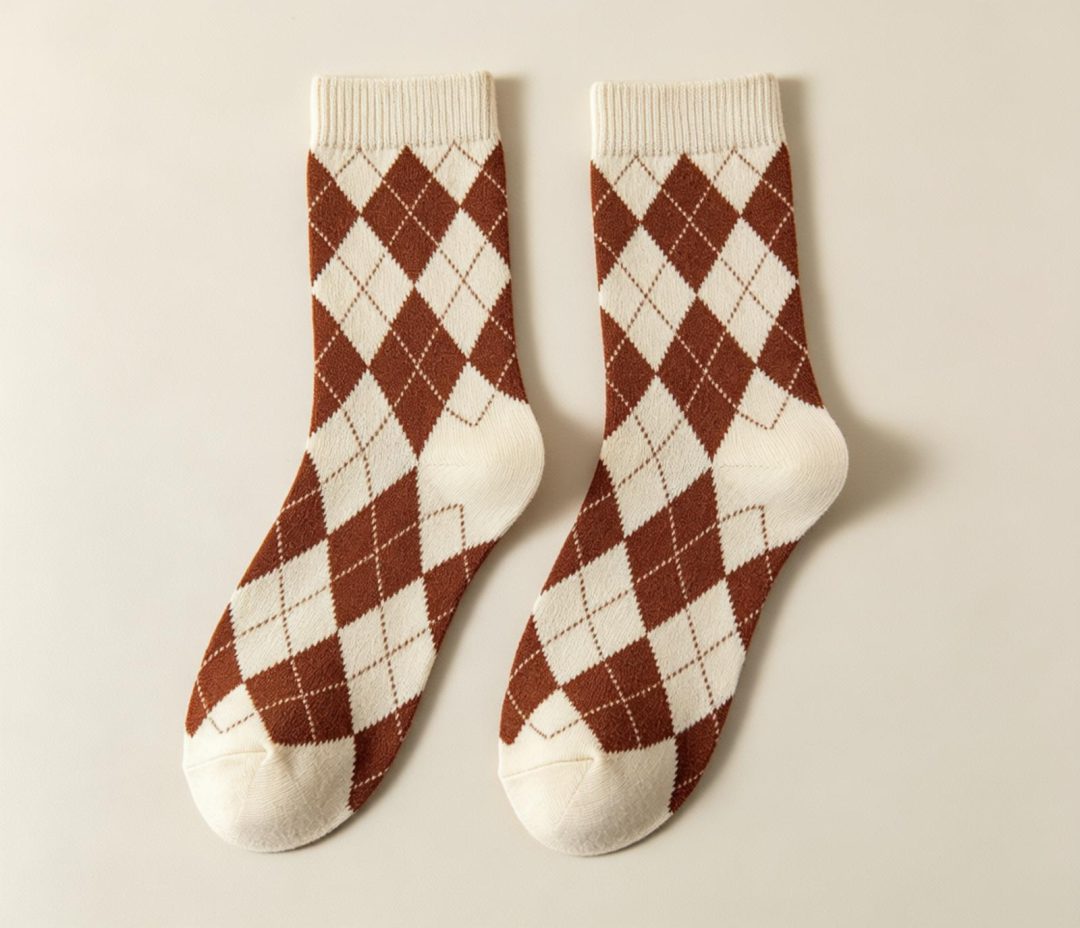
custom jacquard socks is better understood as a specification range than as a product. What you receive depends almost entirely on what you write down first. This guide goes through the numbers worth confirming before you contact anyone, starting with custom jacquard socks.
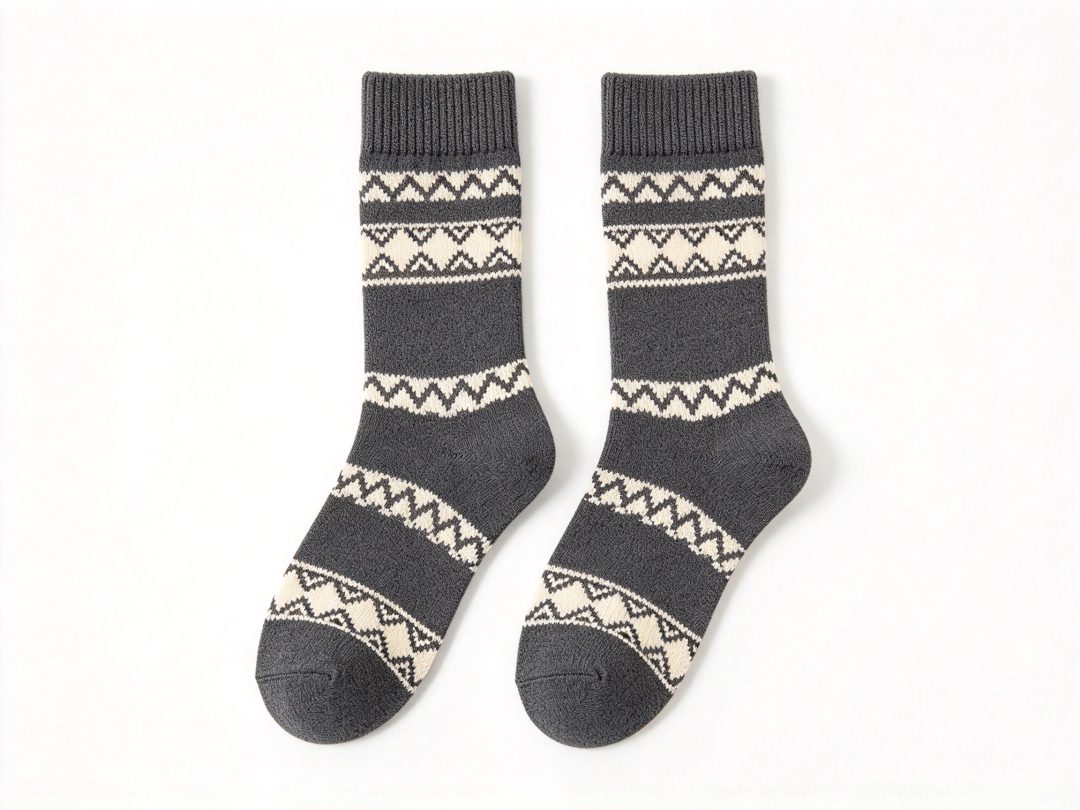
If you landed here by searching custom jacquard socks, you are probably one of two people: someone building a buying brief, or someone checking whether a quote already received makes sense. Either way the reference points are the same – MOQ from 50 pairs, 3-7 days to sample, 5-25 days to produce – because buyers who want the specification and the commercial terms settled before asking anyone for a quote all run into the same four cost lines.
Note those down with number of colours, float length and minimum stroke width before you send anything out.
What this covers:
- How jacquard socks are made, step by step
- The critical path, and where it slips
- Who buys jacquard socks, and what each one actually needs
Search variants worth knowing about: custom knit socks; custom knit socks manufacturer; bulk jacquard socks – they cover the same ground from a different starting point.
How jacquard socks are made, step by step
Understanding the production sequence tells you where delays and defects come from.
1. Yarn preparation. Cones are inspected and, if the programme needs it, dyed to a confirmed shade. Custom dyeing adds 7–14 days and carries a mill minimum.
2. Knitting. Socks are knitted as tubes on circular sock machines. 84N-96N coarse gauges serve terry and heavy socks, 108N-120N is the workhorse for everyday styles, 144N-168N carries fine jacquard and athletic structure, and 200N tops the range for dress socks and very fine jacquard.
3. Toe closing. There are three toe closures: standard overlock, the cheapest and the one that leaves a seam ridge; Rosso linking, which is substantially flat; and hand-linked seamless, the most comfortable and the most expensive per pair.
4. Washing and boarding. Washing removes knitting oils and sets dimensions; boarding (heat-setting on forms) gives the final shape and smoothness.
5. Inspection and pairing. Each pair is checked for defects, matched by size and shade, and paired.
6. Packing. Hang tags, polybags, inner boxes and cartons per the packing specification.
If you need to compress the schedule, the only two levers are skipping custom dyeing (use stock yarns) and reducing the number of sample revision rounds. Full process notes: sock packaging options.
Nearly every sourcing dispute traces back to a spec that was never written down. Put these on your enquiry sheet and most of the risk disappears.
| Spec | What to write | Why it matters |
|---|---|---|
| Minimum stroke width | At least 2 loops for any single logo line. | Below that the artwork turns to mush. |
| Number of colours | Keep to 4-6 per design; most machines run 6, some reach 8. | Each extra colour slows knitting and lengthens the floats. |
| Float length | No more than 5-7 needles on the reverse. | Long floats snag and catch toes. |
Finally, agree the tolerance: size ±0.5 cm, weight ±5%, colour ΔE within an agreed range. Without tolerance, “close enough” becomes an argument. Related reading: Sockmader.
The critical path, and where it slips
There are only three places a schedule genuinely slips, and none of them is knitting capacity.
Yarn availability. If your colour needs dyeing rather than coming from stock, add one to two weeks before anything else can start. Choosing stock yarn is the fastest schedule decision you can make.
Sample rounds. Every clarification costs three to five days. Three rounds will push most programmes past their selling window, which is why the first brief matters so much.
Finishing and packing. Closing, boarding and packing are labour-intensive and are where work queues. A full sea container takes roughly 30-40 days to the US West Coast and 35-45 days to major European ports. Air freight takes 5-8 days but usually costs four to six times the sea rate per unit, and courier shipments for small trial orders arrive in 3-5 days.
Build in a buffer: one week for sample revisions and one week for shipping volatility. Process detail is documented under sock packaging options.
Who buys jacquard socks, and what each one actually needs
| Buyer type | What they push on |
|---|---|
| Designer and concept stores | Distinctive patterns, tolerant of a higher unit price. |
| Brand merchandise and collaborations | Logo fidelity and controlled colour difference. |
| Corporate gift buyers | Many small designs with matched packaging. |
If you serve more than one profile, split the SKUs rather than compromising on a single spec — a mid-point spec usually satisfies nobody. Compare adjacent categories here: yarn color options.
FAQ
How long does sampling take?
Normally 3-7 days including pattern programming and trial knitting; each revision round adds 2-4 days.
What is the minimum order?
50 pairs per design; colour count and gauge shift the MOQ slightly.
Can small logo details be knitted?
The smallest unit in jacquard is a loop, so fine lines need simplifying. Very small text is better embroidered or printed on a label.
What is the fastest way to get an accurate quote?
Send a specification sheet — yarn composition, needle count, size set, construction, artwork route, quantity and packing. A quote built from that is usually within a few percent of final; a quote built from a photo is not.
To place it in context, compare it against wholesale socks.
Where to go from here
Ready to move? Put the spec sheet together first — yarn, needle count, sizes, construction, artwork, quantity, packing. Then custom jacquard socks and Sockmader will get you a number you can plan against.