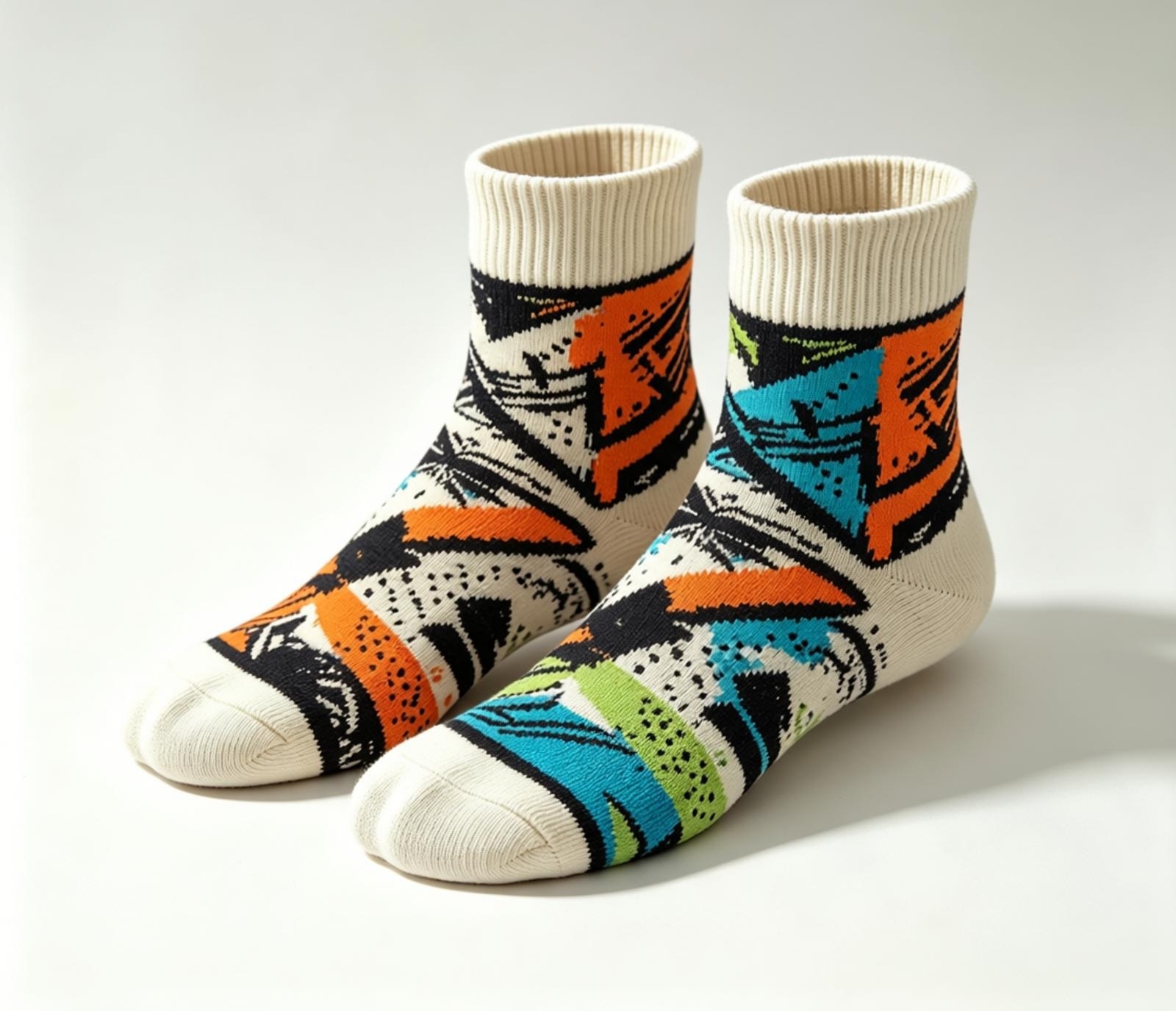
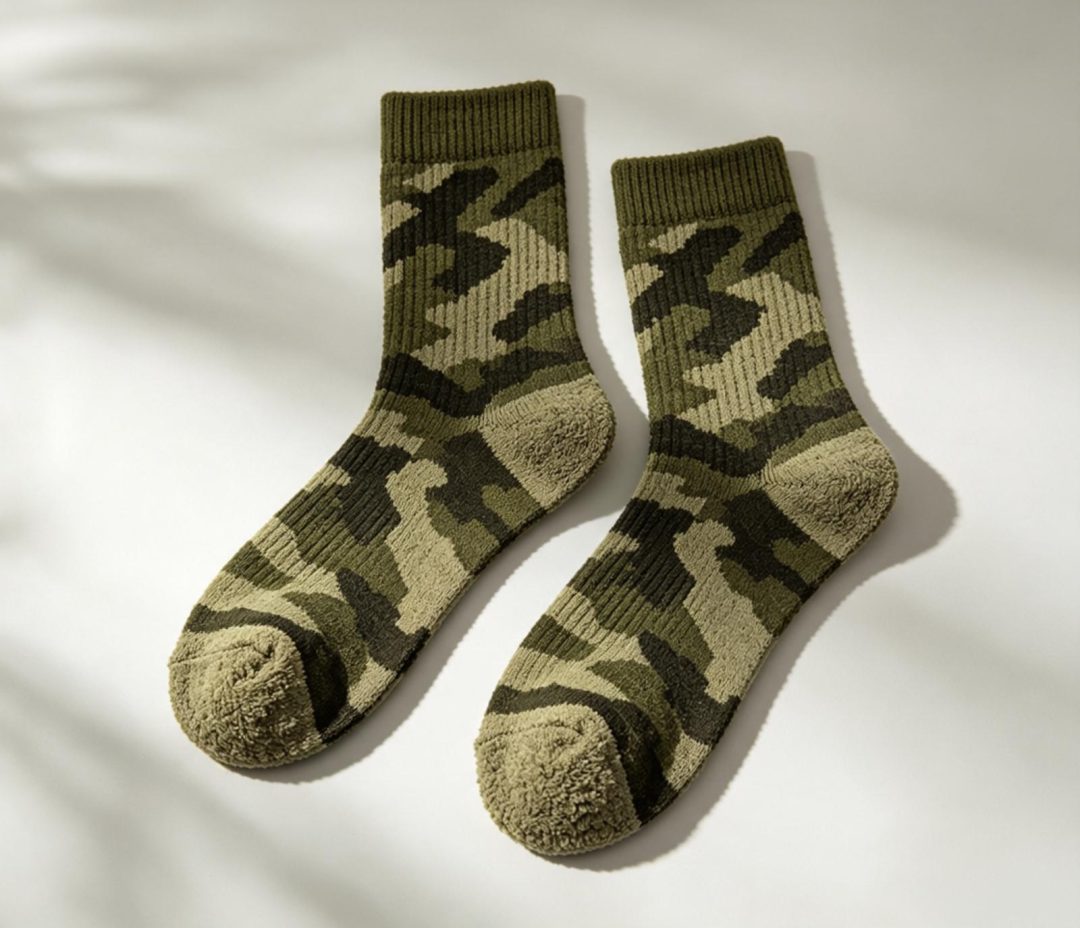
A jacquard sock is not a printed sock. The pattern is not applied to the fabric after it exists — it is built into the fabric while the fabric is being made. That single difference explains why jacquard costs more to sample, why it never cracks or fades, and why the artwork rules are stricter than anything a brand designer usually works with.
This article walks through the actual production sequence we run in Zhengzhou, and flags the two points where most first-time buyers lose money without realising it.
You will see every step below in custom knitted pattern socks, where sampling runs before bulk production and MOQ starts at 100 pairs per design.
H2 What “Jacquard” Means on a Sock Machine
On a flat weaving loom, jacquard refers to a mechanism that lifts individual warp threads. On a circular sock machine the idea is the same but the hardware is different: each needle in the cylinder can be selected independently, one stitch at a time, by an electronic selection system driven by the pattern file.
A standard single-cylinder sock machine might carry 168 or 200 needles. That number is your horizontal pattern resolution. If your design has a motif that needs to be 40 stitches wide, it will repeat four or five times around the leg, whether you intended it to or not. Understanding this before you open Illustrator saves an entire sampling round.
H2 Step 1 — Yarn Preparation and Color Setup
Each color in the design needs its own feeder. A four-color pattern means four feeders threaded and tensioned independently, and each one must be matched for yarn count so the fabric lies flat. Mixing a 32s combed cotton with a finer merino without adjusting tension produces a leg that spirals or puckers.
We wind and condition the cones, check the count, and run a short tension test before the pattern file is even loaded. Most of the visible defects in cheap jacquard socks — slack loops, color bleeding at the edges of a motif — trace back to this stage, not to the knitting itself.
H2 Step 2 — Programming the Needle Selection
The artwork is converted into a stitch map: one grid cell per needle per course. Modern machines read this directly from the design software, but the conversion is not automatic in the creative sense. Colors are indexed, floats are calculated, and the machine decides which needles knit, tuck or miss on every revolution.
This is where a designer’s instinct works against them. A gradient in the artwork does not exist in jacquard. Every pixel must become one solid stitch of one solid color. We routinely flatten a supplied design from twelve shades down to three before sampling, and the result almost always looks better than the original.
H2 Step 3 — Knitting the Leg and the Pattern
The machine knits the rib top first, then transfers into the leg, where the jacquard selection engages. Knitting continues through the heel — usually a Y-heel or a reinforced pouch — and into the foot.
Pattern placement matters commercially. Motifs on the leg and the instep are standard. Motifs under the sole create floats across the inside of the sock, which catch toes and feel rough. If a brand insists on sole patterning, we plate a smooth ground yarn behind the pattern so the floats never touch skin.
H2 Step 4 — Float Control, the Real Constraint
When a needle misses several stitches in a row, the yarn that would have been knitted lies loose across the back of the fabric. That loose segment is a float. Long floats snag on toenails, jewellery and boot linings, and returns for snagged socks are expensive and entirely avoidable.
The industry rule of thumb is to keep floats short — generally under five to seven needles — or to tie them down with tuck stitches. A design with large solid color blocks is the worst case: the larger the block, the longer the float. This is the single most common reason a submitted design comes back for revision, and it is far cheaper to fix on screen than on the machine.
H2 Step 5 — Toe Closing, Boarding and Inspection
After knitting, the toe is closed. A linked toe (Rosso linking) matches stitch for stitch and gives a flat, comfortable seam; a standard overlock seam is cheaper and slightly bulkier. For patterned socks, linking also keeps the pattern aligned across the toe, which matters if the motif runs onto the foot.
The socks are then washed, boarded on heated forms to set the shape, paired, and inspected. Pattern alignment is checked at this stage, because a motif that is off by even two courses is visible when the pair is placed side by side on a retail hook.
What Are Jacquard Socks? picks up where this article leaves off.
FAQ
Q: How long does a jacquard sample take? A: Roughly 10–14 days including artwork conversion, machine setup, knitting and one revision round. A second colorway of an approved design is much faster, usually 5–7 days.
Q: Can jacquard reproduce a photograph? A: No. Photographic detail requires sublimation printing. Jacquard gives you crisp geometric, lettering and motif work in a limited color count, and that is where it outperforms print.
Q: Why does my four-color design cost more than a two-color one? A: More feeders, more setup time, more floats to manage and a slower machine cycle. Color count is the single biggest cost driver in jacquard, ahead of yarn quality.
CONCLUSION
Jacquard is a knitting problem, not a printing problem, and the brands that get the best results are the ones who design for the machine from the first sketch. Keep the color count low, keep the blocks small, keep the pattern off the sole, and you get a sock whose design outlasts the garment.
Ready to price this out? Start with a sample from Sockmader’s custom jacquard socks team, or send your artwork and target quantity for a quote.