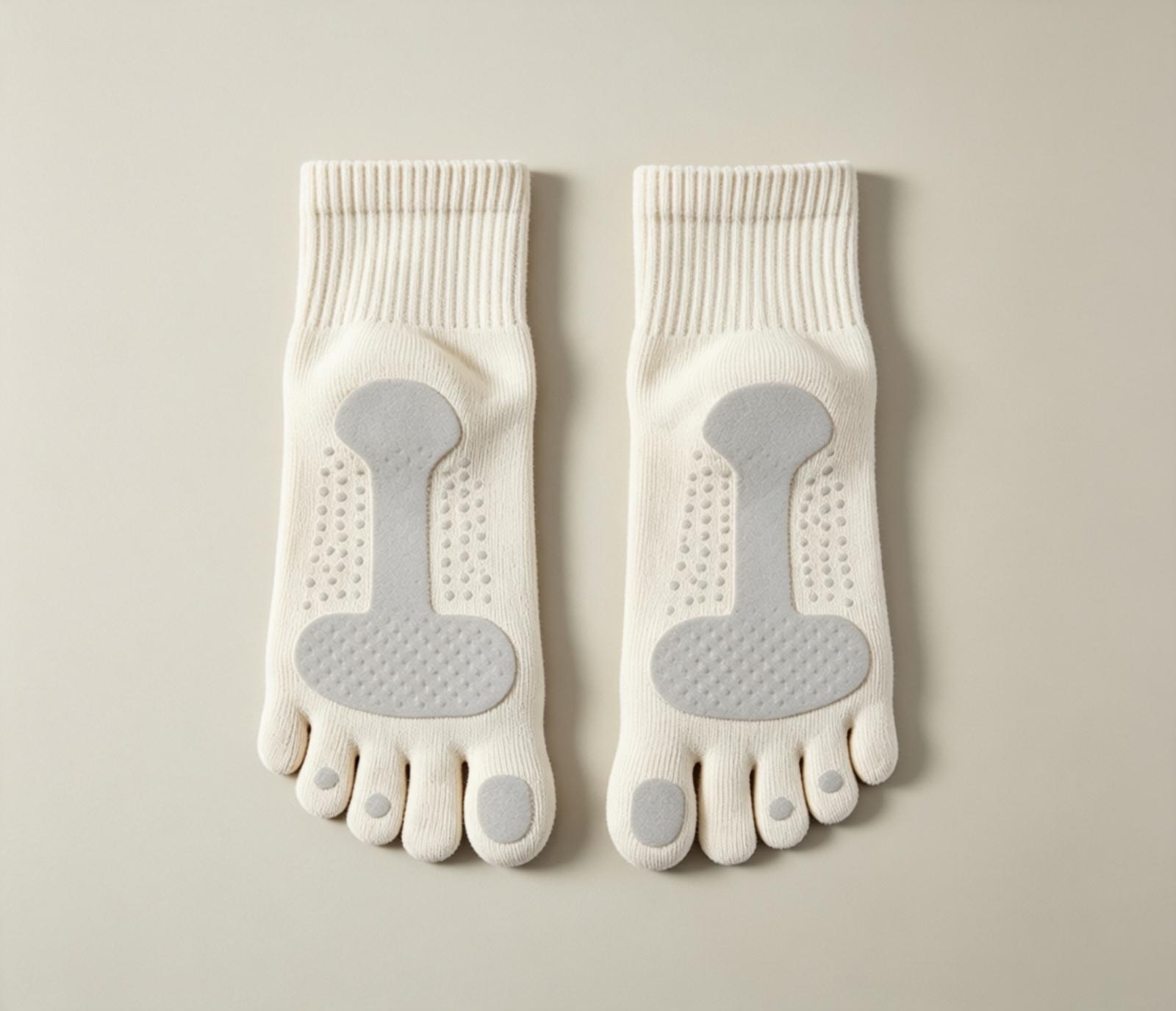
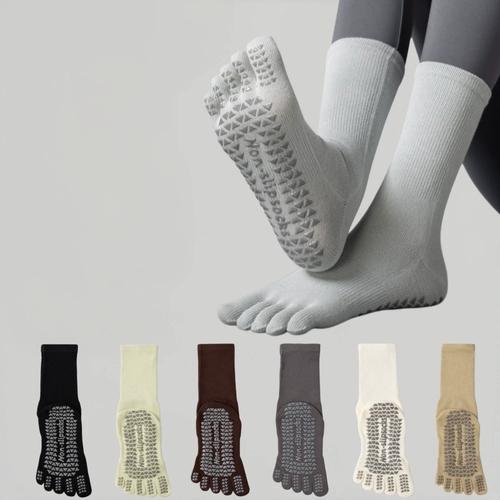
A grip sock starts life as an ordinary sock. It is knitted on the same circular machines, from the same yarns, with the same rib top and the same linked toe. The entire difference is one additional process at the end of the line: a pattern of silicone dots printed or injected onto the sole and cured with heat. That single step turns a garment that slides on a smooth floor into one that holds. Understanding where that matters — and where it does not — is the whole of the buying decision.
Both options are available through wholesale anti-slip socks, and we can sample each one for side-by-side testing.
What the Grip Actually Does Silicone dots work by increasing the coefficient of friction between the foot and the floor. On wood, laminate, tile and yoga mats, the difference is dramatic: a grip sock holds where a regular sock slides. On carpet, it makes almost no difference, because the carpet already provides the friction. So the first question is not “are grip socks better?” but “what is under the foot?” For studio, hospital and home use on hard floors, grip wins decisively. For everyday wear inside shoes, the dots do nothing at all.
Construction Differences Beyond the Dots Grip socks are usually knitted on a finer gauge with a thinner base than a casual sock, because the grip and not the cushion carries the function. Many are designed to be worn without shoes, so the toe seam is linked flat and the yarn next to the skin is soft rather than hard-wearing. Regular socks optimize for durability inside a shoe, where abrasion resistance matters more than ground feel. The two products are built for different environments and it shows in the hand.
Where Each One Belongs Grip socks earn their cost in yoga and Pilates studios, barre classes, trampoline parks, hospital and care settings, maternity wards, and homes with hard floors and stairs. Regular socks remain the right choice for anything worn inside a shoe — office wear, sports, hiking, boots. Selling a grip sock as an everyday sock is a mistake brands make frequently; the dots add cost and deliver nothing to a customer who wears shoes all day.
Cost and Durability The silicone step adds roughly 20 to 40 per cent to unit cost depending on dot coverage and grade. In exchange, the product commands a substantial retail premium, because the benefit is immediately obvious to the customer standing on a studio floor. Durability is the caveat: the dots are the first thing to fail. Good-grade silicone survives fifty to eighty domestic washes; cheap formulations peel or smear in twenty. If you are building a brand on grip socks, the silicone grade is not the place to economise.
Care and Handling Grip socks need cooler washes and lower tumble temperatures than standard socks. High heat degrades the silicone bond. Fabric softener leaves a residue on the dots that reduces grip, so care labels should say so explicitly. These are small things, but they are the difference between a customer who reorders and one who concludes the product does not work.
We handle the adjacent decision in How to Design Grip Socks.
FAQ
Q: Can grip socks be worn inside shoes?
A: They can, but the dots add bulk and cost for no benefit. Use a regular sock.
Q: Do the dots wear off?
A: Eventually, yes. Wash durability is the main quality differentiator between suppliers.
Q: Are grip socks safe for elderly users?
A: They are widely used in care settings for exactly that reason, provided the dot coverage runs heel to toe.
Q: Do they work on carpet? A: Barely. Carpet already supplies the friction the dots would add.
CONCLUSION
Grip socks and regular socks are the same garment until the last step of manufacturing, and that step only pays off on smooth floors. Choose grip for studio, clinical and hard-floor home use; choose regular for anything worn in a shoe. For brands, the opportunity is not to replace the regular sock but to add a specialised product with a benefit the customer can feel in the first ten seconds.
To move from plan to order, send artwork, size range and quantity through Sockmader’s custom sock manufacturing team.
When you are ready to source, the Sockmader custom anti-slip socks team can quote sampling, MOQ and lead times for your quantity.