In a hospital corridor at three in the morning, a fall is not an inconvenience — it is a serious clinical event with real cost and real consequences. Almost every fall happens during a transfer: out of bed, into a chair, across a few metres of polished vinyl flooring. Patients are barefoot or in loose institutional socks, often sedated, frequently unsteady. Non-slip socks address that specific moment. Their benefit is not comfort or warmth, though they provide both. It is that the wearer’s foot grips a surface engineered to be easy to clean and hard to stand on.
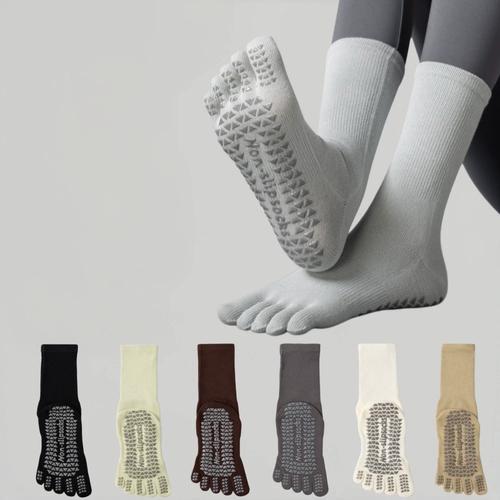
You get these same benefits through custom grip socks, with yarn and construction tuned to your target price point.
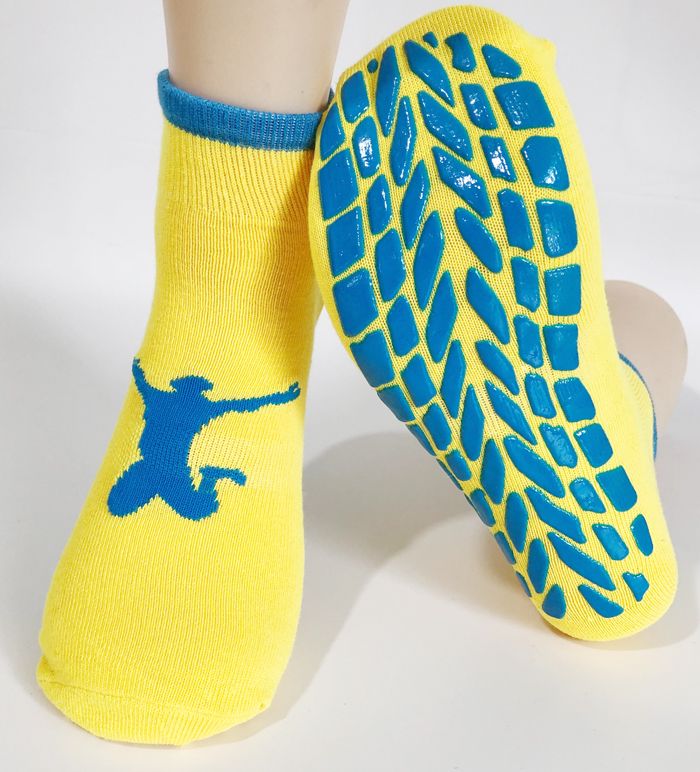
Fall Reduction on Hard Flooring Hospital and care-home flooring is chosen for cleanability, and that means smooth, non-porous surfaces with a low coefficient of friction. The same property that makes a floor easy to mop makes it treacherous for an unsteady gait. A full-sole silicone tread restores grip across the entire plantar surface, so the foot holds even when weight shifts unpredictably mid-step. Published fall-prevention programmes that include footwear interventions consistently report fewer slips, and socks are the cheapest part of that intervention.
Confidence and Independence There is a second benefit that clinicians value and that does not appear on a purchase order. A patient who trusts their footing moves more. They get out of bed without waiting for assistance, walk to the bathroom unaided, and participate in physiotherapy with more commitment. Reduced fear of falling is itself a clinical outcome, because immobility brings its own complications. Carers report the difference in behavior even where fall statistics are hard to isolate.
Why Full-Sole Coverage, Not Patches Consumer grip socks often use a heel-and-ball patch, which is adequate on a yoga mat where the wearer is in control. Clinical socks should specify full-sole tread running from heel to toe, because a fall happens during an unpredictable weight transfer and the foot may land on any part of the sole. Tread should also wrap slightly up the sides at the heel and around the toe box. The additional silicone cost is modest relative to the consequence of a fall.
Material and Safety Specifications Clinical non-slip socks need to satisfy several requirements at once. The base knit should be soft and breathable, with a non-constricting cuff that does not impede circulation — many patients wear them for days. Yarns should be latex-free and tested for skin contact, usually to OEKO-TEX Standard 100. The silicone must be medical-contact safe and securely bonded, because a detached dot is both a choking hazard and a slip hazard. Color coding by size or fall-risk level is common and easy to knit in.
Laundering in Institutional Conditions Domestic wash durability means little in a hospital, where linen is washed at high temperature with industrial detergent. Specify a silicone grade and cure validated for commercial laundering, and ask for test data at 75°C rather than 40°C. This is the single most common failure point: a sock that survives home washing can delaminate in ten industrial cycles.
We go deeper on How to Start a Grip Socks Business in a separate guide.
FAQ
Q: Are non-slip socks a substitute for proper footwear? A: No. They are for bed-to-chair transfers and short indoor movement, not for walking long distances.
Q: How often should they be replaced? A: On visible tread wear. In institutional laundering, budget for replacement every few months.
Q: Do they help with circulation? A: Only in the sense that a non-constricting cuff avoids restricting it. They are not compression garments.
Q: Can they be color-coded by fall risk? A: Yes, and it is common practice — the color is knitted in, so it never fades off.
CONCLUSION
The case for non-slip socks in clinical settings rests on three things: grip on flooring designed for cleaning rather than for walking, the confidence that lets patients move unaided, and a specification — full-sole tread, medical-grade silicone, non-constricting cuff — that holds up under industrial laundering. It is a low-cost item with an outsized effect on one of the most expensive problems in care.
Ready to price this out? Start with a sample from Sockmader, or send your artwork and target quantity for a quote.
If you are planning your own line, our custom anti-slip socks program covers sampling, MOQ and lead times in one place.