Children destroy socks with a consistency that adults cannot match. They wear them on harder surfaces, they drag their feet, they grow half a size a season, and they do not report discomfort until a hole appears. A kids sock is therefore a crew sock engineered around abrasion and fit tolerance rather than around refinement. That changes the yarn, the reinforcement, the cuff and the sizing logic — and it makes this one of the more interesting categories to manufacture well.
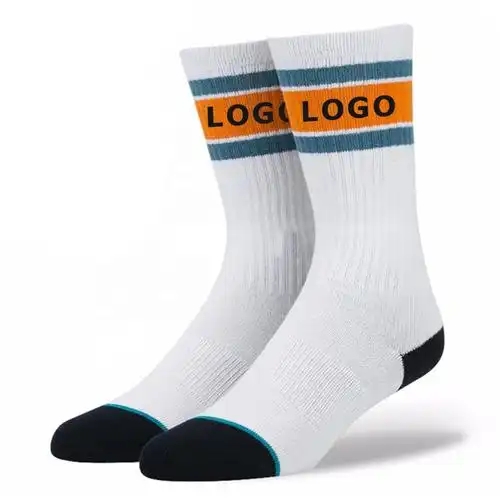
You will see every step below in custom crew socks, where sampling runs before bulk production and MOQ starts at 300 pairs per design.
Yarn: Durability Over Hand Feel Kids socks are usually cotton-rich but with a higher synthetic share than an adult equivalent — commonly 70 to 80 per cent cotton with 20 to 30 per cent nylon or polyester. The synthetic content is doing real work: it is what keeps the heel from wearing through in a fortnight. Some school-wear ranges go further and add a reinforced nylon plating yarn specifically at the heel and toe. Softness matters, but a sock that holes in three weeks is worse than one that feels slightly less plush.
Reinforcement at Heel and Toe The two failure points are universal, and in children’s socks they are reinforced as a matter of course. Toe reinforcement is usually a plated high-tenacity nylon knitted into the toe box during the same cycle; heel reinforcement may be the same plating or a denser stitch. Some manufacturers add a second, heavier yarn feed that engages only for those few centimetres of the sock, which concentrates durability exactly where it is needed without making the whole sock thick.
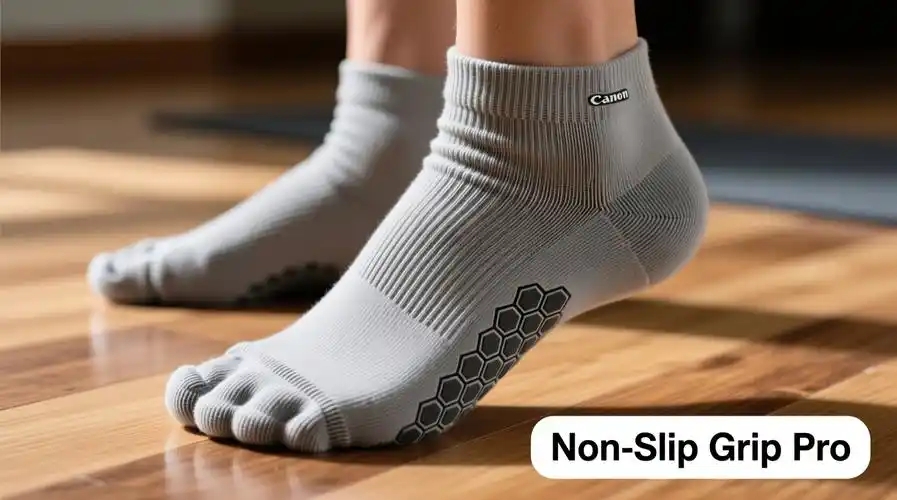
Grip Soles for Younger Children Silicone grip dots are common from toddler sizes through to around age six, both as a safety feature on hard floors and because young children are unsteady. The application is the same print-and-cure process used for adult grip socks, with tighter dot spacing for small soles. Grip socks for this age group must pass the same contact-safety and adhesion testing as baby socks, since a detached dot is a choking hazard.
Cuffs Designed for Independence A child dressing themselves needs a cuff that stretches enough to get a foot through and recovers enough to stay up. This is a wider tolerance than an adult sock, which is why kids cuffs are often slightly looser with a softer rib. Some ranges add a coloured stripe inside the cuff or a name label, which for schools and clubs is a functional requirement rather than a decoration — lost property is a genuine problem at scale.
Sizing by Age, Grading by Shoe Size Retail packs are labelled by age — 1–2 years, 3–5, 6–8 — but production is graded by shoe size and foot length, because age is a poor proxy. A typical run spans roughly 19 to 33 EU with 2 cm foot-length steps. The grading between steps is proportionally larger than in adult socks, since children’s feet grow fast and a sock has to accommodate several months of growth. Getting this right reduces returns from parents who order by age and receive a sock that does not fit.
Safety and Compliance Children’s textiles carry specific requirements: restricted substances in dyes and finishes, secure attachment of any applied component, flammability rules in some markets, and in the US, CPSIA compliance including tracking labels. Reputable factories test to these standards and hold the documentation on file. For school uniform programmes, ask for the test reports before placing an order rather than after.
We go deeper on How Are Toe Socks Made? in a separate guide.
FAQ
Q: Why do kids socks wear out so fast? A: Harder use plus a thin fabric. Higher nylon content and plated heel and toe reinforcement extend life significantly.
Q: Are grip soles worth it for school age? A: Useful up to about six or seven, particularly on hard indoor floors and in socks-only school policies.
Q: Should I buy by age or shoe size? A: Shoe size. Age ranges vary too much between children to be reliable.
Q: What certifications should a kids sock carry? A: OEKO-TEX Standard 100 for substances, plus market-specific requirements such as CPSIA in the US.
CONCLUSION
A kids sock is a crew sock built around the two things children do to socks: wear holes in them and grow out of them. That means higher synthetic content, plated reinforcement at heel and toe, a forgiving cuff, grading by shoe size rather than age, and documented safety compliance. Specify those five and the socks will survive both the playground and the wash cycle.
Ready to price this out? Start with a sample from Sockmader, or send your artwork and target quantity for a quote.
If you are planning your own line, our custom crew socks program covers sampling, MOQ and lead times in one place.