A low-cut sock looks like a sock with most of it missing, which is why it is easy to assume it is simply a shorter version of an ankle sock knitted on the same machines. It is not. Cutting the upper removes the very thing that holds a sock up, so every other part of the construction has to compensate. The manufacturing of a low-cut sock is a series of engineering answers to one problem: how do you keep a garment on a foot when there is almost nothing to grip it?
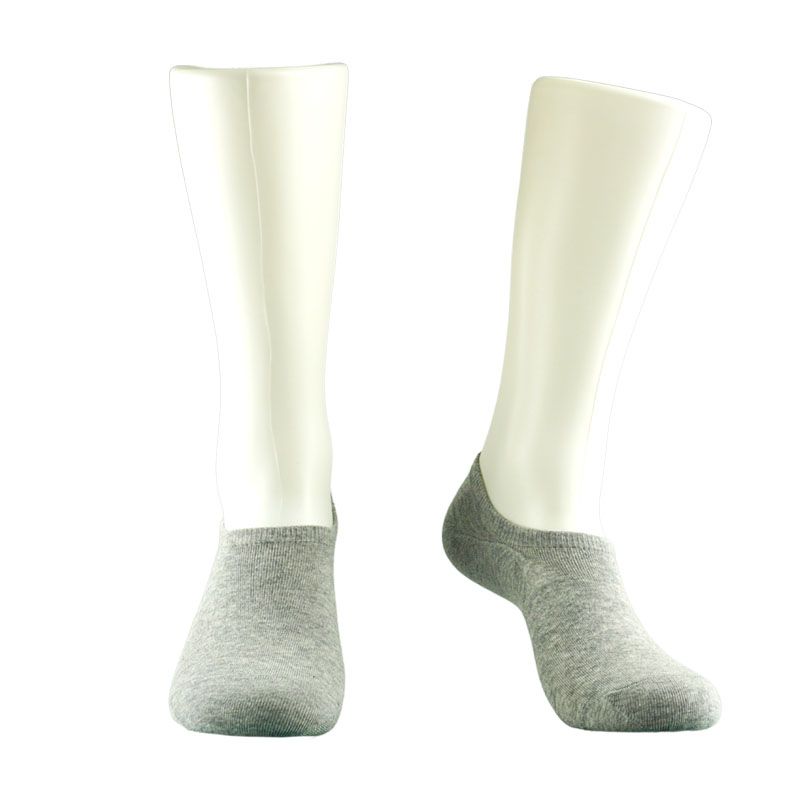
You will see every step below in custom no-show socks, where sampling runs before bulk production and MOQ starts at 300 pairs per design.
Knitting the Shortened Upper Low-cut socks are knitted on standard circular machines, typically 144 to 200 needles depending on the yarn and the desired fineness. The machine programme simply stops the upper earlier than it would for an ankle sock. The complication comes at the opening: with no shaft to hold shape, the top edge must be finished with an elasticated welt or a fine rib that lies flat against the skin. A poorly finished edge curls outward and becomes visible above the shoe line, which defeats the entire product.
The Silicone Heel Grip This is the defining process. After knitting, the sock is turned inside out and placed on a form, and a pattern of medical-grade silicone is screen-printed, dispensed or injected onto the inside of the heel. The sock then passes through a curing oven, usually at 120 to 160°C, which cross-links the silicone and bonds it to the fibres. Coverage, dot diameter and cure temperature are the three variables that determine grip strength and wash life. Under-cured silicone peels; over-cured silicone cracks.
The Elasticated Arch Band Many low-cut socks add a second retention feature: a band of elastic yarn knitted across the arch, roughly under the instep. This pulls the sock gently against the underside of the foot so the whole garment is held rather than just the heel. It is invisible in wear, costs almost nothing, and makes the difference between a sock that survives a day of walking and one that does not.
Shallow Boarding Forms Standard boarding forms are leg-shaped, which is wrong for a sock with no leg. Low-cut socks are boarded on short, shallow forms that match the finished dimensions, then passed through a steam or dry-heat tunnel to set the shape. Correct boarding is what gives the sock its heel pocket, and a well-formed pocket is the third element holding it on. A sock boarded on the wrong form will have a heel that sits proud and a sole that twists.
Toe Closure and Finishing Because a low-cut sock sits close to the skin with no shaft to absorb movement, the toe seam matters more than on longer socks. Linked or rosso closing produces a flat seam; overlock produces a ridge that becomes noticeable in a snug shoe. After closing, the socks are paired, inspected for silicone placement and cure quality, then branded — usually with a small jacquard mark or a printed logo on the sole or the outer ankle, since there is no cuff to speak of.
Quality Control Points Four checks decide whether a batch is acceptable: silicone adhesion after a defined number of wash cycles, elastic recovery of the welt after stretching, dimensional conformity after boarding, and symmetry of the heel pocket between left and right. The wash test is the one most often skipped and the one that most often predicts a return.
We go deeper on Ankle Socks Design Ideas in a separate guide.
FAQ
Q: Why do some low-cut socks slip off? A: Insufficient silicone coverage, a poorly cured grip, or a heel pocket that was boarded on the wrong form.
Q: Can the grip be applied to any yarn? A: Yes, though adhesion is strongest on synthetic-rich blends. High-cotton socks need a primer or a different silicone formulation.
Q: How long does the silicone last? A: Fifty to eighty domestic washes at a good grade, fewer with high-temperature tumble drying.
Q: Is printing or injecting better? A: Printing suits fine dot patterns and soft hand feel; injecting gives a thicker, harder-wearing tread.
CONCLUSION
Making a low-cut sock means solving a retention problem that longer socks never face. The shortened upper removes the anchor, so the heel grip, the arch band and a correctly boarded pocket have to replace it. Those three specifications — silicone coverage and cure, elastic placement, and boarding form — are where quality lives, and they are exactly what to ask about when auditing a supplier.
When you are ready to produce, Sockmader covers sampling, MOQ and lead times in one place.
Start your next order with custom no-show socks from Sockmader — send artwork, size range and target quantity for a quote.