“Work sock” is a durability specification more than a style. The job — construction, warehouse, industrial — abrades the toe and heel far harder than daily wear. A work sock is therefore an exercise in reinforcement engineering. This is how they are made to take abuse, and why the cheapest work sock is usually the most expensive once the return and replacement costs land. For procurement teams buying at volume, the reinforcement spec is the line that protects the budget, not the color or the price on the quote.
You will see every step below in custom work socks, where sampling runs before bulk production and MOQ starts at 100 pairs per design.
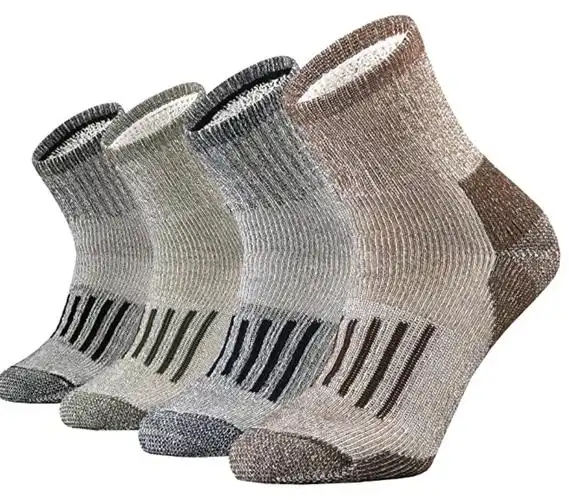
Reinforced Toe and Heel The highest-wear zones use aramid (para-aramid) or high-tenacity nylon plated into the stitch — not a patch, but a yarn switch written into the pattern. The heel often gets a double-layer (double-knit) construction for twice the abrasion resistance. This is the defining work-sock feature, and it is invisible from the outside, which is why buyers who cannot see it often skip it and then wonder why the sock holed. We plate the whole toe and heel cap, not just the tip, because wear travels as the boot flexes.
Dense, Stable Knit Work socks use a coarser gauge (96–120 needles) with a tight stitch for structure. Looser knits snag and hole faster, and they lose shape under the constant pressure of a boot. The leg is a firm rib that stays up through bending and kneeling, so the sock does not slide down into the boot mid-shift — a small annoyance that becomes a blister risk over a long day. Stability of the hand is the quiet quality marker of a work sock done right.
Cushion and Support A medium terry sole cushions on concrete; an arch compression band supports during long standing. Some lines add a metatarsal pad for heavy-lifting comfort. The cushion is functional, not plush — a work sock should absorb shock, not feel like a slipper. We tune the sole density to the floor: thicker for concrete and steel decks, lighter for tight safety-toe boots where room is scarce and a fat sole crowds the toes.
Yarn Choices Cotton-poly blends for general work; merino-nylon for cold climates; synthetic-only for high-heat jobs. Aramid is added only at wear zones (it is stiff and costly elsewhere, and would make the whole sock board-like). Elastane is minimal to keep the hand stable rather than stretchy. We pick the base yarn by the job site climate, because a warm-climate crew in merino will be miserable, and a cold-climate crew in synthetic-only will be cold — the yarn is a comfort spec, not just a cost line.
Manufacturing and QA Work socks are 100% inspected at toe and heel for reinforcement integrity — a missed aramid plate is a premature failure that turns into a blister and a complaint. Boarding uses a form sized to the thicker profile. MOQ ~100 pairs; lead 30–40 days. We sample for both feel and abuse, because a sock can feel fine and still fail at the heel in week three, and the inspection gate is what catches the latter before it ships.
We go deeper on Hiking Socks Buying Guide in a separate guide.
FAQ
Q: Aramid or just thick nylon for the toe? A: Aramid lasts far longer on abrasive jobs; thick nylon is a budget alternative that holes sooner.
Q: Cushion or thin for work? A: Medium terry sole on concrete; thin only for tight safety boots where volume is limited.
Q: Why inspect 100% at toe and heel? A: A missed reinforcement is a hole in weeks; work socks live or die at those zones, so we check every pair.
CONCLUSION
Work socks are defined by reinforcement: aramid toes, double heels and a dense knit. Spec the wear zones and the sock outlasts the job site, not the first month — and that durability is what makes a bulk work-sock program actually cheap in the long run.
To move from plan to order, send artwork, size range and quantity through Sockmader.
When you are ready to source, the Sockmader custom work socks team can quote sampling, MOQ and lead times for your quantity.