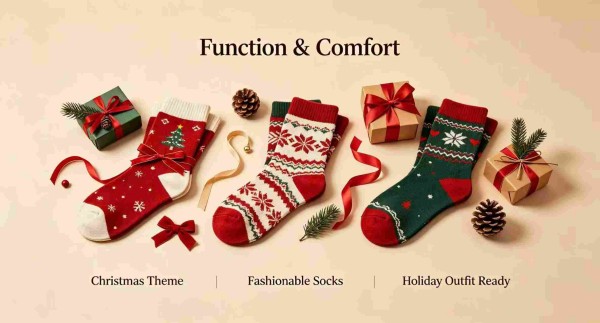
Christmas socks are the ultimate seasonal product: enormous demand compressed into a eight-week selling window, driven by impulse purchases, corporate gifting, and stocking-stuffer bundles. That combination makes manufacturing quality and delivery timing everything. A shipment that arrives in January is inventory you will store — and discount — for eleven months. Understanding how Christmas socks are actually produced helps brands and wholesalers plan orders correctly and evaluate whether a factory can hit the season reliably.
You will see every step below in custom Christmas sock range, where sampling runs before bulk production and MOQ starts at 100 pairs per design.
Step 1: Design and Knit Programming
Christmas socks are predominantly produced on computerized jacquard knitting machines. Motifs — snowflakes, reindeer, Santa faces, candy canes, “naughty or nice” lettering — are converted into knit programs that map every colored stitch. Unlike printed socks, jacquard patterns are knitted into the fabric itself, so they never crack, peel, or fade in the wash. A factory’s in-house design team can turn your artwork into production-ready knit files in a few days; this is where the custom capabilities of your supplier really show.
Step 2: Yarn Selection for Festive Effects
Beyond standard cotton and polyester, Christmas lines lean on specialty yarns: metallic threads (Lurex) for sparkle, chenille for plush textures, and high-bulk acrylic for that classic chunky knit look. Red, white, green, and gold dominate, and dye-lot consistency across thousands of pairs matters more than in any other category — mismatched reds between the sock body and the attached cuff are the most common seasonal QC rejection.
Step 3: Knitting the Body and Cuff
The sock body is knitted with the jacquard motif, while the cuff — often a fold-over roll cuff or ribbed band — may be knitted integrally or attached separately. Classic “stocking-style” Christmas socks frequently use a turn-down plush cuff that mimics traditional wool stockings. Rib construction and cuff elasticity are checked on every size run, because a cuff that loses its shape after one wash generates immediate returns.
Step 4: Embroidery, Appliqué, and 3D embellishments
Premium Christmas designs go beyond knit patterns. Embroidered patches (a knitted Santa face, a felt reindeer with a pom-pom nose), appliqué felt pieces, pom-poms, bells, and sequins are attached after knitting. These operations are semi-manual and are the main capacity bottleneck in peak season — a factory with dedicated embellishment lines, rather than outsourced handwork, will deliver far more consistent results.
Step 5: Toe Closing, Washing, and Boarding
Socks are toe-closed (typically rosso or overlock seams), then washed to remove knitting oils and soften the hand feel. Heat boarding sets the final shape and stabilizes dimensions. For Christmas socks, this stage also includes anti-pilling treatment on chenille and acrylic styles, since fuzzy fibers are prone to pilling without proper finishing.
Step 6: Quality Control and Seasonal Packaging
QC covers motif alignment between left and right socks, colorfastness of deep reds and greens (notorious for bleeding), seam strength where embellishments attach, and size conformity. Packaging is where Christmas socks sell: header cards with holiday artwork, hang tags with twine, gift-ready boxes, and pre-assorted multi-packs. Many buyers order mixed-design assortments, so factories also manage kitting — collating the correct design mix into each retail bag.
Christmas Socks Trends picks up where this article leaves off.
FAQ
Q: When should I place Christmas sock orders? A: Production slots for the Christmas season are typically booked from March through July, with shipments leaving the factory by September to reach shelves before the selling window opens.
Q: Can I mix multiple designs in one order? A: Yes. Most factories allow design mixing within a total order quantity — for example, five designs at 1,000 pairs each within a 5,000-pair order — subject to per-design minimums.
Q: Jacquard knit or printed patterns — which is better? A: Jacquard-knitted motifs are more durable and premium-feeling; printing is cheaper for photographic designs. High-end Christmas collections almost always use jacquard.
CONCLUSION
Christmas socks reward suppliers who plan early and punish those who do not. When evaluating a factory, ask about jacquard capability, in-house embroidery capacity, and their seasonal production calendar. Then place your order with enough lead time that the sea freight, not the knitting machines, is the slowest part of your supply chain — and enjoy a season where your shelves are full while your competitors are still waiting for containers.
Ready to price this out? Start with a sample from Sockmader’s custom christmas socks team, or send your artwork and target quantity for a quote.