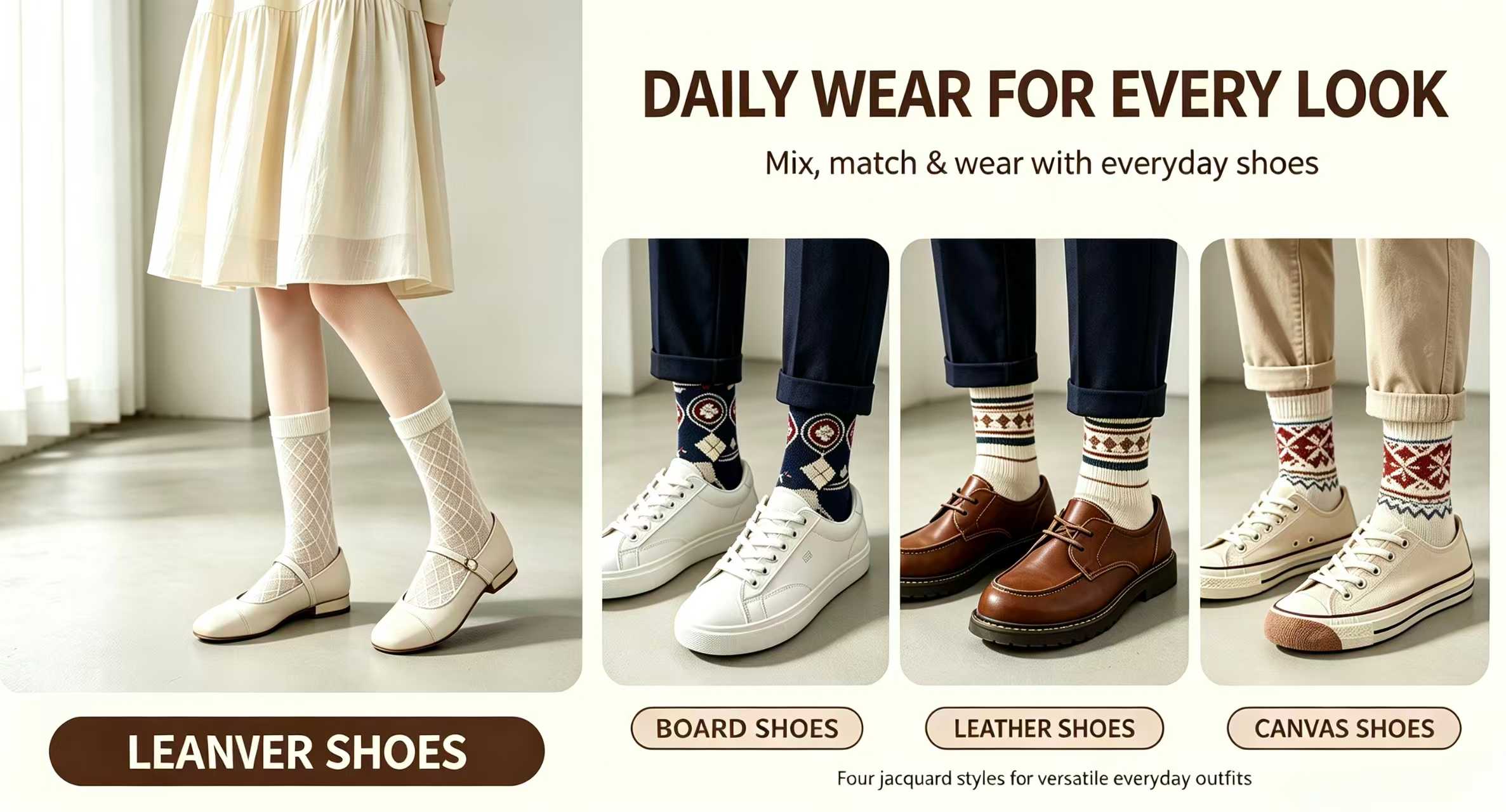
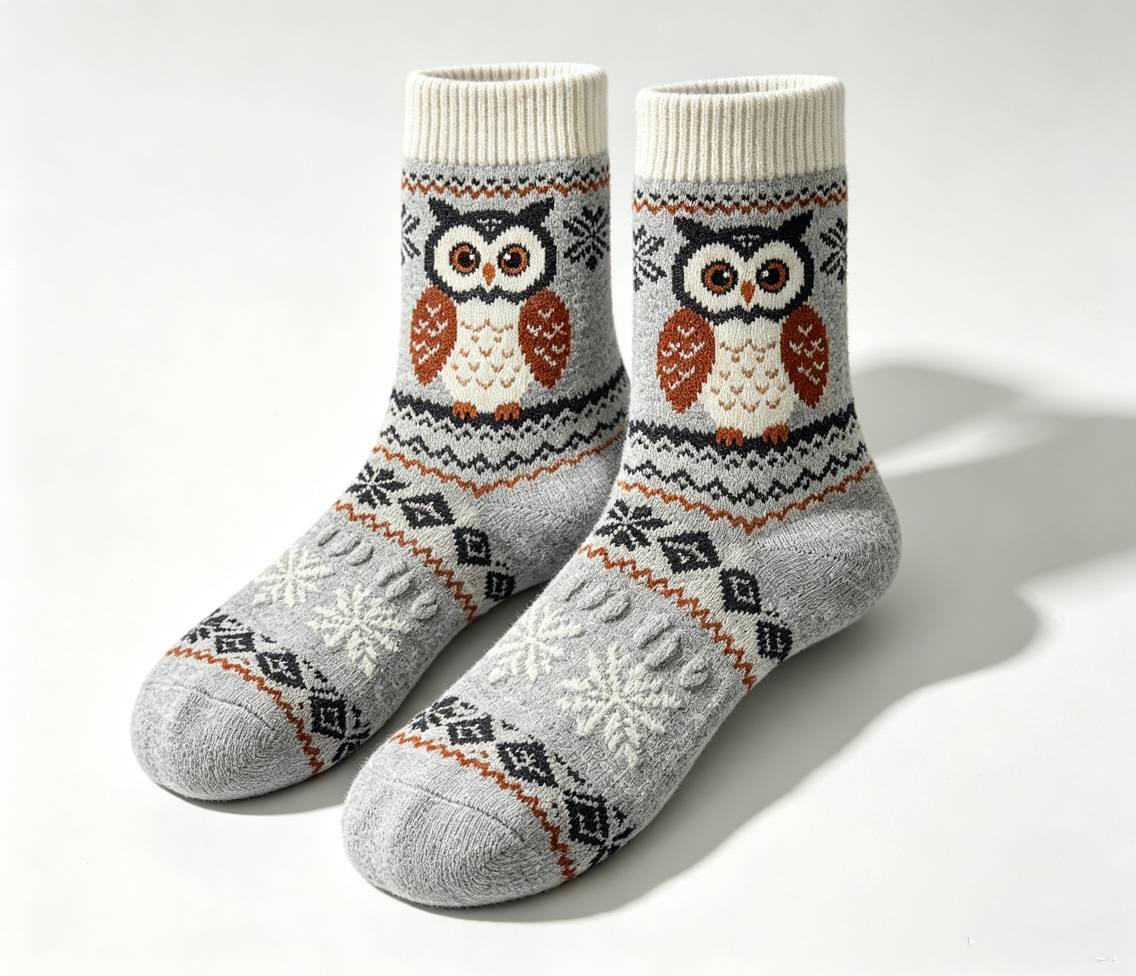
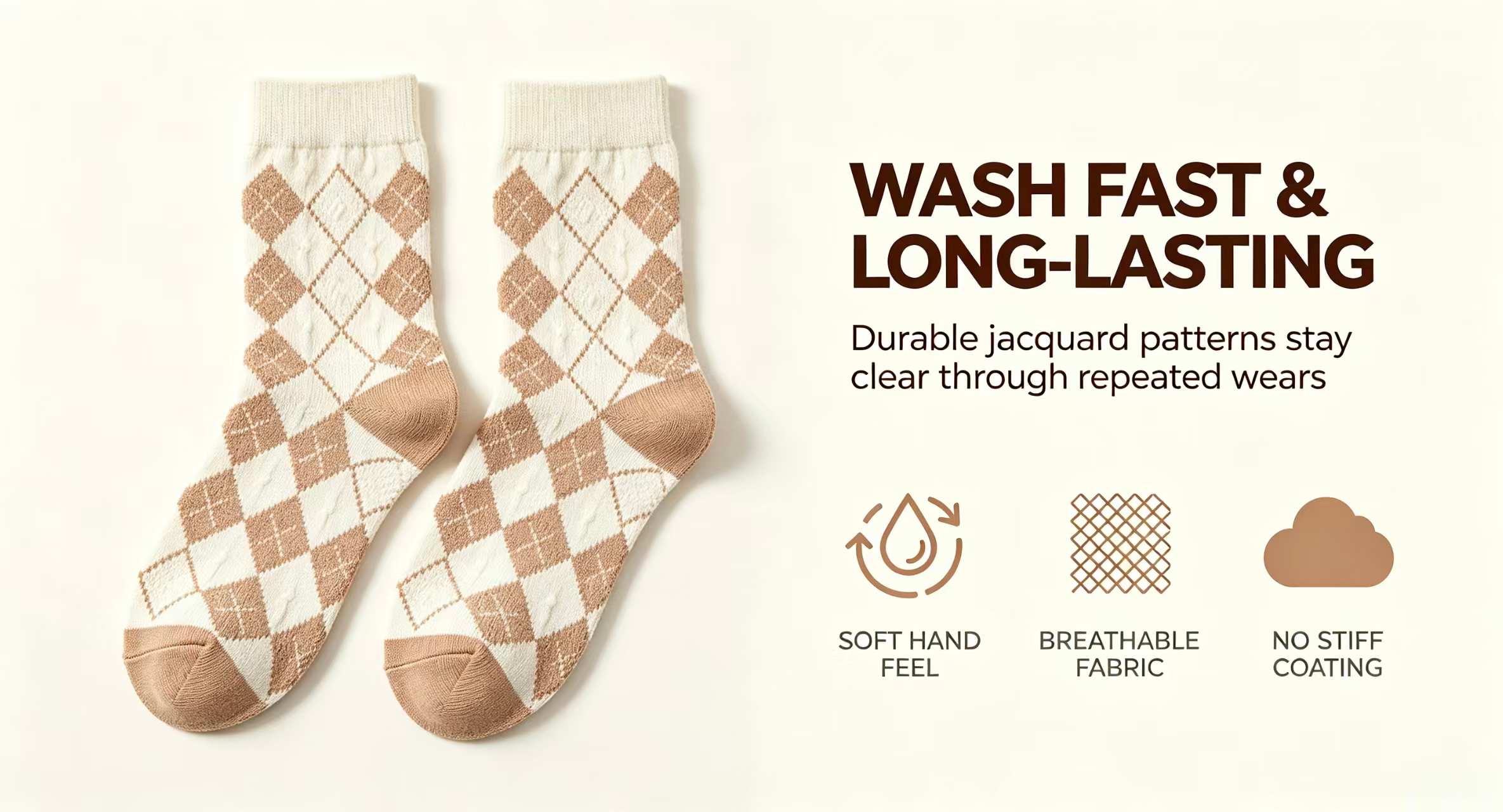
The best jacquard designs are the ones that look deliberate on the machine rather than translated onto it. That means motifs built from straight edges, limited palettes and repeats — not illustrations fighting the grid.
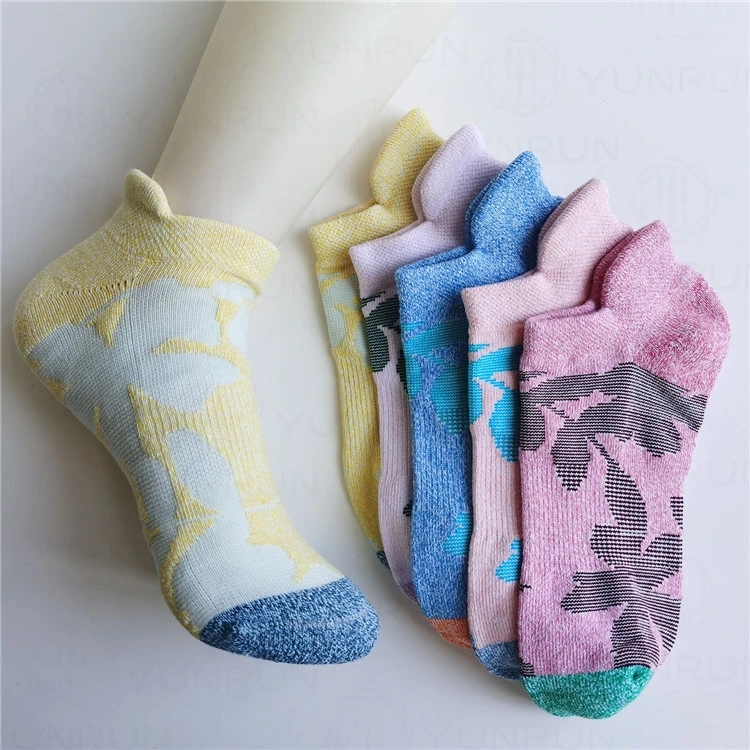
Below are the directions that consistently knit cleanly and sell through, grouped by where they work hardest.
Every idea below can be produced through wholesale jacquard socks, including jacquard, printing and retail-ready packaging.
H2 Retail and Lifestyle
Heritage argyle. Two or three tones, low contrast. The most reliable seller in men’s dress-casual, and the easiest pattern to produce.
Breton stripe with a twist. Even horizontal bands, one row broken by a small motif. Reads as classic, knits fast, and works in any gauge.
Chevron and zigzag. Diagonal structure flatters the leg and hides minor stitch irregularity better than a horizontal band does.
Small repeating icon. A coffee cup, a pine tree, a bicycle — one motif, repeated. Keep it under twenty stitches tall and let the repeat do the work.
H2 Gift and Seasonal
Fair Isle band. A narrow band of traditional motif across the cuff or the ankle. Nostalgic, seasonal, and cheap because the band is small.
Knitted wordmark. “warm”, “hello”, “weekend”, or a brand name. Bold sans-serif, five stitches minimum, placed above the ankle.
Snowflake and star repeats. Winter gift ranges rely on these every year. They are geometric, so they knit cleanly, and they photograph well in flat lays.
Contrast heel and toe with a small motif. Effectively a two-colour sock with one accent. Lowest possible jacquard cost with a designed look.
H2 Corporate and Team
Placement logo above the ankle. One mark, one or two colours, on a plain ground. The professional default and the most wearable option for staff.
Vertical wordmark on the back of the leg. Reads well in photos of teams and is invisible from the front, which makes the sock wearable outside work.
Stripe in brand colours. No logo at all. Useful when brand guidelines restrict mark usage but allow colour.
Number or initial on the cuff. For team kits. Large and bold, on the rib.
H2 Authorised and Licensed Ranges
Character silhouettes. Simplified to solid shapes with no internal line work. Licensors usually require flat colour, which suits jacquard perfectly.
Badge and crest motifs. Heraldic shapes are geometric by nature and translate to the grid with minimal loss.
Pattern from an existing textile. If the brand already has a fabric pattern, it can usually be adapted to a stitch repeat with a colour reduction.
H2 Choosing Between Them
Ask three questions. Who wears it and where — office, home, gym? What is the price point, which sets the colour count? And does the design need to survive three years of reorders, which argues against anything dependent on a discontinued yarn shade?
A good range usually mixes one safe repeat, one statement motif and one placement logo, rather than five variations of the same idea.
H2 Sampling a Range Efficiently
Knit all candidates in the same colourway first. That isolates the pattern as the variable. Once a motif is approved, recolouring is a fast and cheap second step, and it lets you test three colourways of one proven design instead of three untested designs.
We handle the adjacent decision in Jacquard Socks Buying Guide.
FAQ
Q: How many designs should a first range have? A: Three to five. Enough to look like a collection, few enough that each gets proper sampling attention and a viable minimum quantity.
Q: Do licensed designs have extra requirements? A: Yes — licensors typically require approval of both artwork and physical sample, which adds two to three weeks. Build that into the calendar.
Q: Which design is cheapest to produce? A: A small placement motif in one contrast colour on a stock ground, with a standard linked toe and no special packaging.
CONCLUSION
Pick designs that are geometric, low-colour and repeat-based, and you will get crisp samples first time. Save the complex ideas for when you have a proven seller and a reason to invest in a longer sampling cycle.
To move from plan to order, send artwork, size range and quantity through Sockmader’s custom sock manufacturing team.
When you are ready to source, the Sockmader custom jacquard socks team can quote sampling, MOQ and lead times for your quantity.