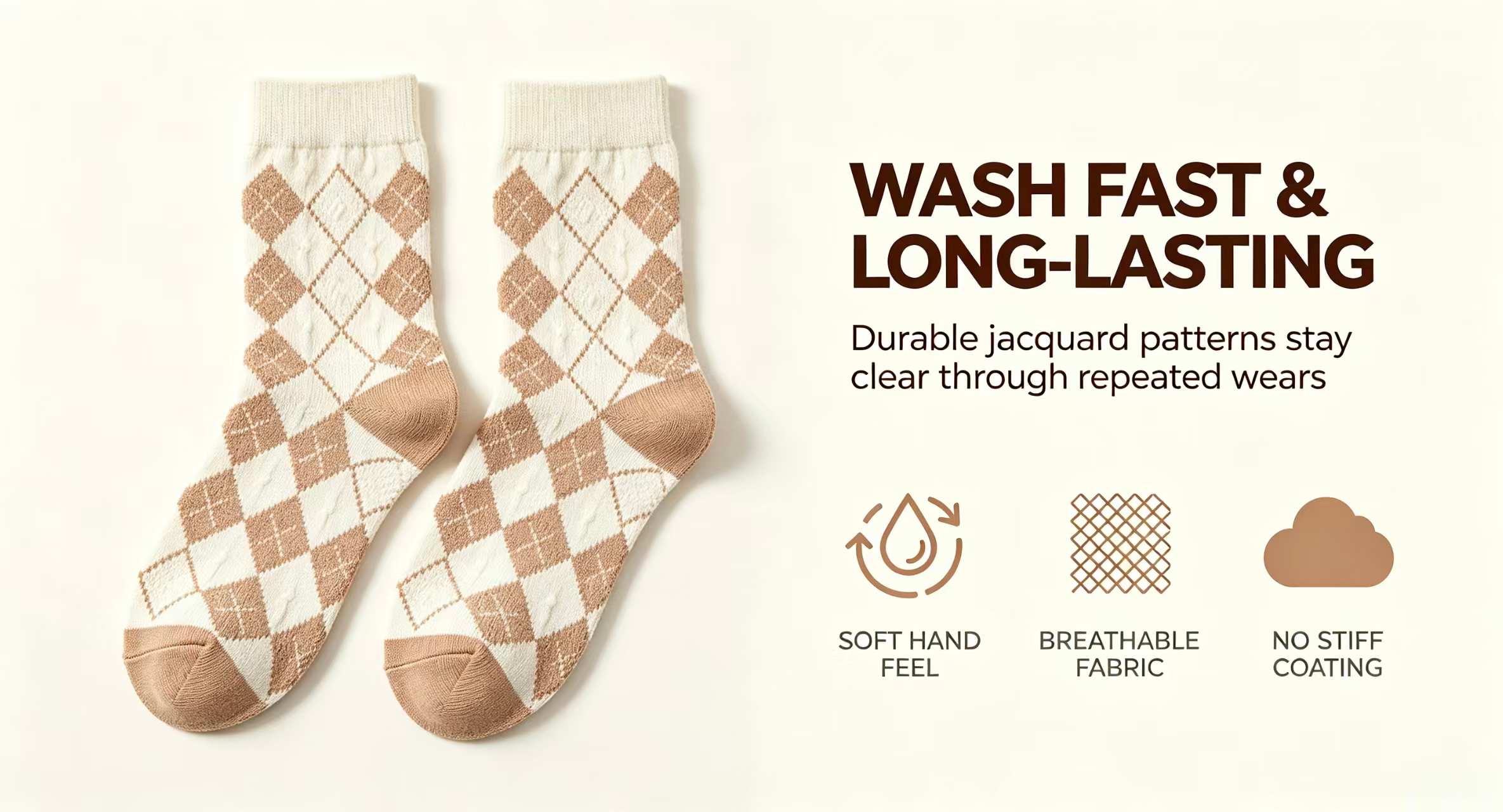
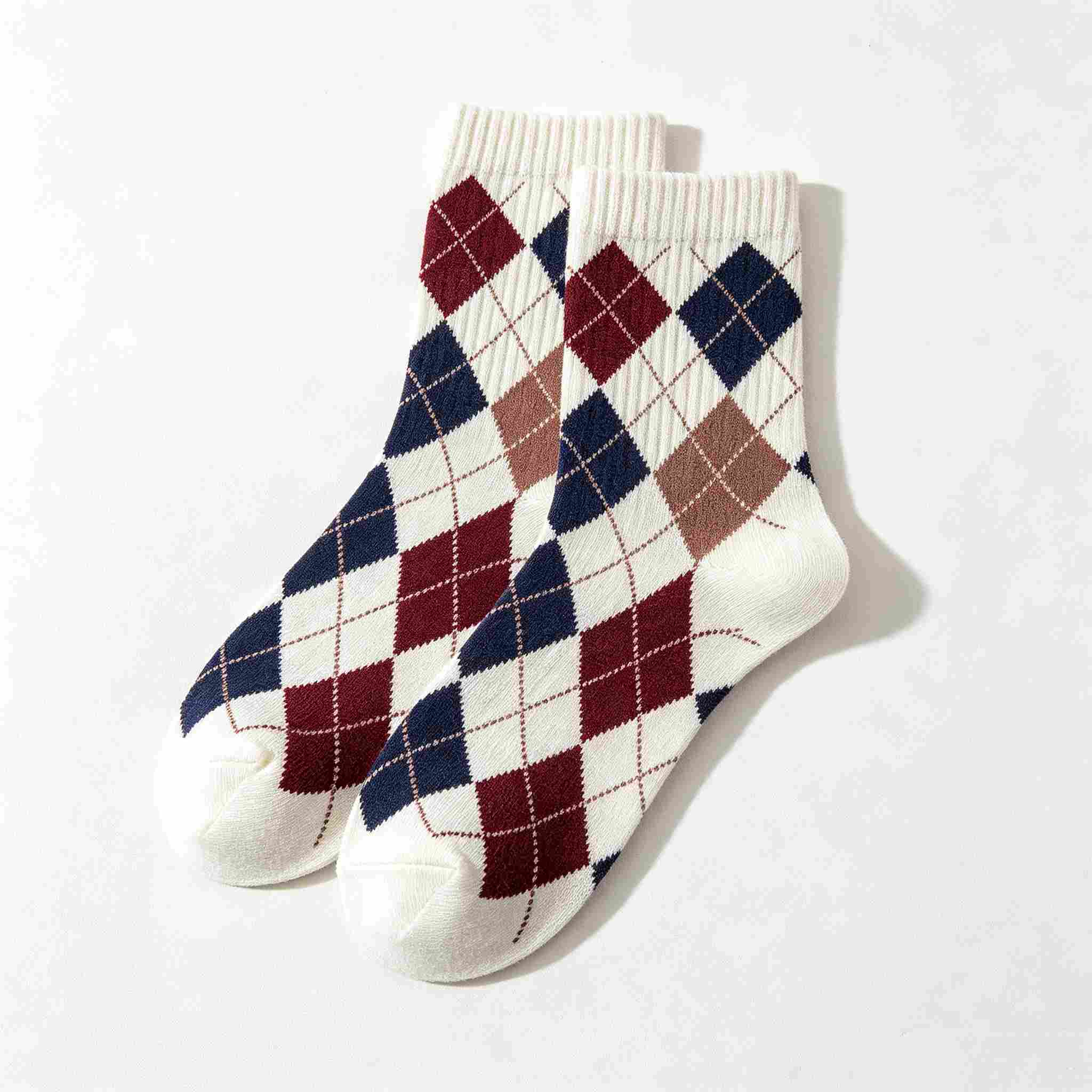
A patterned sock does not fit exactly like a plain sock made on the same machine. The floats on the reverse of a jacquard design reduce the fabric’s ability to stretch, and the more of the leg the pattern covers, the more that reduction shows up.
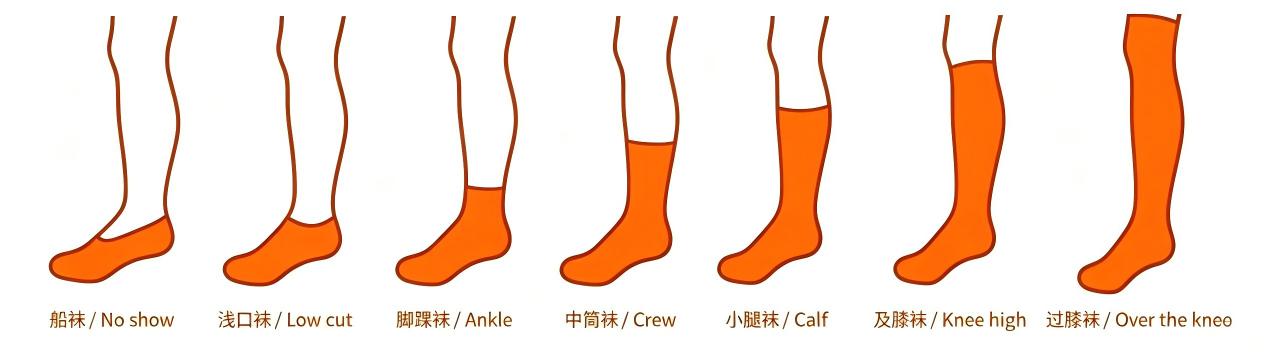
None of this is a reason to avoid jacquard. It is a reason to grade a patterned range slightly differently, and to state three numbers on every spec sheet instead of one.
Production-ready specifications for all of the above are handled through custom jacquard socks.
H2 Why Pattern Changes Stretch
In a plain jersey stitch, every loop can deform and recover freely. Add floats and you add yarn lying across the back of the fabric that has to straighten out before the loop can extend. The effect is a modest but real loss of circumference stretch, typically in the range of five to fifteen percent depending on float length and coverage.
On a sock with a small placement motif, this is invisible. On a sock with an all-over pattern and large colour blocks, it is the difference between a comfortable leg and one that feels tight over a wide calf.
H2 The Three Numbers to Specify
Always give your factory a shoe size range, a leg height measured from the heel, and a cuff width measured flat and relaxed. Brands that specify only shoe size get socks that fit the foot and disappoint everywhere else.
For a patterned sock, add a fourth: pattern coverage, expressed as a percentage of the leg area. This lets the factory decide whether to open the stitch setting slightly or to shorten the floats.
H2 Standard Size Ranges
Our stock grading for adult unisex runs:
- S: EU 35–38 / US Women 5–7
- M: EU 39–42 / US Women 8–10, US Men 6.5–8.5
- L: EU 43–46 / US Men 9–12
- XL: EU 47–50 / US Men 12.5–15
Children’s grading runs in two-year bands: 1–2, 3–4, 5–6, 7–8, 9–10, with a non-slip sole option on the two youngest sizes.
H2 Cuff Width and the Rib Top
The rib top is where a poor fit is noticed first. A 1×1 rib gives more stretch and a tighter return; a 2×2 rib is broader visually and slightly firmer. On a patterned leg we usually specify a slightly longer rib top, because the patterned section below it will not give as much.
If the design includes a knitted wordmark on the cuff, remember that the cuff is stretched every time the sock is pulled on. Letters distort. Keep cuff lettering short and bold.
H2 Grading a Pattern Across Sizes
This is the mistake that costs the most. A motif designed for a size L leg looks wrong on a size S leg if it is simply scaled down, because the needle count in the cylinder does not change with the size — only the number of courses does.
The correct approach is to keep the motif the same width and adjust its vertical repeat, or to redesign the repeat for each size band. We flag this at sampling stage rather than discovering it in bulk.
H2 Plus-Size and Wide-Calf Considerations
For wide-calf or plus-size programmes, the safest construction is a placement pattern with a plain ground, plus elastane in the rib rather than the whole leg. An all-over heavy jacquard on a wide calf is the combination most likely to generate comfort complaints.
H2 Sampling Before You Commit to a Run
Always order a full size set — S through XL — as samples, not just a medium. Pattern behaviour at the extremes is where problems live, and a single sample size hides them completely.
We go deeper on How to Design Jacquard Socks in a separate guide.
FAQ
Q: Do jacquard socks run small? A: Slightly, in patterned areas. If you are between sizes and the sock is all-over patterned, take the larger size.
Q: Can I use the same size chart as my plain socks? A: As a starting point, yes, but the cuff width and the rib length should be reviewed for patterned styles.
Q: Does washing change the fit? A: A small amount of relaxation is normal after the first wash. Cotton socks tighten slightly then settle; the pattern itself does not shrink independently.
CONCLUSION
Specify shoe size, leg height, cuff width and pattern coverage together, sample the full size range, and keep all-over patterns off wide-calf styles. Do that and a jacquard range fits as reliably as a plain one.
When you are ready to produce, Sockmader covers sampling, MOQ and lead times in one place.
Start your next order with custom jacquard socks from Sockmader — send artwork, size range and target quantity for a quote.