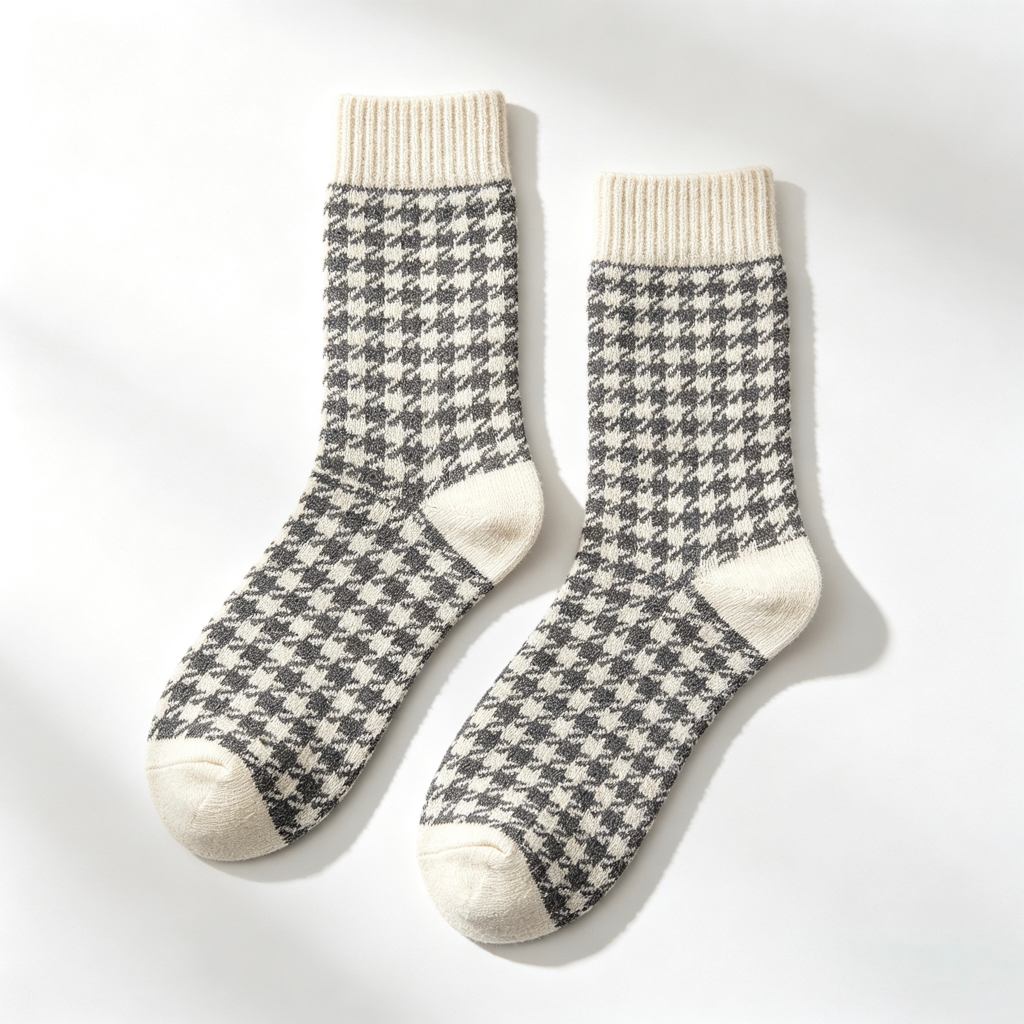
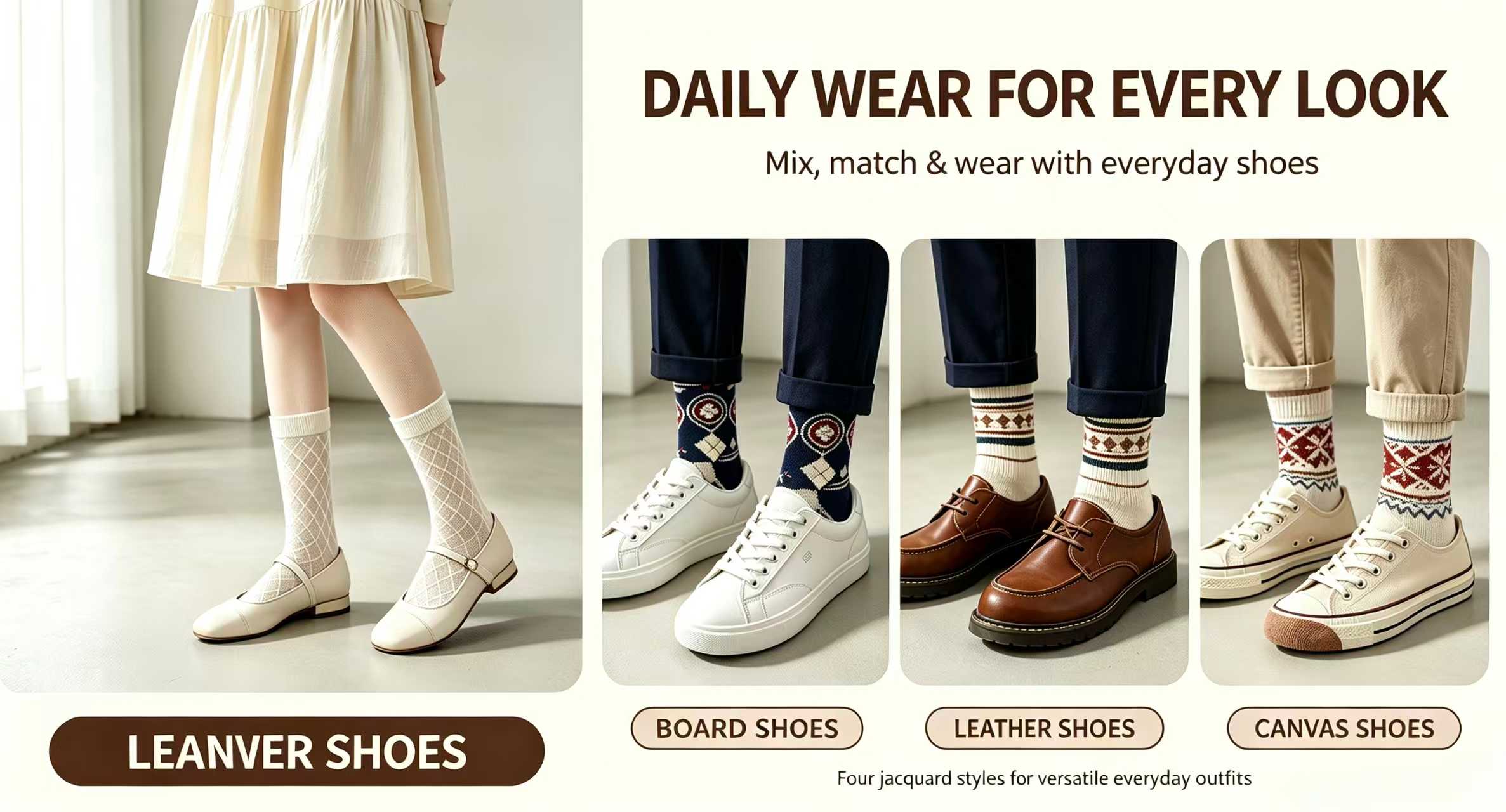
Wholesale jacquard pricing confuses buyers because two quotes for “the same sock” can differ by thirty percent with no obvious reason. The reason is almost always one of four variables, and once you know them you can predict a price before you ask for it.
MOQ, lead times and bulk pricing for this category are set out on the jacquard sock manufacturing page.
H2 Variable One: Colour Count
Every additional colour is another feeder, another setup, more floats to manage and a slower machine cycle. Moving from two colours to four typically adds more to the unit price than upgrading from standard combed cotton to mercerised.
This is why the first question to ask about an expensive quote is not “can you do better” but “what happens if we drop a shade”. Very often the design survives the cut and the price falls into range.
H2 Variable Two: Volume Tiers
Sock factories price in bands, because setup cost is fixed and has to be amortised. Typical thresholds sit at 300, 500, 1,000, 3,000 and 5,000 pairs per design. The largest single drop in unit price is usually between 500 and 1,000.
Note that tiers apply per design and per colourway, not per total order. Five designs at 500 each is five separate 500-tier prices, not one 2,500-tier price. Consolidating colourways is often worth more than negotiating.
H2 Variable Three: Yarn and Gauge
Standard combed cotton is the baseline. Mercerised adds a premium, merino adds more, and certified organic or recycled yarns add both a material premium and a documentation cost. Gauge changes yarn consumption: a coarser sock uses more fibre per pair.
If you are working to a fixed retail price, decide which of these you actually need. A mercerised finish on a sock sold as a novelty gift is money the customer will not perceive.
H2 Variable Four: Packaging
Retail-ready packaging is frequently twenty to thirty percent of landed cost, and it is the item most often omitted from an initial budget. Header cards, belly bands, printed polybags, hangtags and barcodes each have their own minimums, usually higher than the sock minimum.
A common trap: the sock MOQ is 300 pairs but the printed header card MOQ is 1,000. Either accept a higher sock quantity or use a generic card with a sticker.
H2 Realistic Lead Times
Plan on 10–14 days for sampling, 3–5 days for approval and revisions, 25–35 days for bulk production, and 3–6 weeks for sea freight or 5–8 days for air. Packaging artwork adds a week if it is being designed in parallel.
Seasonal capacity is the hidden risk. Factories serving northern-hemisphere winter programmes are heavily booked from July to October. A first order placed in September for a December delivery is likely to be quoted at a premium or refused.
H2 Payment and Terms
Standard terms are a deposit on order confirmation with the balance before shipment, or against a copy of the bill of lading. Letters of credit are accepted for larger orders. New buyers should expect a deposit; established accounts often move to open terms after two or three successful orders.
H2 Planning a First Bulk Order
Start with three designs rather than one. That gives you a range to sell, spreads the setup cost across more SKUs than you might expect, and — most usefully — tells you which motif actually sells before you commit to a large reorder.
Order the size split based on your market, not evenly. For adult unisex ranges, M and L usually carry sixty percent or more of volume.
H2 What a Reorder Saves
Once a design has been sampled and approved, the pattern file and machine settings exist. A reorder of the same design skips artwork conversion and setup, which typically reduces both the unit price and the lead time. Factor this into your first-order economics: the first run pays for the development, subsequent runs harvest it.
If that is settled, the next question is usually answered in Jacquard Socks vs Embroidered Socks?.
FAQ
Q: Why is my 300-pair quote so much higher per unit than the 1,000-pair quote? A: Setup cost is the same regardless of quantity. At 300 pairs it is spread over far fewer units.
Q: Can I mix designs to reach a volume tier? A: Usually not — tiers apply per design and colourway. Ask whether the factory offers a mixed-SKU programme.
Q: Is air freight worth it? A: For a launch or a seasonal window, often yes. For a steady replenishment programme, sea freight is almost always the right choice.
CONCLUSION
Wholesale jacquard pricing is predictable once you separate colour count, volume tier, yarn and packaging. Optimise the first two before you touch the third — and treat packaging as a line item from day one rather than an afterthought.
To move from plan to order, send artwork, size range and quantity through the Sockmader custom sock factory.
When you are ready to source, the Sockmader custom jacquard socks team can quote sampling, MOQ and lead times for your quantity.