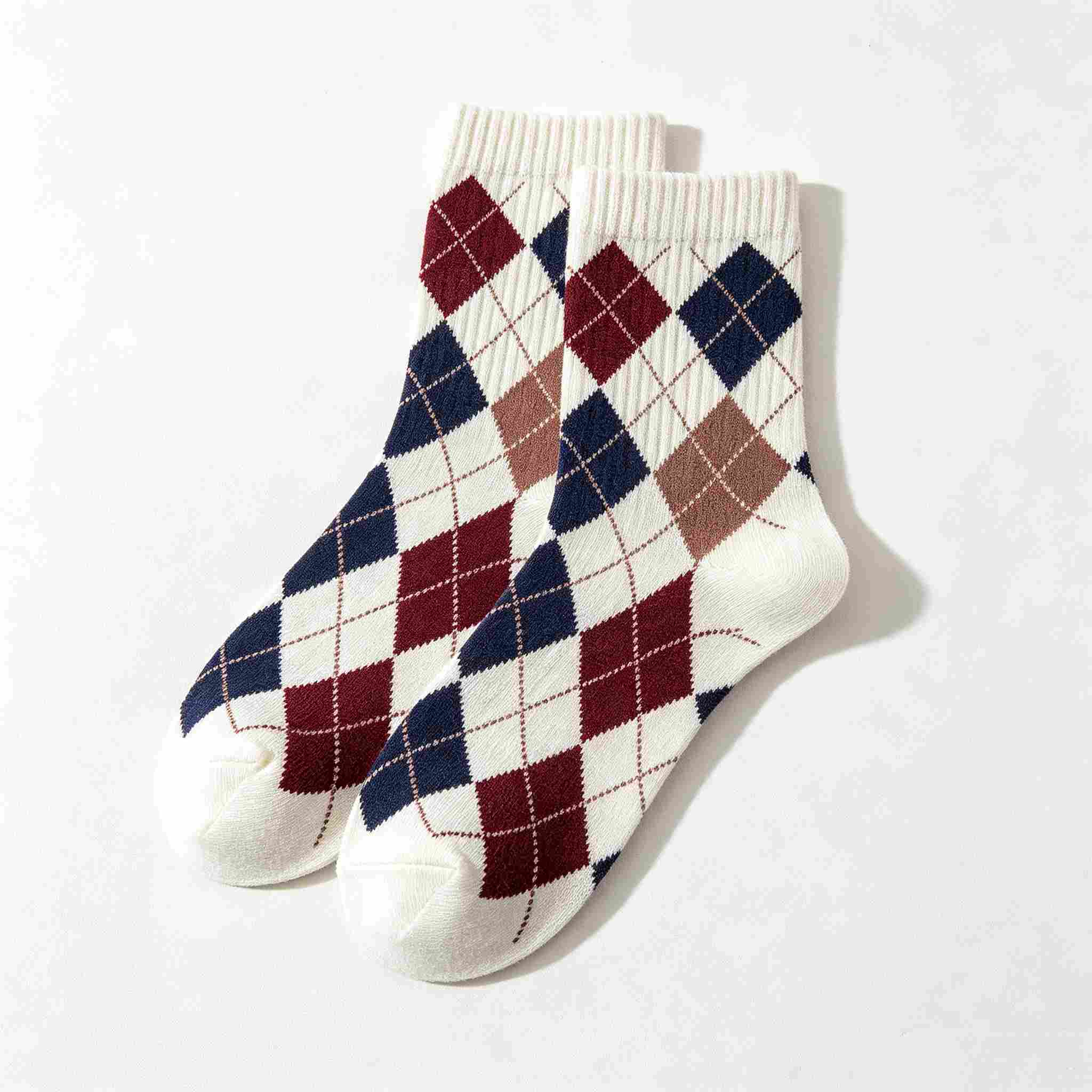
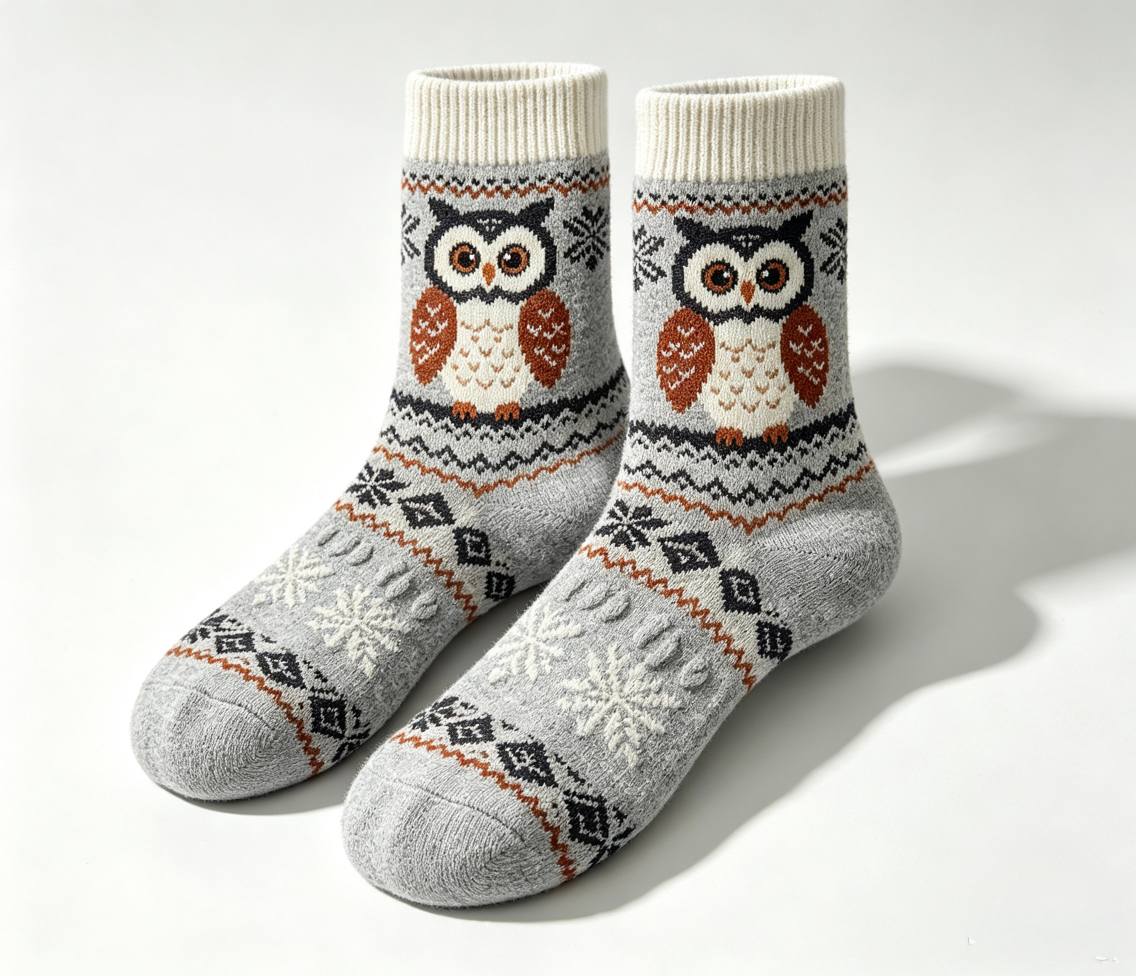
A novelty sock is a jacquard sock with a sense of humour. The production route is the same: the motif is knitted into the fabric by selecting needles individually, one stitch at a time. What differs is the artwork — and the artwork is where most novelty projects either succeed or stall.
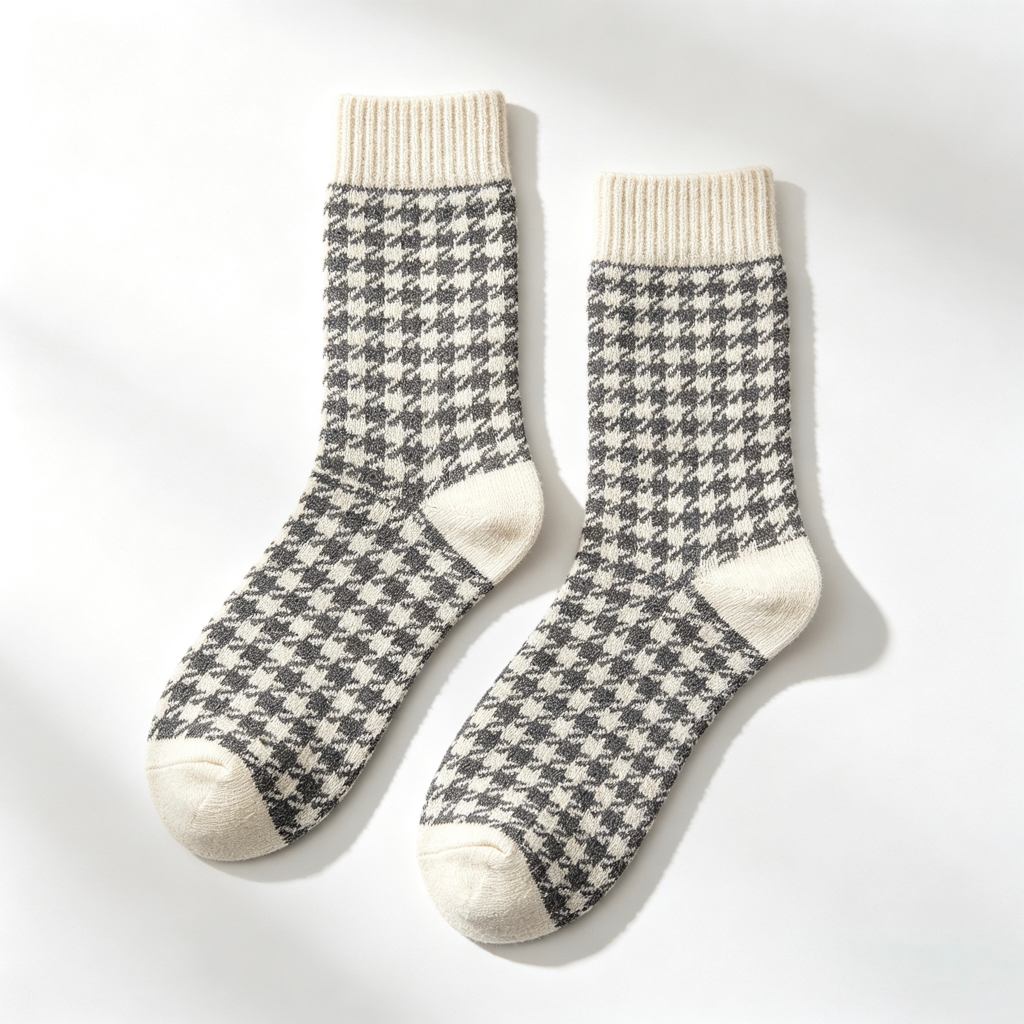
Here is the full path from a designer’s sketch to a boxed retail pair.
You will see every step below in jacquard sock manufacturing, where sampling runs before bulk production and MOQ starts at 300 pairs per design.
H2 Step 1 — Concept and Colour Reduction
Novelty designs usually arrive with too many colours. An illustration of a slice of watermelon might have six shades: three greens, two reds, pink and black seeds. On a sock machine that is six feeders, six tensioning setups and a float problem under every solid area.
The first production task is reduction — typically down to three or four shades, chosen for contrast rather than realism. This is not a compromise. A novelty motif read at sock scale is more legible in three bold colours than in six accurate ones, and it knits dramatically better.
H2 Step 2 — Fitting the Grid
The motif is mapped to the needle grid. On a 168-needle machine, the leg is 168 stitches around, so a motif designed at 40 stitches wide repeats a little over four times. Designers usually want it repeated two or three times, which means sizing the motif at roughly 56 to 84 stitches.
Everything is checked at this stage against minimum feature sizes: letters at least five stitches tall, solid blocks kept short, and at least two stitches of clearance between elements.
H2 Step 3 — Float Engineering
Where a colour is not knitting, its yarn lies loose across the back of the fabric. Those are floats, and on a novelty design with chunky shapes they are the main technical risk. Long floats snag on toes and boot linings, and a snagged novelty sock is a returned novelty sock.
The remedies are to shorten floats by breaking up solid areas, to tie them down with tuck stitches, or to plate a smooth ground yarn behind the patterned area. On children’s novelty socks we plate as standard.
H2 Step 4 — Yarn Selection and Dyeing
Most novelty socks use a combed cotton body with polyamide for strength and a little elastane for recovery. Bright, saturated colours are characteristic of the category, so dye-fastness matters more here than in a sober dress sock.
If the design uses a house shade, the yarn comes from stock and the lead time drops by a week or more. Custom-dyed shades require lab dips and a minimum dye lot, and should be reserved for designs you expect to reorder.
H2 Step 5 — Knitting
The machine knits the rib top, engages jacquard selection for the leg and the motif, forms the heel, and closes the foot. Cycle time depends on colour count: a two-colour novelty sock may knit in a couple of minutes, a four-colour one noticeably longer.
Placement is decided here. Most novelty motifs sit on the outer ankle or wrap the leg; keeping them off the sole avoids both float discomfort and premature wear.
H2 Step 6 — Linking, Boarding and Pairing
The toe is closed, usually by linking, which gives a flat seam and keeps the motif aligned across the join. The socks are then washed, boarded on heated formers to set shape and size, and paired.
Pairing is done by eye under consistent light, checking that both socks in a pair place the motif at the same height. Misalignment is the defect most often noticed by a customer in a shop, and it is entirely preventable at this station.
H2 Step 7 — Packing for Retail
Novelty socks sell on presentation. Header cards, belly bands, gift boxes and hangtags are applied here, and each has its own artwork approval and minimum quantity. Barcodes and fibre-content labels are checked against the destination market’s requirements before cartons are sealed.
If that is settled, the next question is usually answered in Jacquard Socks Benefits.
FAQ
Q: Can a novelty design include a face or a character? A: Yes, if it is simplified to solid shapes. Fine line work and shading do not knit — they have to be redrawn as flat colour blocks.
Q: How long does a novelty sock sample take? A: Around 10–14 days including artwork conversion, test knit and one revision round. Allow longer for a first collaboration while the artwork language is being established.
Q: What is the minimum for a novelty design? A: Typically 300–500 pairs per design, less if you use a stock ground yarn and keep the colour count low.
CONCLUSION
Novelty socks are made exactly like any other jacquard sock; the craft is in the artwork. Reduce the colours, respect the grid, control the floats, and the motif will knit crisply enough to survive years of washing and still make someone smile.
When you are ready to produce, the Sockmader custom sock factory covers sampling, MOQ and lead times in one place.
Start your next order with custom jacquard socks from Sockmader — send artwork, size range and target quantity for a quote.