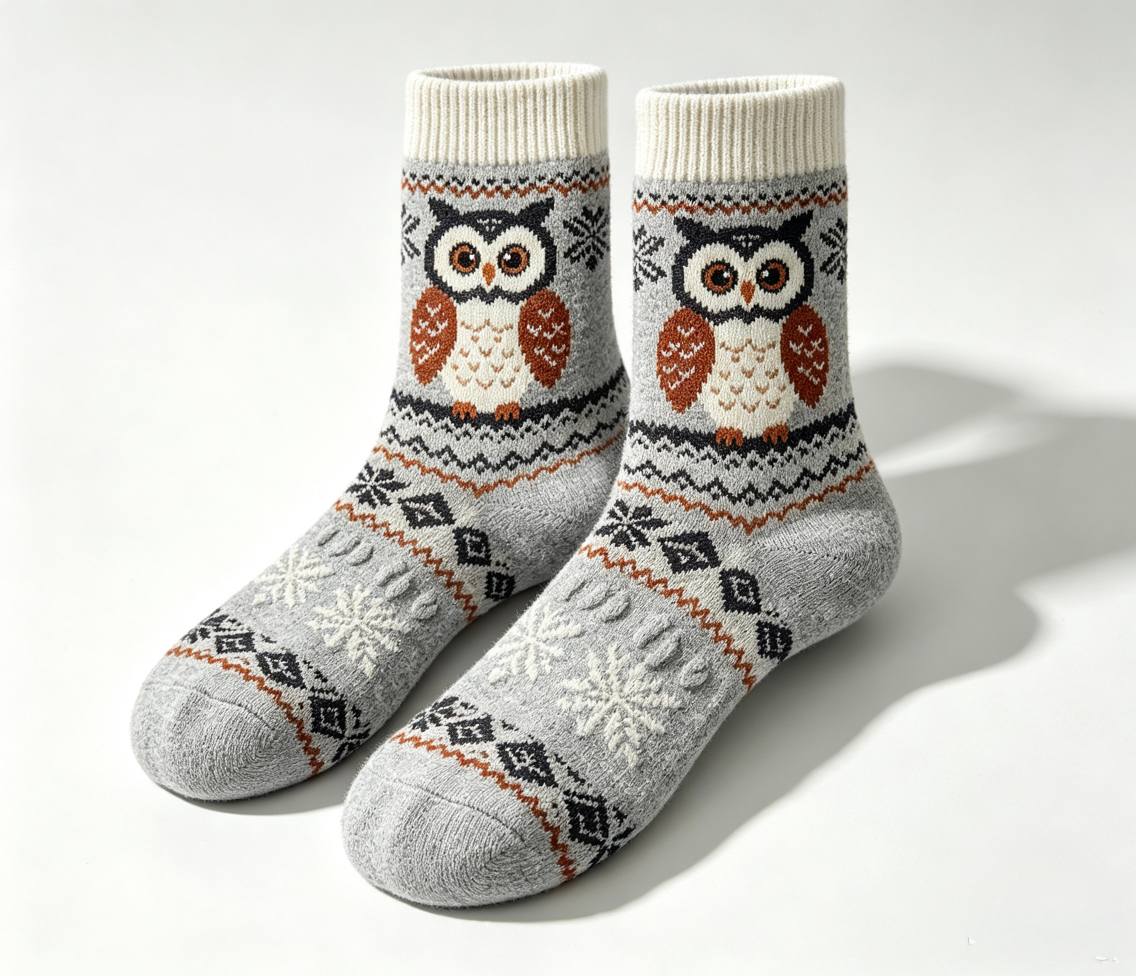
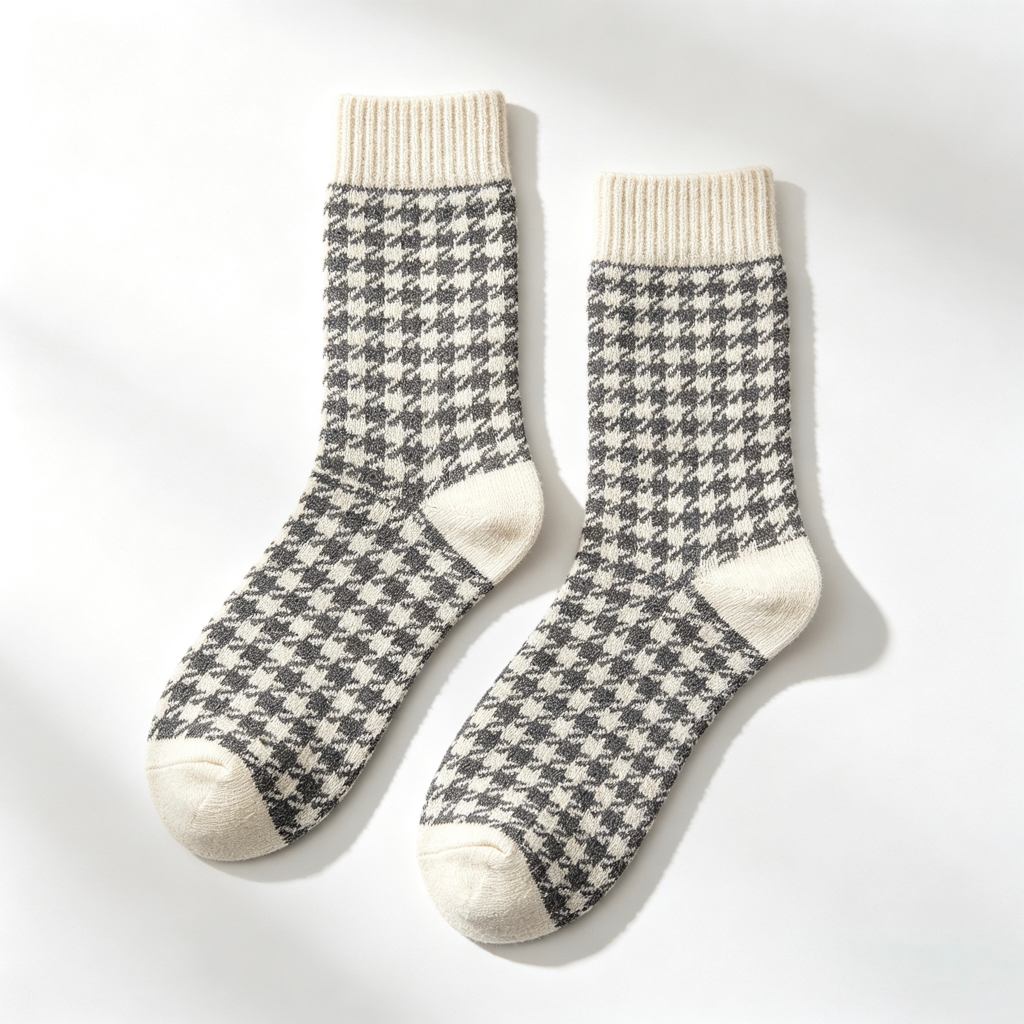
A jacquard order goes wrong in one of two ways. Either the sample is beautiful and the bulk is inconsistent, or the sample takes four rounds because the spec was never complete. Both are preventable, and both are prevented by the same document: a tech pack that answers every question a knitting machine asks.
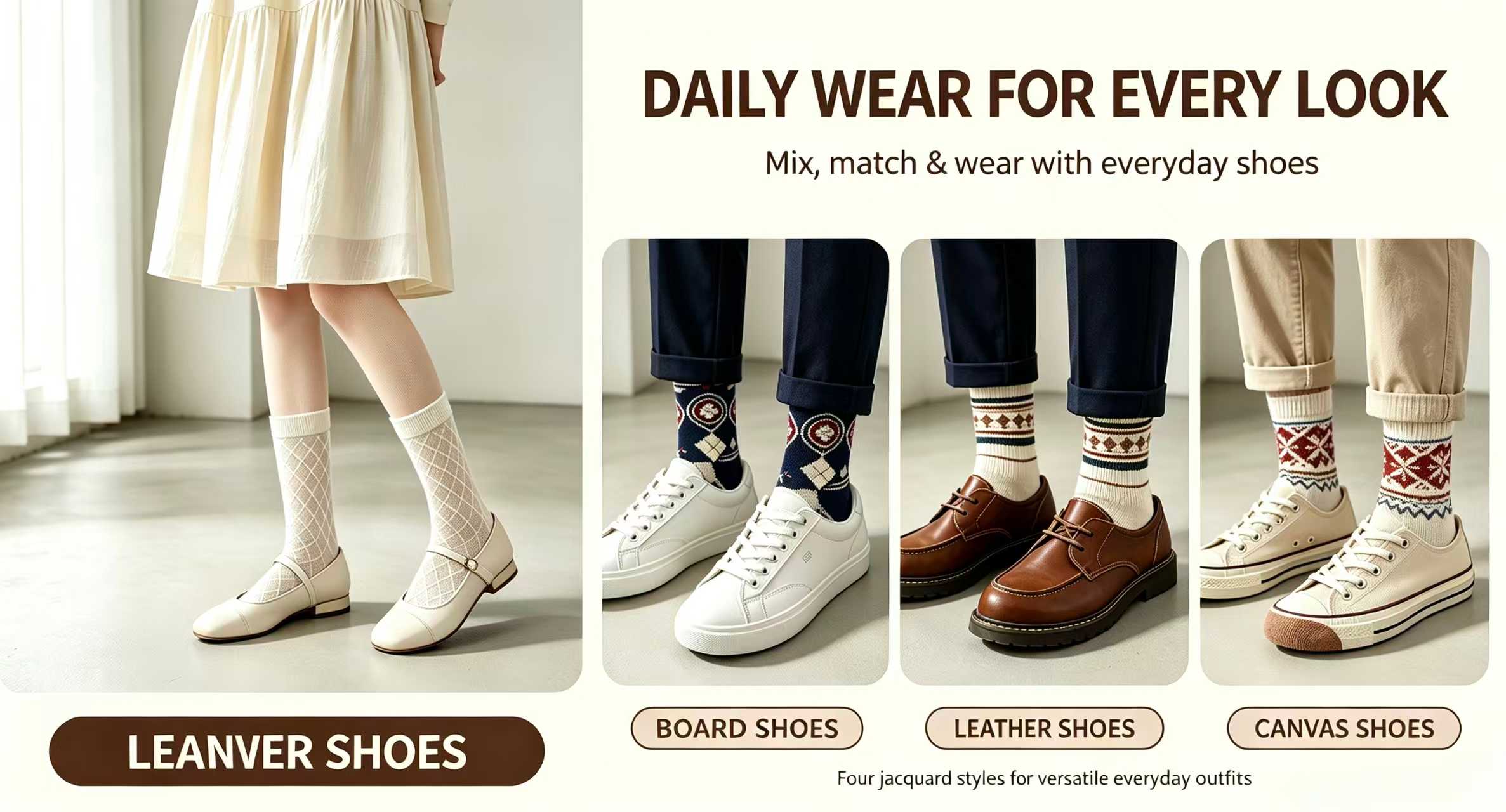
Here is what that document needs to contain.
Every specification in this guide is adjustable through custom knitted pattern socks, from yarn and gauge to cushioning and packaging.
H2 Yarn and Blend
Name the fibre and the ratio, not “cotton-rich”. A workable spec reads: 75% combed cotton, 22% polyamide, 3% elastane. If you want mercerised, organic or recycled content, say so here, because changing it later invalidates the sample.
Also specify the ground colour by reference, not by description. “Navy” covers a wide range, and the difference is obvious when the second order arrives.
H2 Gauge and Weight
Gauge is needle count — 144N, 168N, 200N — and it sets both the fineness of the fabric and the maximum yarn count. Choosing gauge by feel is legitimate; choosing it by guesswork is not.
Ask for a swatch at two gauges if you are unsure. It is the cheapest way to settle a question that otherwise resurfaces as “the socks are too thin” after five thousand pairs are made.
H2 Colour Count and Placement
State the number of colours in the pattern, name each one, and state whether the design is all-over or placement. If placement, give the position and the distance from the cuff edge in centimetres.
This is also where you confirm that the pattern does not cross the sole. If it must, specify a plated ground yarn.
H2 Reinforcement and Construction
Specify heel and toe reinforcement, cushioning level if any, and the toe closing method. For patterned socks we recommend a linked toe, because it keeps the motif aligned across the seam and gives a flat finish.
If the sock has a function — grip dots, compression, cushioning — that is a separate specification with its own testing, and it should be written up separately from the pattern.
H2 Size Range and Grading
List every size you are ordering and the split across sizes. A common first-order mistake is an even split; in practice M and L usually account for the majority of adult sales, and an even split leaves you with a surplus of S and XL.
Ask how the motif is handled across the size range. If it is simply scaled, look closely at the smallest and largest samples.
H2 Packaging and Labelling
Header cards, belly bands, printed polybags, hangtags, care labels and size stickers all have minimums and lead times of their own, and they are the most common cause of a shipment that is ready but cannot leave.
Confirm fibre content labelling for your target market. The EU, the US and the UK each have slightly different requirements, and a mislabelled shipment can be held at customs.
H2 Compliance and Testing
Decide which certificates you need before production, not after. OEKO-TEX Standard 100 for chemical safety, GOTS for organic fibre, BSCI or Sedex for social compliance. Each has a cost and a lead time, and each is far cheaper to arrange at the start.
H2 Questions to Ask the Factory
How many needles are your machines? How many feeders per pattern? How do you handle floats beyond five needles? What is the sampling lead time and how many revision rounds are included? What is the MOQ per design and per colourway? What happens to the setup cost if I reorder the same design?
A manufacturer with real jacquard capability answers all of these immediately and in specifics. A trading company answers them vaguely.
How to Buy Jacquard Socks Wholesale picks up where this article leaves off.
FAQ
Q: What is a realistic MOQ for a custom jacquard design? A: Typically 300–500 pairs per design per colourway. Lower minimums are possible on simpler constructions but carry a meaningful unit-price premium.
Q: Should I order samples before bulk? A: Always, and in the full size range. A jacquard pattern behaves differently at the extremes of the size run.
Q: How much does setup cost? A: It varies with colour count and machine time. Ask for it as a separate line item so you can see exactly what a reorder saves.
CONCLUSION
The more completely you specify the sock, the faster the sample and the closer the bulk. Ten minutes on a tech pack is worth ten days in the sampling queue.
When you are ready to produce, Sockmader’s custom jacquard socks team covers sampling, MOQ and lead times in one place.