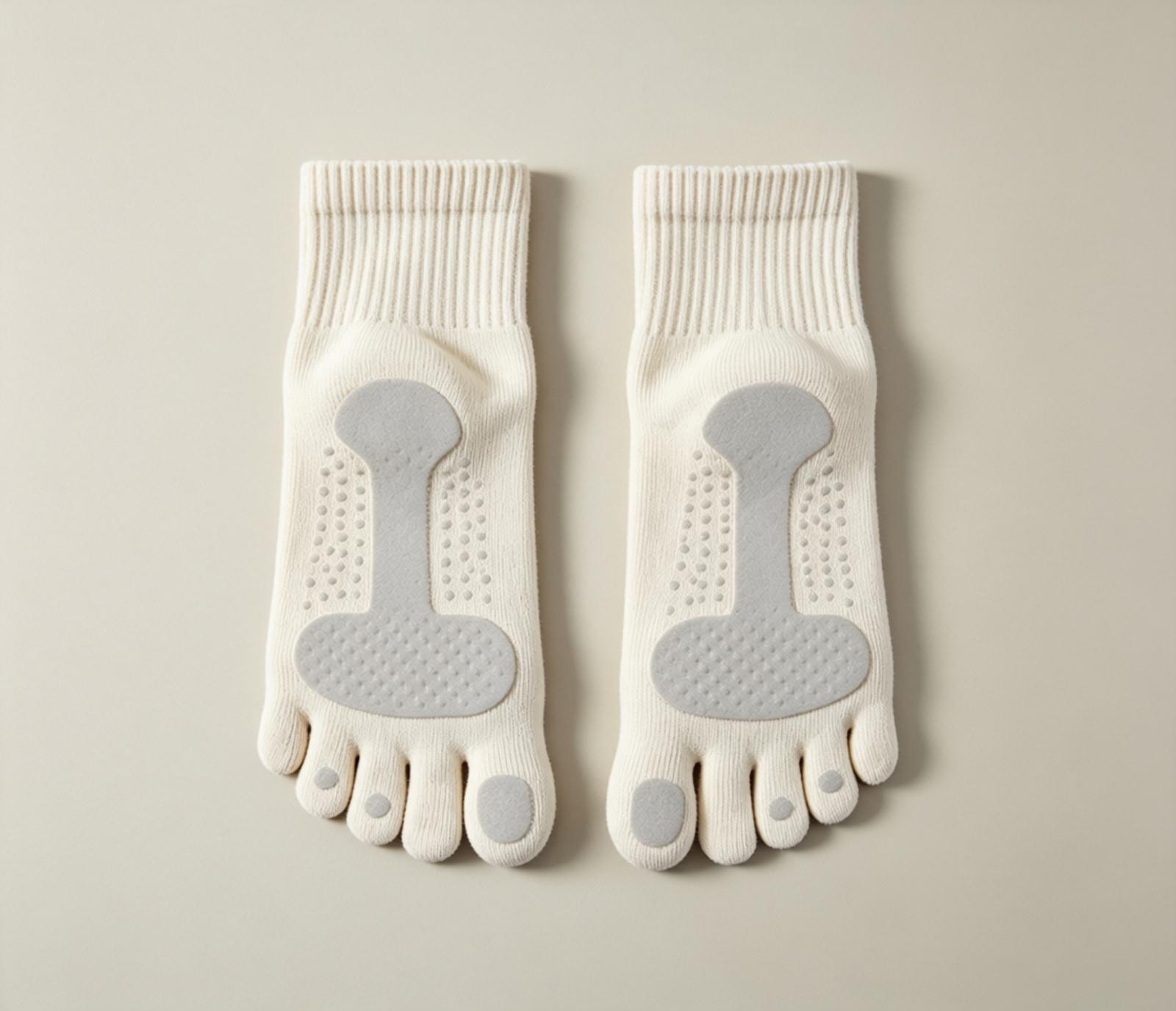
custom grip socks looks like a simple purchase until you try to specify one. Two orders with the same name can differ in yarn, needle count, cushion structure and finishing, and end up at very different prices. This page is written for buyers who already know they want the product and now need the parameters behind it. Full route: custom grip socks.
Short answer: for anyone searching custom grip socks, MOQ starts at 50 pairs per design, sampling takes 3-7 days and bulk production takes 5-25 days. People who look this up want the specification and the commercial terms settled before asking anyone for a quote, so below I have kept it to the parameters, the cost structure and the calendar rather than product adjectives.
The single most useful thing you can do before contacting a factory is write down grip material, grip pattern and wash durability. Almost every delay traces back to that being left vague.
On this page:
- What the price per pair is actually made of
- Minimum order: what actually sets the number
- Timeline, stage by stage
- Who buys anti-slip socks, and what each one actually needs
Related terms in the same decision: grip socks wholesale; custom grip socks manufacturer; custom non-slip socks.
Nearly every sourcing dispute traces back to a spec that was never written down. Put these on your enquiry sheet and most of the risk disappears.
| Spec | What to write | Why it matters |
|---|---|---|
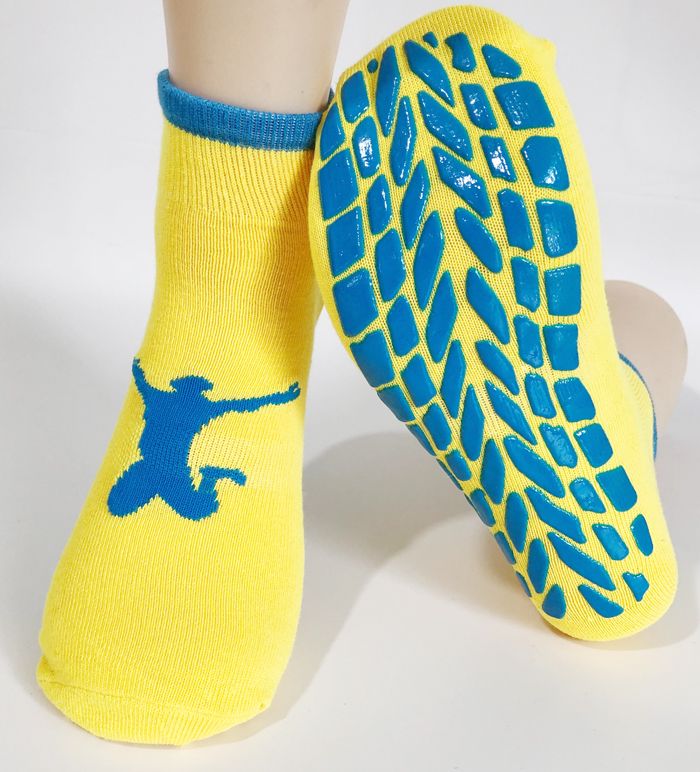
| Grip material | Silicone as the default, PVC or hot-melt as alternatives. | Silicone survives washing, PVC is cheaper but fails sooner. |
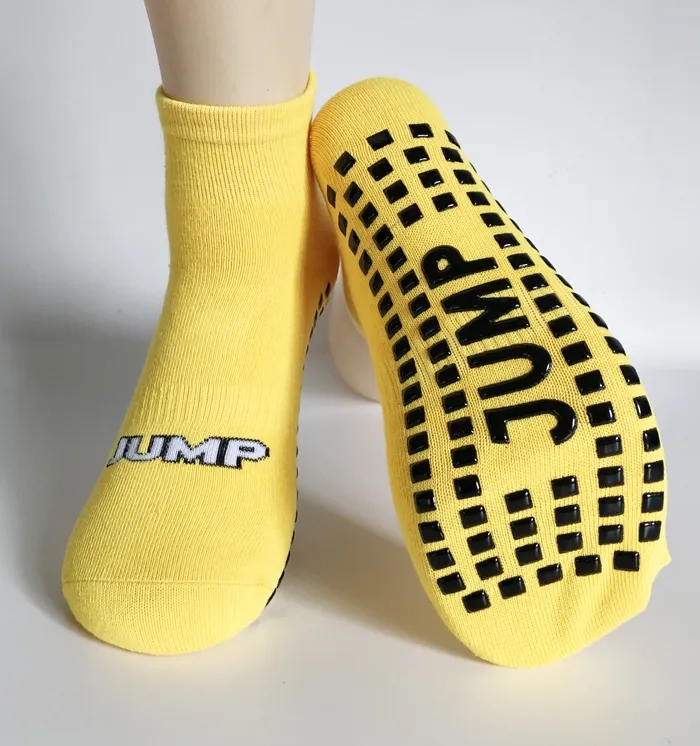
| Grip pattern | Dots, stripes, full coverage or a logo shape. | Coverage changes how grippy the sock feels. |
| Wash durability | Specify no loss after 20 washes. | The single most common complaint in this category. |
Two more that buyers forget: the needle count and the toe closure. 84N-96N coarse gauges serve terry and heavy socks, 108N-120N is the workhorse for everyday styles, 144N-168N carries fine jacquard and athletic structure, and 200N tops the range for dress socks and very fine jacquard. There are three toe closures: standard overlock, the cheapest and the one that leaves a seam ridge; Rosso linking, which is substantially flat; and hand-linked seamless, the most comfortable and the most expensive per pair. Related reading: custom sock manufacturer.
What the price per pair is actually made of
Prices go stale; structure does not. This is the split to negotiate against.
- Yarn, 35 to 50 percent of the total. The dominant line. Combed cotton 78% / nylon 19% / elastane 3% – Soft, absorbent and easy to print dots on.; Polyester / cotton blend – Dimensionally stable, holds shape after washing.; Bamboo blend – The handfeel yoga channels prefer.
- Knitting and labour, 20 to 30 percent. Set by gauge and structural complexity.
- Artwork and setup, 5 to 15 percent. Programming, screens, digitising – a fixed cost, which is exactly why small orders carry a higher unit price.
- Finishing, pairing and packing, 8 to 12 percent. Washing, boarding, pairing, tags, cartons.
- QC, overhead and margin, the remainder.
The worst place to save money on anti-slip socks is the grip material: switching to PVC saves a little per pair and costs far more in returns and complaints.
A useful rule: discounts come from amortising setup cost, not from secretly cheaper yarn. Ask which line moved. The commercial route is explained on white label socks.
Minimum order: what actually sets the number
MOQ is not a policy number a factory invents. It is the point at which machine set-up, yarn minimums and finishing labour stop losing money, and that point moves with construction.
| What changes | How MOQ moves |
|---|---|
| Number of colours in one design | each extra colourway is a separate knitting run |
| Whether yarn comes from stock or is dyed | custom dyeing carries a mill minimum per shade |
| Technique | jacquard and complex structures need longer machine programming |
| Size range | each size block is knitted and paired separately |
| Packing | retail-ready packing has its own minimum per carton |
A first order close to the minimum is a legitimate way to test quality and communication before committing volume – most programmes start there. Terms and sampling rules are set out on white label socks.
Timeline, stage by stage
| Stage | Duration | What happens |
|---|---|---|
| Enquiry and quotation | 1 to 3 days | spec sheet confirmed, yarn availability checked |
| Sampling | 3 to 7 days | programming, trial knitting, finishing, sample shipped |
| Sample revision | 2 to 4 days per round | each change restarts part of the loop |
| Bulk production | 5 to 25 days | knitting, closing, washing, boarding, inspection |
| Packing and export | 3 to 7 days | pairing, packing, cartons, documentation |
| Shipping | 3 to 45 days | A full sea container takes roughly 30-40 days to the US West Coast and 35-45 days to major European ports. Air freight takes 5-8 days but usually costs four to six times the sea rate per unit, and courier shipments for small trial orders arrive in 3-5 days. |
The biggest avoidable delay is a vague sample brief. Every clarification round costs three to five days. Process detail is documented under sock fabrics.
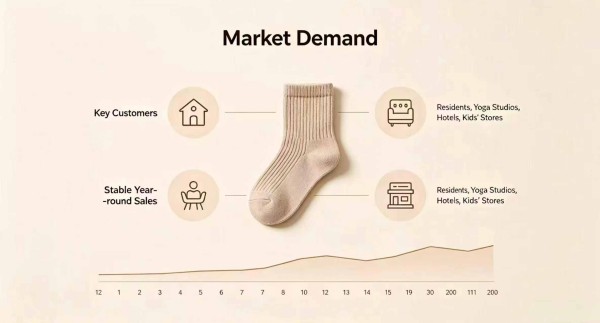
Who buys anti-slip socks, and what each one actually needs
| Buyer type | What they push on |
|---|---|
| Hospitals and rehabilitation providers | Wash durability and batch-to-batch consistency. |
| Yoga and Pilates studios | Handfeel and appearance. |
| Baby and toddler brands | Softness plus safety compliance. |
Notice that the three profiles optimise for different things. A buyer optimising for unit price and one optimising for compliance will not accept the same spec — decide which one you are selling to before you ask for a quote. Compare adjacent categories here: custom no-show socks.
The numbers to put in your enquiry
Copy this block into your first email. It is the difference between a real quote and a placeholder.
| Line | Your value | Why the factory needs it |
|---|---|---|
| Yarn composition | e.g. Combed cotton 78% / nylon 19% / elastane 3% | Sets the largest single cost line |
| Gauge | 108N-168N | Determines knitting time and machine availability |
| Sizes needed | foot length in cm plus quantities | Sizing drives grading and waste |
| Artwork route | jacquard, print or embroidery | Each route carries a different setup minimum |
| Quantity per design | including per colour | Sets where you land on the price ladder |
| Target in-stock date | a real calendar date | Lets the factory quote honestly or decline |
Two lines are most often left blank, and they are the ones that cause the most trouble: the per-colour quantity and the real in-stock date. Without the first, MOQ is quoted per design and your order may not qualify; without the second, nobody can tell you the truth about capacity. Reference route: custom grip socks.
Where this decision actually sits in the buying process
Most programmes move through the same four gates, and each one has its own failure mode.
| Gate | The decision | What usually goes wrong |
|---|---|---|
| Concept | Is anti-slip socks right for the range at all | Buyers commit before checking whether the channel wants it |
| Specification | Writing down what is actually being made | Vague briefs turn into repeated sample rounds |
| Supplier | Choosing who makes it | Comparison without a written spec is meaningless |
| Commitment | Quantities, dates, payment | Freight and lead time discover the date has already passed |
Work out which gate you are actually at before asking for anything else. Most wasted conversations happen because a buyer asks a commitment-stage question while still at the specification gate. Commercial terms start from white label socks.
FAQ
Can the grip be a logo shape?
Yes. Silicone can be formed into a logo, but it needs a screen or mould and carries a one-off cost.
Can we claim a slip-resistance rating?
Describe construction and measured friction data. Avoid fall-prevention or medical claims.
What is the minimum order?
50 pairs per design; logo-shaped grip usually only makes sense from 300 pairs because of the screen cost.
What is the fastest way to get an accurate quote?
Send a specification sheet — yarn composition, needle count, size set, construction, artwork route, quantity and packing. A quote built from that is usually within a few percent of final; a quote built from a photo is not.
Where to go from here
The short version: fix the specification, then the quantity, then the date. Everything else is negotiable; those three are not. If you want the full route, start at custom grip socks and keep custom sock manufacturer open while you write your spec sheet.