Buyers searching for custom compression socks supplier usually want three things settled before they write to anyone: the specification, the minimum and the calendar. Vetting comes down to a short list of questions, and asking them in the first email separates the factories from the trading desks in a single round.
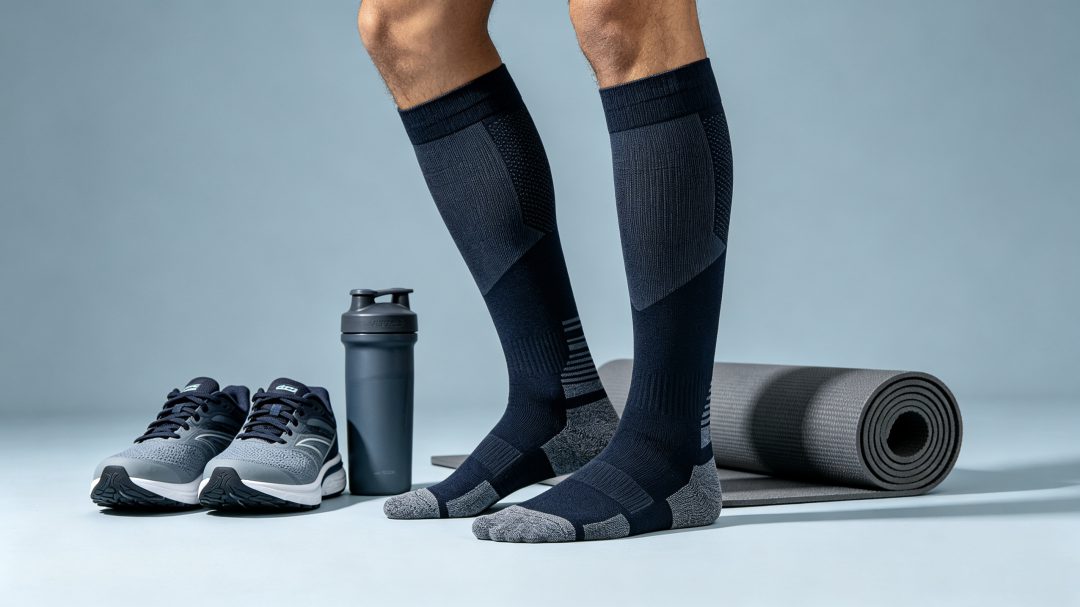
In plain terms: a custom compression socks will usually quote against a minimum of 300 pairs per color, take 3-7 days on samples and 5-25 days on production. Searches like this usually come from buyers who are shortlisting production partners rather than shopping for a single pair, which is why this page goes straight to numbers rather than marketing copy.
Ask three things first: compression level, gradient direction and elastane brand and share. Suppliers who answer all three without coming back for clarification are usually the ones worth shortlisting.
On this page:
- QC: the checks to ask for before the shipment leaves
- How compression socks are made, step by step
- Certificates and reports to request up front
- Minimum per color, and why the number is what it is
Search variants worth knowing about: compression socks wholesale; compression socks manufacturer; custom compression socks manufacturer – they cover the same ground from a different starting point.
QC: the checks to ask for before the shipment leaves
AQL 2.5 is the common default for apparel, and many European and US buyers additionally require zero tolerance for critical defects. AQL 4.0 suits promotional goods, and AQL 1.0 is used for high-value or medical channels. Then the product-specific checks:
| Check | Method |
|---|---|
| Broken elastane | Stretch and inspect against light for exposed yarn. |
| Left and right pairing | Graduated socks with L/R construction must ship as pairs. |
| Measured pressure | Test at ankle, calf and below knee on a pressure tester. |
| Pressure after washing | Re-test after 20 cycles of AATCC 135. |
For the first order, add a pre-production sample and an in-line check. Two checkpoints cost very little compared with finding a defect at final inspection. Process and test references: OEM sock manufacturing.
How compression socks are made, step by step
Understanding the production sequence tells you where delays and defects come from.
1. Yarn preparation. Cones are inspected and, if the programme needs it, dyed to a confirmed shade. Custom dyeing adds 7–14 days and carries a mill minimum.
2. Knitting. Socks are knitted as tubes on circular sock machines. 84N-96N coarse gauges serve terry and heavy socks, 108N-120N is the workhorse for everyday styles, 144N-168N carries fine jacquard and athletic structure, and 200N tops the range for dress socks and very fine jacquard.
3. Toe closing. There are three toe closures: standard overlock, the cheapest and the one that leaves a seam ridge; Rosso linking, which is substantially flat; and hand-linked seamless, the most comfortable and the most expensive per pair.
4. Washing and boarding. Washing removes knitting oils and sets dimensions; boarding (heat-setting on forms) gives the final shape and smoothness.
5. Inspection and pairing. Each pair is checked for defects, matched by size and shade, and paired.
6. Packing. Hang tags, polybags, inner boxes and cartons per the packing specification.
The bottleneck for compression socks is rarely knitting capacity; it is finishing and packing, which is where most schedule slips actually happen. Full process notes: OEM sock manufacturing.
Certificates and reports to request up front
Certificates prove a management system exists; test reports prove a specific batch passed. You generally need both. For compression socks, request:
- OEKO-TEX Standard 100
- ISO 13485 for medical channels
- SGS pressure test report
Match the certificate to the channel, not to a checklist. A promotional giveaway and a pharmacy listing do not need the same paperwork, and over-buying tests is as wasteful as under-buying. Commercial terms and compliance handling: socks wholesale.
Minimum per color, and why the number is what it is
Buyers often treat MOQ as a negotiating position. It is not: it is arithmetic done by the production planner. Three costs have to be covered before the first pair is worth knitting.
- Machine programming and set-up. Fixed per design, regardless of how many pairs follow.
- Yarn minimum. A dyelot has a floor, which is why custom shades raise the entry point.
- Changeover labour. Every swap of yarn, needle setting or programme costs machine hours.
The standard minimum is 300 pairs per color. What shapes the order is not the design but the way it is split: each colourway is its own production run, and each size block is knitted and paired separately.
If you are unsure about size split, ask how the 300 pairs are distributed across sizes within one colourway; that is the number that actually constrains the order. Terms and sampling rules are set out on socks wholesale.
Where this decision actually sits in the buying process
Most programmes move through the same four gates, and each one has its own failure mode.
| Gate | The decision | What usually goes wrong |
|---|---|---|
| Concept | Is compression socks right for the range at all | Buyers commit before checking whether the channel wants it |
| Specification | Writing down what is actually being made | Vague briefs turn into repeated sample rounds |
| Supplier | Choosing who makes it | Comparison without a written spec is meaningless |
| Commitment | Quantities, dates, payment | Freight and lead time discover the date has already passed |
Work out which gate you are actually at before asking for anything else. Most wasted conversations happen because a buyer asks a commitment-stage question while still at the specification gate. Commercial terms start from socks wholesale.
The numbers to put in your enquiry
Copy this block into your first email. It is the difference between a real quote and a placeholder.
| Line | Your value | Why the factory needs it |
|---|---|---|
| Yarn composition | e.g. Nylon 75-80% / elastane 20-25% | Sets the largest single cost line |
| Gauge | 168N-200N fine gauge | Determines knitting time and machine availability |
| Sizes needed | foot length in cm plus quantities | Sizing drives grading and waste |
| Artwork route | jacquard, print or embroidery | Each route carries a different setup minimum |
| Quantity per color | including the size split | Sets the unit price you are quoted |
| Target in-stock date | a real calendar date | Lets the factory quote honestly or decline |
Two lines are most often left blank, and they are the ones that cause the most trouble: the per-colour quantity and the real in-stock date. Without the first, the MOQ is quoted as one figure and your order may not qualify; without the second, nobody can tell you the truth about capacity. Reference route: custom compression socks.
FAQ
What is the minimum order?
Standard MOQ is 300 pairs per color. Because compression needs machine set-up and testing, a first order above the per-colour minimum spreads that cost sensibly.
Can you provide a pressure test report?
Ask before you place the order. Testing adds cost and time and is quoted separately.
Does the pressure disappear after washing?
A good elastane system holds 80% or more of its pressure after 20 washes. Put that in the contract rather than accepting a verbal promise.
What is the fastest way to get an accurate quote?
Send a specification sheet — yarn composition, needle count, size set, construction, artwork route, quantity and packing. A quote built from that is usually within a few percent of final; a quote built from a photo is not.
To place it in context, compare it against sock resources.
Where to go from here
If you take one thing from this: the cheapest quote is usually the one with the loosest spec. Write the spec first and the quotes become comparable. custom compression socks is the place to begin; Sockmader covers the commercial terms.