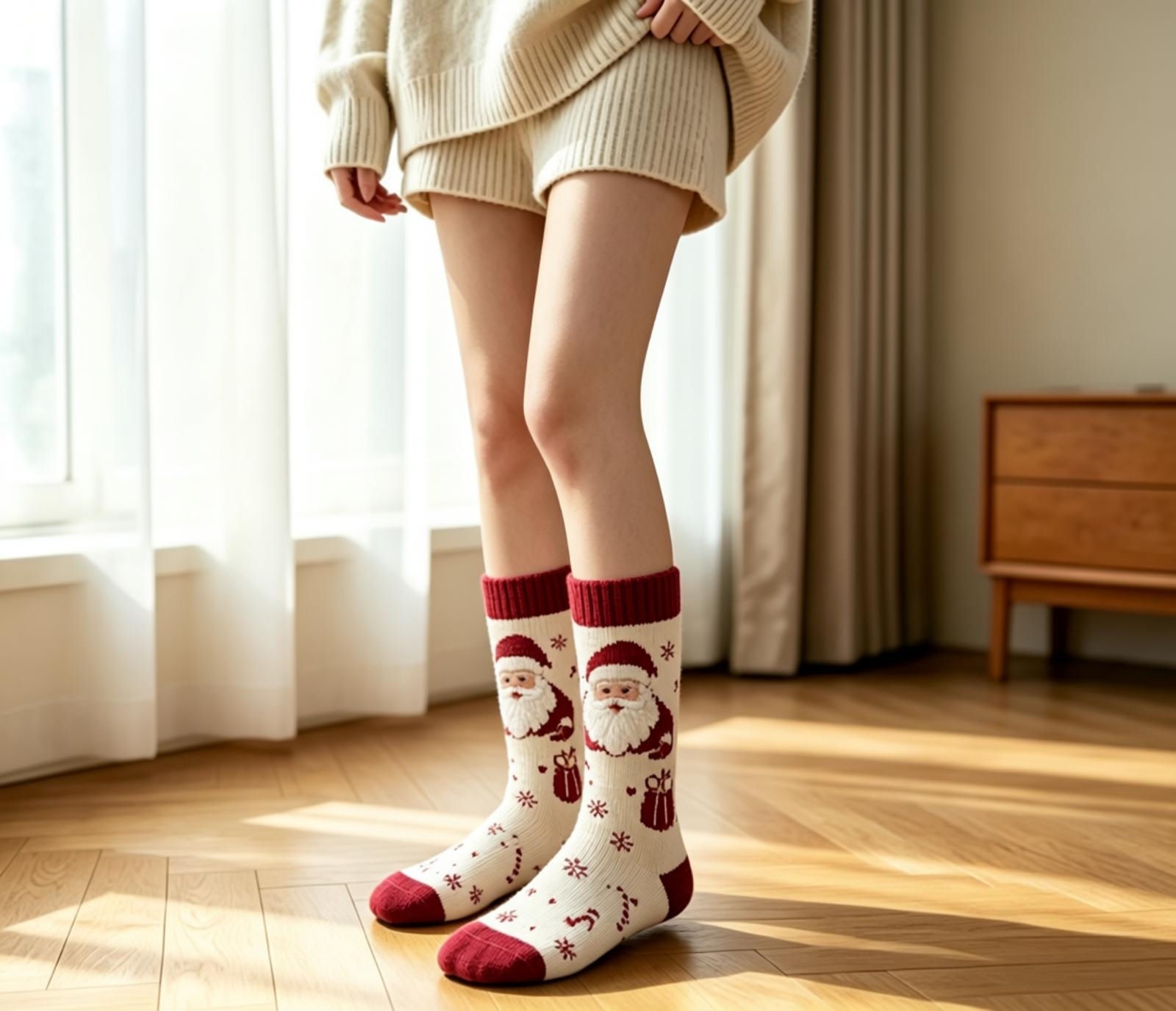
A Christmas socks business looks like the simplest retail idea imaginable — until you meet its defining constraint: you earn most of your annual revenue in about six weeks. Businesses that respect that constraint are remarkably profitable year after year; businesses that don’t are liquidating stock in January. Having watched the category from the manufacturing side, here is the playbook for building one that works.
Sampling, production and retail packaging for a first line all run through custom Christmas socks.
Choose Your Lane
The category supports several distinct business models. A curated seasonal brand designs or sources an exclusive assortment and sells direct-to-consumer through its own store and marketplaces. A corporate gifting operation sells branded festive socks to companies — larger orders, earlier season, extremely repeatable. A boutique/wholesale reseller curates other brands’ Christmas lines for gift shops and local retail. And content-led businesses (subscription boxes, holiday gift guides with affiliate commerce) monetize the season’s search traffic without holding much inventory. Each lane has different capital needs — pick one and resist doing all four in year one.
The Economics of a Seasonal Six-Week Business
Plan the year backwards from the season. Roughly 60–75% of revenue lands between late October and mid-December, with the corporate gifting slice arriving in October and early November. That means: inventory committed by summer, marketing content built in September, and cash flow managed so that January (your inventory-heavy low month) doesn’t kill a business that just had its best six weeks. Experienced operators keep fixed costs minimal in the off-season — that’s when design, supplier development, and next year’s assortment planning happen.
Build the Assortment Like a Merchant
Winning Christmas sock assortments are structured, not random: one or two hero designs to carry marketing and social sharing, a base of classic patterns (fair-isle, snowflake, reindeer) that conservative gift buyers trust, one value multipack for stocking-stuffers, and one premium gift-boxed set to lift average order value. Family matching sets reliably multiply basket size. A tight assortment of 8–15 SKUs beats a sprawling 40-SKU catalog in both inventory risk and marketing clarity — every extra SKU is a bet, and seasonal bets are settled fast.
Source With the Calendar
Production for Christmas is booked in spring; the best factories’ seasonal capacity fills by early summer. First-time founders typically start with private-label programs (factory designs with your branding and packaging) at approachable MOQs, then move hero designs to fully custom knitting in year two once sell-through data identifies what customers actually want. Order roughly 70% of forecasted demand pre-season, hold a fast reorder agreement for November replenishment, and pre-plan your January markdown channel — the discipline that separates healthy margins from a warehouse of regrets.
Marketing: Ride the Existing Wave
The beautiful thing about this business is that demand arrives on schedule. Search interest for Christmas socks climbs from late September and explodes from mid-November — your job is to be present with content when it does. Start posting and building gift-guide placements in October, activate paid ads from early November, and lean into the category’s natural viral moments: matching-family photos, stocking-stuffer guides, workplace “Secret Santa” content. Gift bundles and free-gift-with-purchase mechanics reliably lift AOV during the peak, when purchase intent needs no convincing.
Corporate Gifting: The Underrated Channel
Companies buy holiday gifts for employees and clients in volume, order early, and re-order annually if the product lands well. A simple corporate offer — branded or curated sock gift boxes with custom cards, ordered in quantity — can anchor an entire season’s revenue with far lower marketing cost than consumer sales. Approach HR departments and office managers from late September through October; procurement happens before consumer shopping starts.
We go deeper on How to Design Christmas Socks in a separate guide.
FAQ Q: How much capital does a Christmas socks business need to start? A: A focused D2C launch with a 10-SKU assortment, custom packaging and professional imagery can start in the low tens of thousands of dollars; reseller models start lower. Q: When should a first-time founder place production orders? A: Confirm designs and place orders by May–June for sea freight delivery in September; later ordering means air freight costs or leftover risk. Q: What happens to unsold stock after December? A: Plan markdown partners in advance — outlet channels, post-holiday bundles, corporate giveaway pricing — because eleven months of storage is the most expensive way to “save” inventory.
CONCLUSION
A Christmas socks business is really a timing business with a product attached. Choose one lane, build a structured assortment, respect the calendar, and line up corporate buyers alongside consumer demand — do those four things and the season’s six weeks will fund a business that grows every year, exactly on schedule.
When you are ready to produce, Sockmader covers sampling, MOQ and lead times in one place.
Start your next order with custom christmas socks from Sockmader — send artwork, size range and target quantity for a quote.