custom cotton socks wholesale is better understood as a specification range than as a product. What you receive depends almost entirely on what you write down first. This guide goes through the numbers worth confirming before you contact anyone, starting with custom cotton socks wholesale.
If you landed here by searching custom cotton socks wholesale, you are probably one of two people: someone building a buying brief, or someone checking whether a quote already received makes sense. Either way the reference points are the same – MOQ of 300 pairs per color, 3-7 days to sample, 5-25 days to produce – because buyers who are usually building a resale or distribution programme, not buying for personal use all run into the same four cost lines.
Note those down with cotton type, nylon share and shrinkage before you send anything out.
On this page:
- 4 mistakes buyers make with cotton socks
- Four things that decide your unit price
- QC: the checks to ask for before the shipment leaves
- Sizing the first order
Related terms in the same decision: wholesale cotton socks; cotton socks manufacturer; custom cotton socks.
4 mistakes buyers make with cotton socks
1. Not distinguishing combed from carded
Why it happens: Pilling differs a great deal.
What to do instead: Write ‘combed’ into the contract.
2. Ignoring shrinkage
Why it happens: Socks arrive smaller after the customer washes them.
What to do instead: Set a shrinkage limit and pre-compensate the size.
3. No transaction certificate for organic cotton
Why it happens: GOTS needs the TC to travel with the goods.
What to do instead: Confirm TC availability before ordering.
4. Insisting on 100% cotton
Why it happens: No stretch, no durability, loses shape.
What to do instead: The standard ratio is 80/17/3.
A useful test: if you cannot point to where each of these is addressed in your spec sheet, the spec sheet is not finished. The commercial terms that prevent most of them: custom socks wholesale.
Four things that decide your unit price
Every quote you receive for cotton socks comes back to the same four variables.
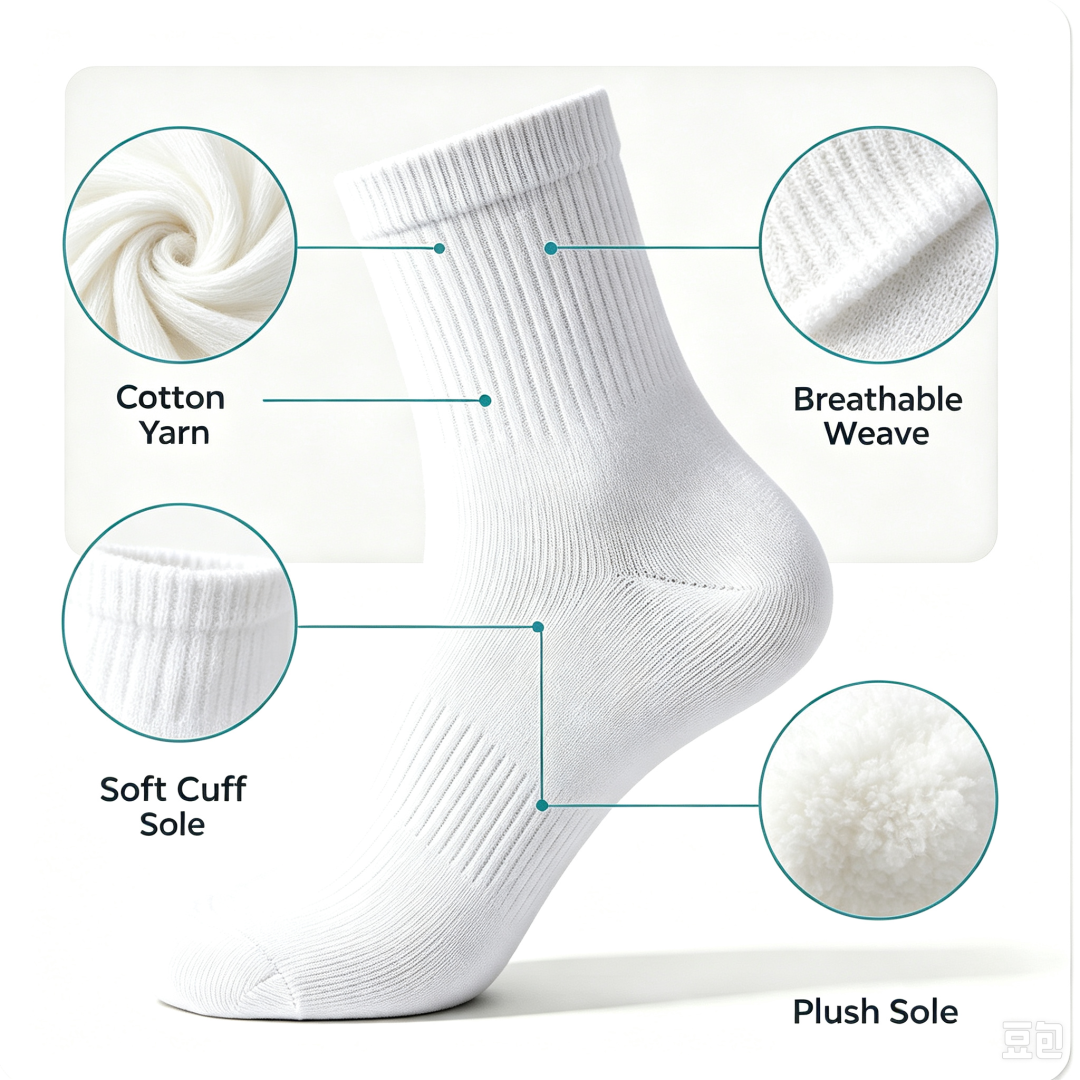
1. Fibre system. Mercerised cotton – Lustre and reduced pilling.; Combed cotton 80% / nylon 17% / elastane 3% – The balance of handfeel and service life.; Organic cotton with GOTS certification – Required for organic channels, needs a transaction certificate.
2. Construction time. Higher gauges knit more loops per pair, and every added zone, band or colour slows the machine down further. This is usually 20 to 30 percent of what you pay.
3. Fixed setup cost. Programming, screens and machine changeovers are charged per design, not per pair. This is why the first step up from the minimum moves the price far more than doubling an already large order.
4. Everything after knitting. Washing, boarding, pairing, labels and cartons add another 8 to 12 percent and are frequently forgotten in comparisons.
Yarn is the price anchor in cotton socks. Combed versus carded and organic versus conventional flow straight through to unit price, so there is little room to negotiate it away.
Ask for the quote broken into those lines. A supplier who can split it will; one who cannot usually has not costed it. The commercial route is explained on custom socks wholesale.
QC: the checks to ask for before the shipment leaves
AQL 2.5 is the common default for apparel, and many European and US buyers additionally require zero tolerance for critical defects. AQL 4.0 suits promotional goods, and AQL 1.0 is used for high-value or medical channels. Then the product-specific checks:
| Check | Method |
|---|---|
| Shrinkage | AATCC 135. |
| Pilling grade | Pilling box test. |
| Colour fastness | To washing and to rubbing. |
| Fibre composition | Third-party fibre content test. |
Agree in writing what happens to rejected goods: rework, replacement or credit. Without that clause, an inspection report is just a document. Process and test references: OEM sock manufacturing.
Sizing the first order
There is no advantage in ordering more than you can sell through, and no advantage in ordering less than the factory can schedule cleanly. The useful question is what the first order is for.
| Purpose | Sensible first order | Why |
|---|---|---|
| Quality and communication test | close to the minimum | you are buying information, not margin |
| Live launch with a known sell-through | one to three months of cover | avoids a forced reorder mid-season |
| Seasonal or gift programme | full season cover in one run | colours and yarn lots will not match later |
The standard minimum is 300 pairs per color. Ask separately about the size split within a colourway, because a supplier who answers with a single figure is usually quoting a stock item.
Seasonal and highly constructed styles carry a higher minimum for a simple reason: the machine spends longer being set up than it does knitting. Terms and sampling rules are set out on custom socks wholesale.
FAQ
What certification does organic cotton need?
GOTS certification plus a transaction certificate for each batch. Only the TC proves that particular batch was organic.
What is the minimum order?
300 pairs per color; organic yarn depends on the mill minimum, so ask for it separately.
How long is sampling?
3-7 days, plus yarn lead time for organic.
What is the fastest way to get an accurate quote?
Send a specification sheet — yarn composition, needle count, size set, construction, artwork route, quantity and packing. A quote built from that is usually within a few percent of final; a quote built from a photo is not.
Buyers comparing this usually open sock resources next.
Where to go from here
Ready to move? Put the spec sheet together first — yarn, needle count, sizes, construction, artwork, quantity, packing. Then custom cotton socks wholesale and Sockmader will get you a number you can plan against.