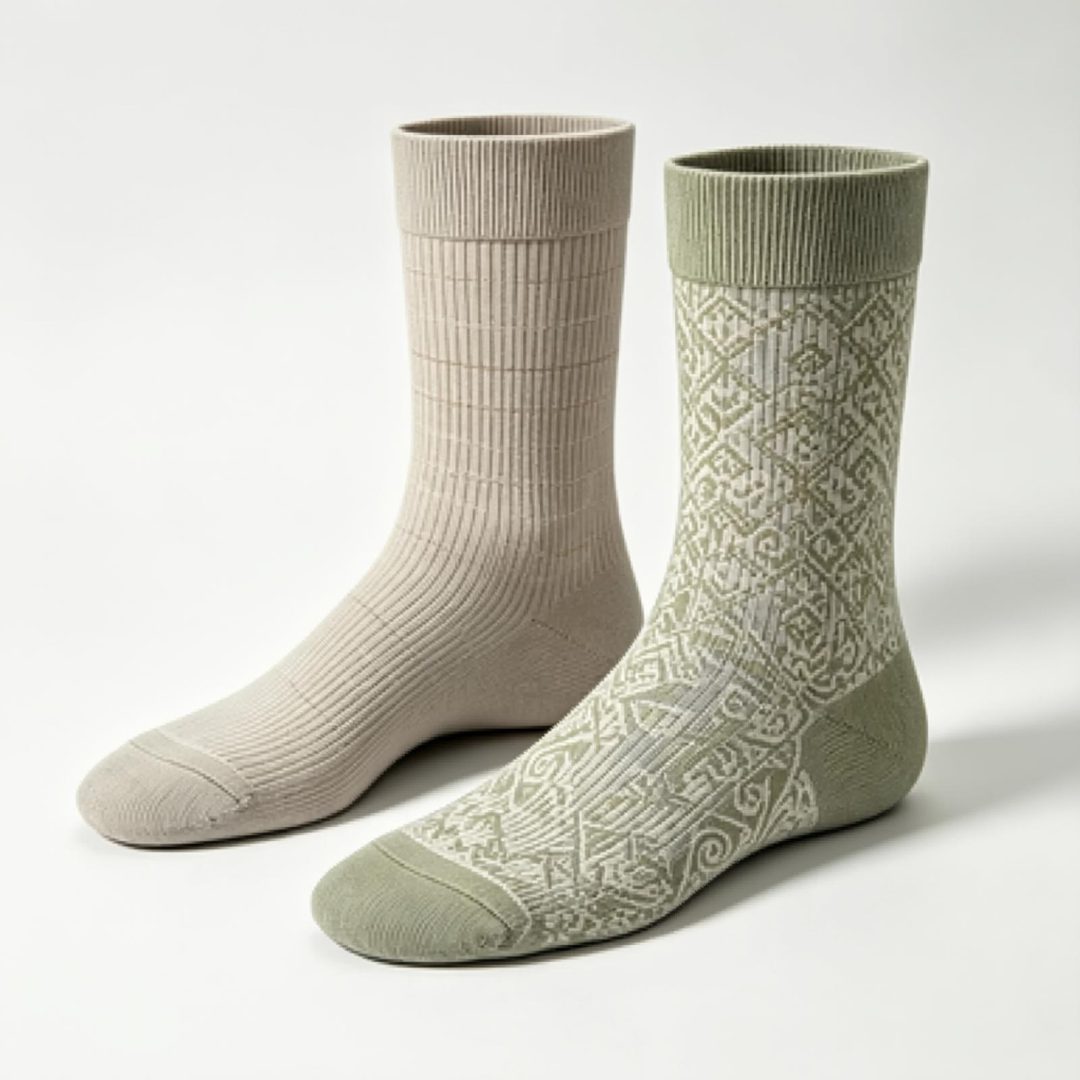
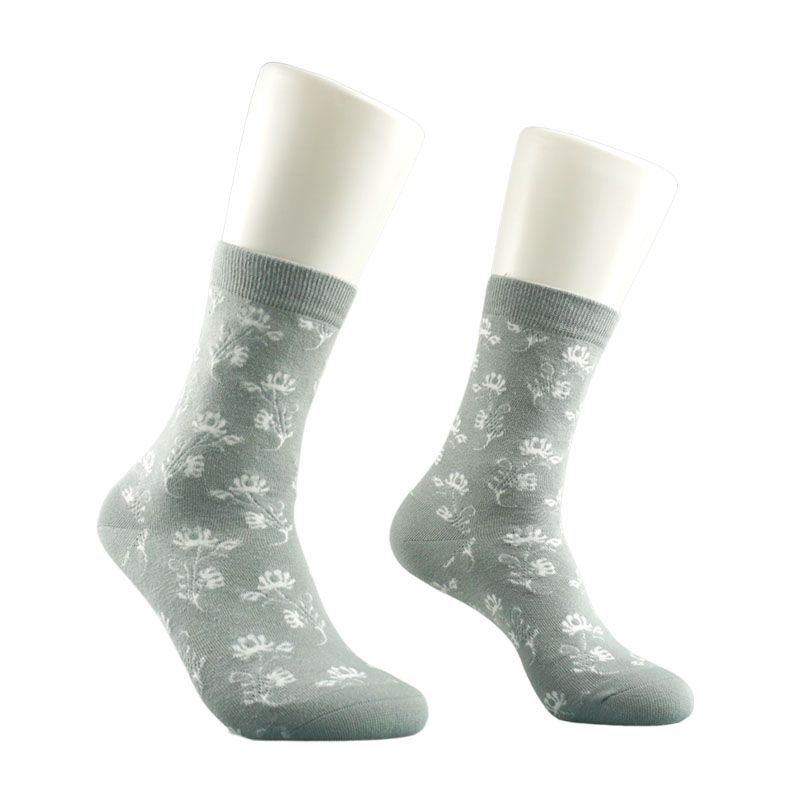
Dress sock design is a discipline of subtraction. There is no cushioning to shape, no large sole area to print on, and no cuff wide enough for an obvious logo. What is left is a narrow band of visible fabric between the shoe and the trouser hem, and the design has to work in that space at a scale most designers initially get wrong. The three decisions that matter are gauge, pattern scale and colour count, and they are tightly interdependent.
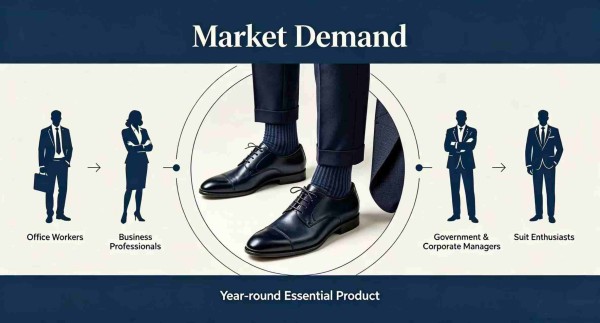
Every idea below can be produced through custom dress socks, including jacquard, printing and retail-ready packaging.
Choose the Gauge First Gauge sets everything else. At 168N the knit is fine but still forgiving, taking a four-colour pattern without trouble. At 200N — the quality standard — the surface is smooth enough for tailoring and takes three colours comfortably. At 240N and above you are in luxury territory, where patterns must be simpler and yarns must be long-staple and strong. Choose the gauge from the price point and the intended yarn, then design within its limits rather than the other way round.
Pattern Scale: Smaller Than You Think A pattern that looks correct on a screen or on a crew sock will look clumsy at dress-gauge on a leg. The visible area is small, the knit is fine, and the fabric curves. As a working rule, halve the pattern scale you would use on a casual sock. Micro-dots at 3 to 5 mm, diamonds at 8 to 12 mm, and stripes at 5 to 8 mm all read clearly. Large argyle, which works on a chunky country sock, becomes a mess at 200N.
Place Patterns Where They Are Seen The only part of a dress sock reliably visible is the front of the shin, from the shoe to the trouser hem — roughly 15 cm. That is where a pattern belongs. An all-over pattern is wasted on the foot, and a pattern on the sole or the back of the calf is invisible in wear. If the budget only allows a small patterned area, put it on the shin and leave the rest plain. It will look deliberate rather than economical.
Limit the Colour Count Fine-gauge knitting handles fewer colours well, because every additional colour adds yarn floats on the inside of the sock, and long floats catch on toes and reduce stretch. Three colours is comfortable at 200N, four is the practical ceiling, and beyond that you should consider printing instead of knitting. Tone-on-tone — two shades of the same colour — reads as sophisticated and behaves better in production than a high-contrast palette.
Yarn Selection for Fine Gauge Fine-gauge knitting demands long-staple, strong, even yarn. Short-staple cotton produces nep and irregularity that is very visible in a smooth knit. Mercerised cotton, fine merino, silk blends and high-quality filament nylon are the safe choices. Whatever you pick, insist on a knitted swatch at the actual gauge before approving artwork — a yarn that looks right on a cone can knit up disappointingly flat.
Branding Without a Logo Most dress socks carry no visible logo at all. The branding lives in the pattern itself, in a signature stripe, or on a small jacquard mark just below the cuff that only the wearer sees. This is a feature rather than a limitation: a sock that carries the brand through a distinctive repeat pattern is more wearable, and therefore gets worn more, than one with a visible mark.
We go deeper on How to Choose Dress Socks for Your Brand in a separate guide.
FAQ
Q: What gauge should I use for a first dress sock? A: 200N with a mercerised cotton or fine merino blend. It is the recognized quality standard and the easiest to produce well.
Q: How many colours can I use? A: Three comfortably, four at the limit. Beyond that, print rather than knit.
Q: Where should the pattern go? A: The front of the shin, between the shoe line and the trouser hem. Nowhere else is reliably visible.
Q: Can I put a logo on a dress sock? A: Yes, but small and below the cuff. A visible logo undermines the formality that justifies the price.
CONCLUSION
Dress sock design is governed by constraint: a small visible area, a fine knit and a limited colour count. Choose the gauge from the price point, halve the pattern scale you first reach for, put the pattern on the shin, and keep to three colours. Do that and the sock will look considered rather than decorated — which is exactly what a dress sock should be.
When you are ready to produce, Sockmader covers sampling, MOQ and lead times in one place.
Start your next order with custom dress socks from Sockmader — send artwork, size range and target quantity for a quote.