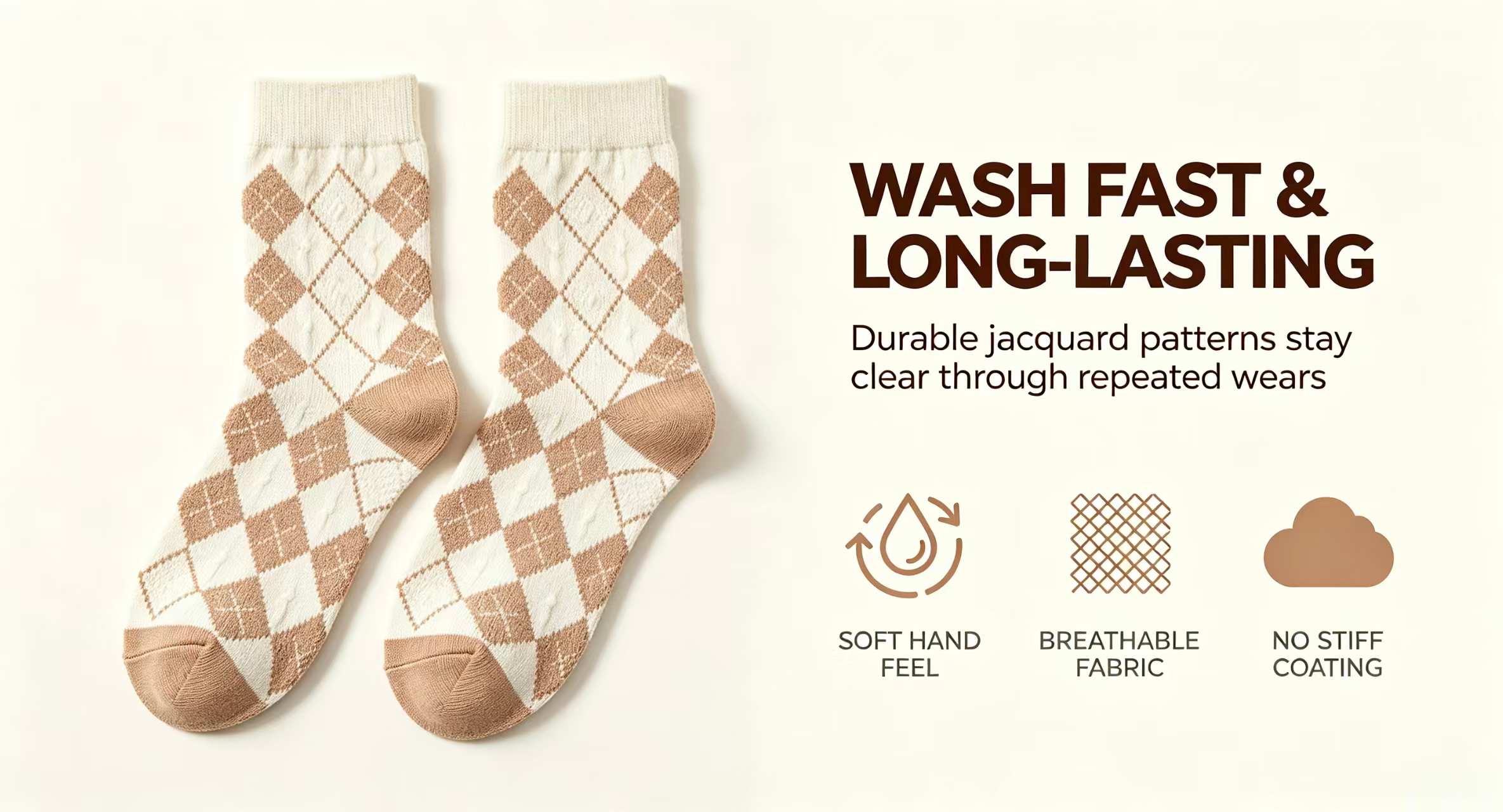
Sourcing jacquard is harder than sourcing plain socks, because the capability gap between factories is much wider. Any plant can knit a plain crew; far fewer can knit a clean four-colour pattern with controlled floats and consistent placement across ten thousand pairs.
This guide is about separating the two before you place a deposit.
Factory audits, certifications, MOQ and lead times for this category are documented on the custom jacquard socks page.
H2 Factory or Trading Company?
Both have a place, but you should know which you are dealing with and pay accordingly. The fastest test is technical rather than administrative: ask what needle counts their machines run, how many feeders a pattern can use, and how they handle long floats.
A factory answers in machine models and stitch counts. A trading company answers in generalities and forwards the question. Neither is dishonest, but only one of them can fix a problem on the floor at short notice.
H2 What to Look For on the Floor
Three areas tell you most of what you need to know. The knitting floor: are the machines maintained, are the yarn feeds tensioned consistently, is there a pattern programming station? The linking and finishing area: is toe closing done in-house or subcontracted? The inspection and packing area: is pairing done by eye under consistent light, and is there a needle-detection step?
The last one is non-negotiable for socks sold into the EU or UK. A metal-detection or needle-detection checkpoint protects both you and the factory, and its absence is a serious flag.
H2 Pattern Capability Audit
Ask for physical evidence, not a portfolio photograph. Request three samples: one with a small motif, one with an all-over repeat, and one with lettering. Turn each one inside out and look at the floats.
Short, tidy floats mean the pattern was engineered. Long, loose floats mean the design was pushed through a machine that was not properly set up, and the socks will snag in the field.
Also check alignment across a pair. Place the two socks side by side and see whether the motif starts at the same distance from the cuff. Misalignment is a programming or boarding issue and it is very visible on a retail hook.
H2 Certifications That Matter
OEKO-TEX Standard 100 covers chemical safety and is the baseline expectation for most Western retailers. GOTS applies if you are claiming organic fibre, and it requires chain-of-custody documentation, not just a yarn purchase.
BSCI, Sedex or WRAP cover social compliance and are increasingly requested by corporate buyers for uniform and gift programmes. Ask for the certificate number and check it, rather than accepting a scan.
H2 Sampling Terms
Clarify before you pay: how many revision rounds are included, who owns the pattern file, and whether the sample fee is credited against the bulk order. A factory confident in its capability usually credits the fee; one that does not is telling you something.
Ask whether the setup is retained. If you reorder the same design in six months, the second run should be materially cheaper because the pattern file and machine settings already exist.
H2 Lead Times and Capacity
A realistic calendar for a first custom jacquard order is 10–14 days for sampling, 3–5 days for approval, 25–35 days for bulk production, plus transit. Factory capacity is tightest from July to October for northern-hemisphere winter programmes, so booking early is worth more than negotiating hard.
H2 Red Flags
Reluctance to show the production floor by video. Sample quality noticeably better than a reference bulk order. Certificates that cannot be verified online. A quote significantly below the market without a clear technical explanation. And a yes to every design request, which usually means the constraints have not been understood.
We go deeper on How to Buy Jacquard Socks Wholesale in a separate guide.
FAQ
Q: Is a trading company always worse? A: No. Good trading companies coordinate packaging, testing and consolidation well. The issue is transparency and response speed, not the business model.
Q: How many samples should I request before committing? A: At least three of your own designs, plus any stock samples of similar complexity the factory can send.
Q: Should I visit in person? A: If the order is large or recurring, yes. If not, a live video walkthrough of the knitting floor is a reasonable substitute.
CONCLUSION
Source jacquard on demonstrated pattern capability, not on price per pair. Look at floats, check alignment, verify certificates, and confirm that the setup is retained for reorders — those four checks will save you far more than a two-cent unit-cost saving.
Ready to price this out? Start with a sample from Sockmader, or send your artwork and target quantity for a quote.
If you are planning your own line, our custom jacquard socks program covers sampling, MOQ and lead times in one place.