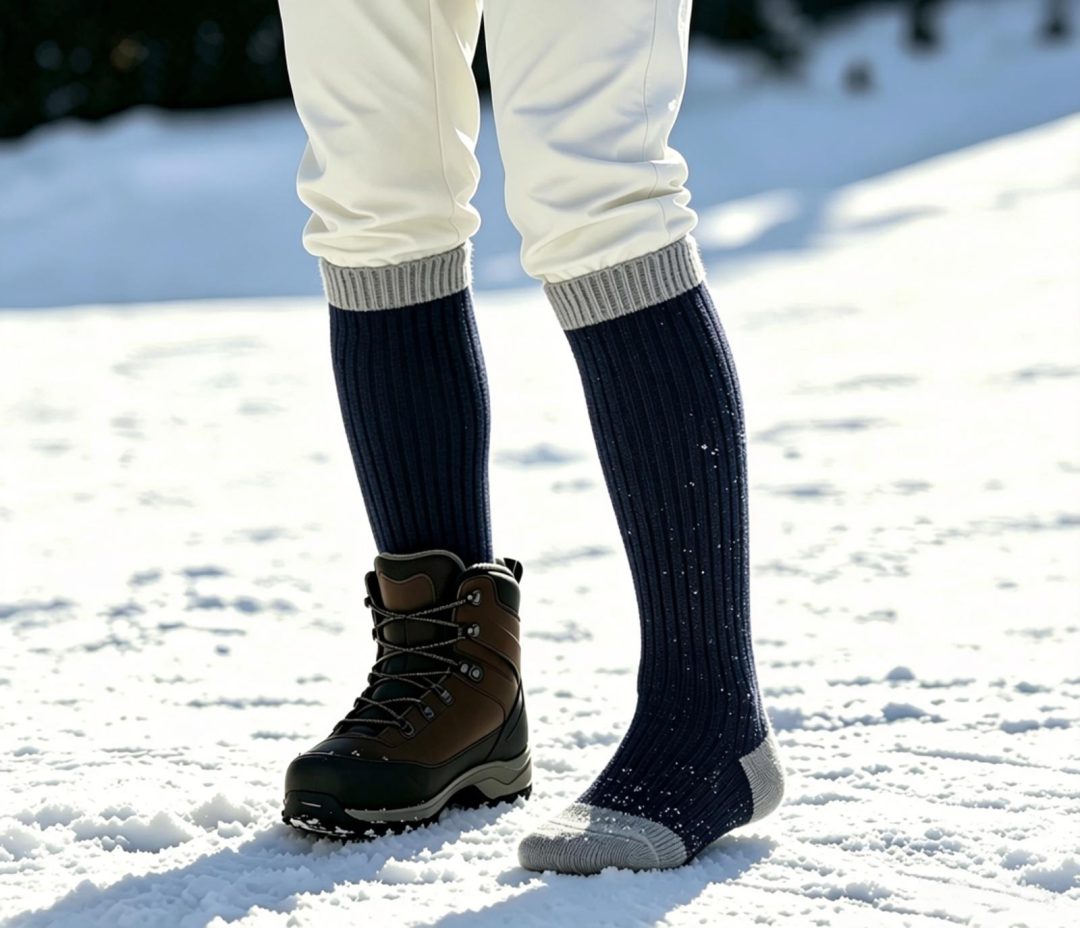
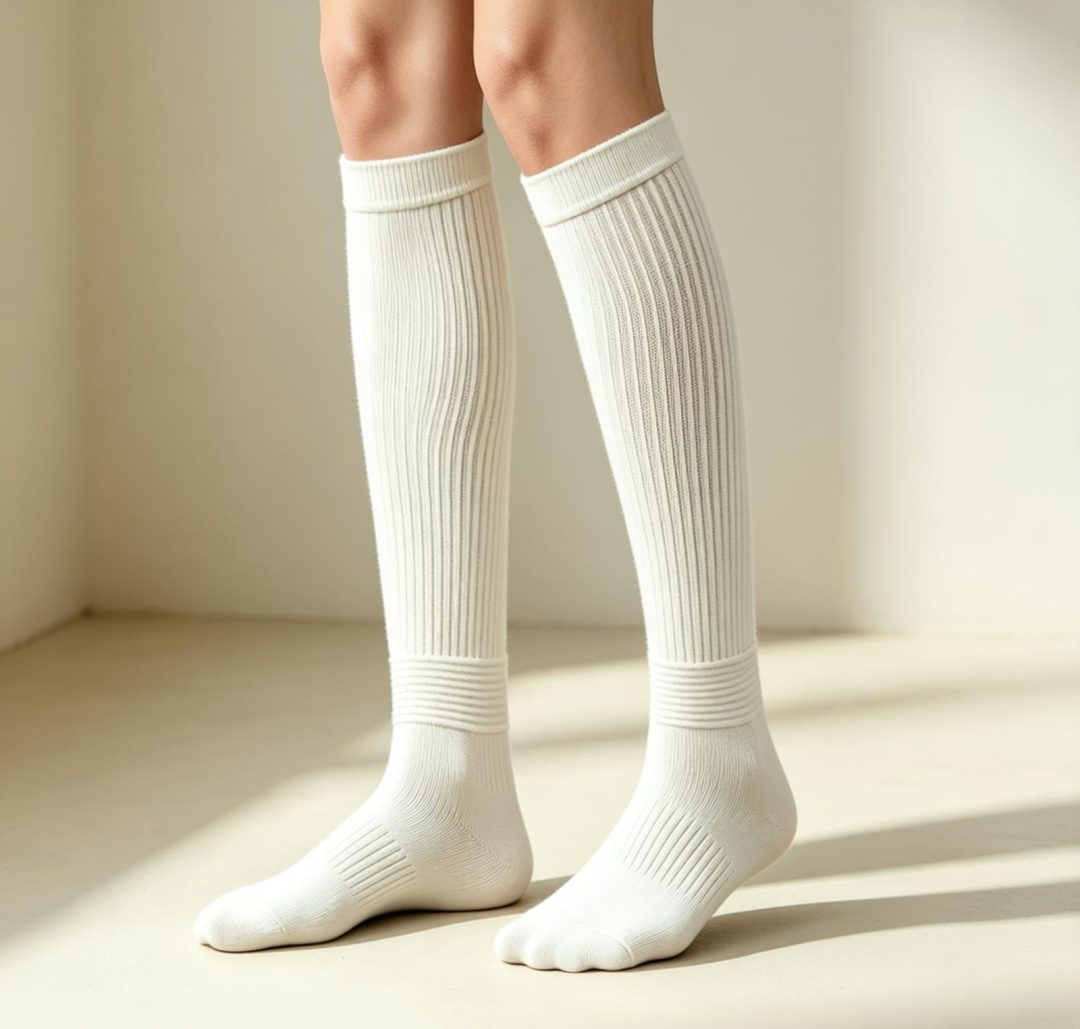
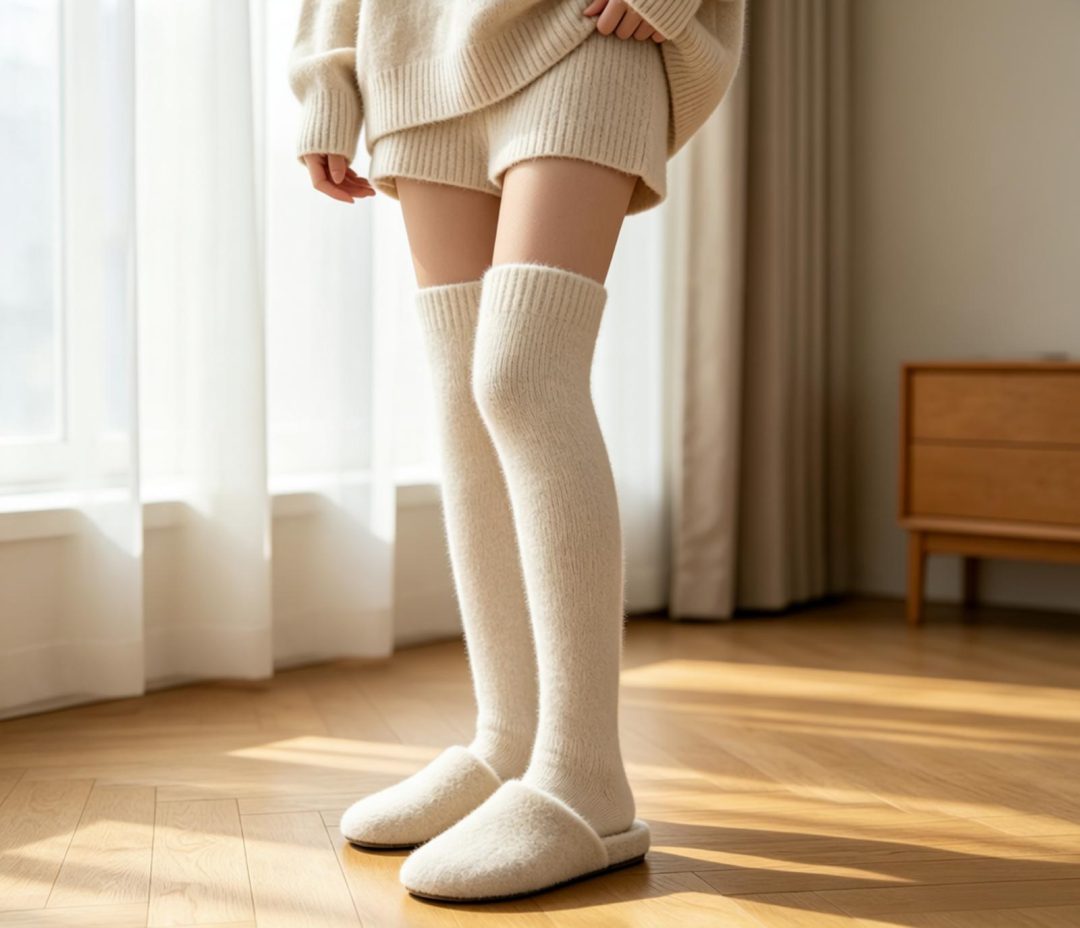
Knee-high socks are the quiet workhorses of hosiery: school uniforms, sports, work boots, hiking, formal wear and fashion all depend on them. Their manufacturing challenge is precise — cover the entire calf with consistent tension, stay up all day without squeezing, and grade cleanly across dramatically different leg shapes. Here is how they are made.
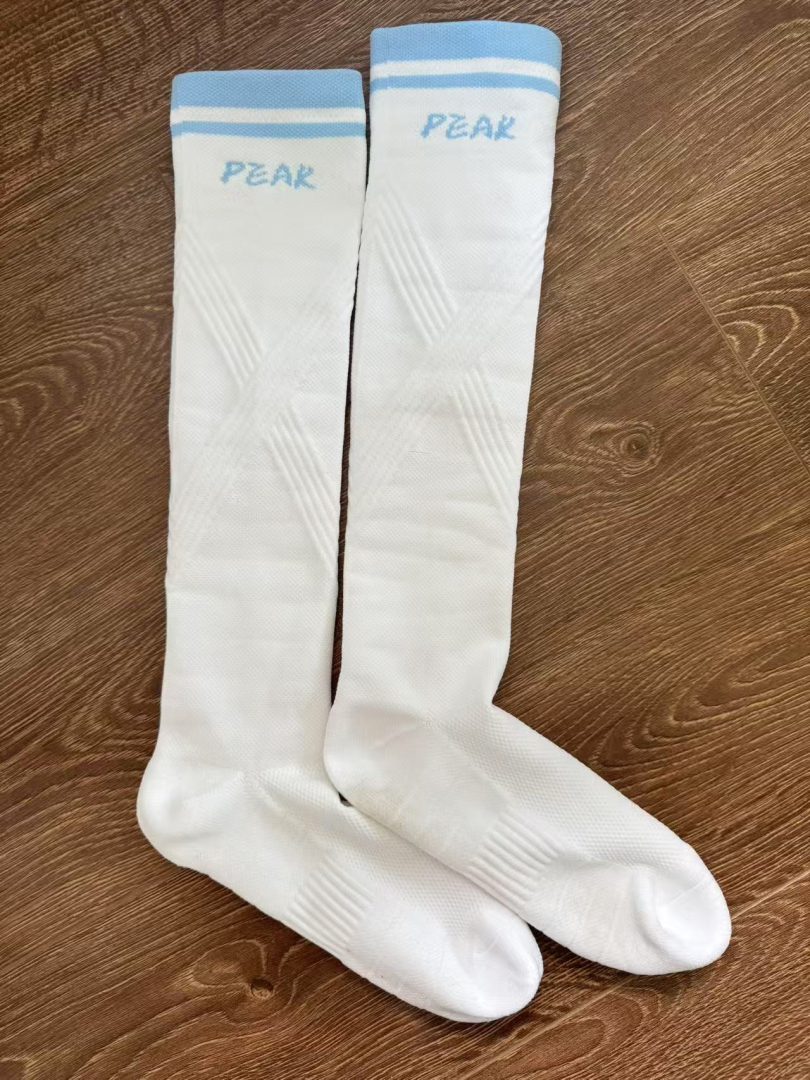
You will see every step below in custom knee-high sock range, where sampling runs before bulk production and MOQ starts at 300 pairs per design.
The Full-Calf Knitting Program
A knee-high is roughly 50% more knitted fabric than a crew sock, produced in one continuous program on circular machines. The engineering runs top to bottom: a stay-up cuff zone (ribbed or elasticized), a calf body zone with graduated tension that accommodates the calf muscle’s shape, an ankle transition zone, and a full foot with heel and toe. Consistent fabric tension across this long run is the core quality discipline — tension drift that a crew sock absorbs shows as bagging or tight bands on a knee-high.
Cuff Engineering: Staying Up Without Squeezing
The cuff is where knee-highs succeed or fail. The standard construction is deep ribbing with covered elastane: rib structure provides mechanical grip while elastic recovery holds position. Quality programs tune cuff pressure to grip without leaving marks — verified physically on samples. Silicone grip bands (borrowed from thigh-high technology) appear on fashion and sport styles needing extra hold. And fold-over cuffs, common in school and sport styles, double the fabric’s grip surface comfortably.
Applications Shape Construction
The knee-high category serves distinct use cases, each with its own engineering profile. School uniform knee-highs prioritize durability (reinforced heel/toe) and colorfastness (deep navy and black dye discipline, laundered weekly at home or industrially). Sport knee-highs (soccer, baseball, cricket) add shin-guard compatibility and performance fibers. Work and outdoor knee-highs (boot socks) carry cushioned terry soles and warmer blends. Dress knee-highs knit fine-gauge and smooth for formal shoes. Fashion knee-highs range from sheer to chunky ribbed — appearance standards are strictest here.
Grading for Real Calves
Calf circumference varies enormously — more than any measurement below the knee — so professional knee-high ranges grade on calf circumference, not just foot length. Extended-calf versions (with more generous stretch range and taller openings) are a fast-growing, underserved segment, especially in riding and workwear markets. Length grading matters too: the same sock must reach below-knee on short and tall legs alike, which is why quality ranges offer regular and tall lengths.
Finishing and Quality Control
Knee-highs are boarded on full-length leg forms that heat-set the entire garment without distortion. QC checks: cuff elasticity and recovery (no slippage or marks), length conformity across sizes, tension consistency (no bagging zones), pattern matching between pairs on patterned styles, and heel positioning — a knee-high that pulls its heel off-center on the foot was mis-graded. School and institutional programs add industrial-wash durability testing.
Materials Across the Category
Fiber selection follows application: combed cotton and blends for school and everyday (comfort, colorfast deep dyes), polyamide/polyester with elastane for sport (moisture management, recovery), merino blends for outdoor (insulation, odor resistance), and fine-gauge cotton or synthetic dress weights for formal wear. OEKO-TEX certification covers the institutional and school segments where compliance documentation is expected.
How Are Leg Warmers Made? picks up where this article leaves off.
FAQ
Q: How do knee-high socks stay up? A: Ribbed cuffs with covered elastane provide mechanical grip and recovery; silicone grip bands add hold for fashion and sport styles.
Q: What is an extended-calf knee-high? A: A version graded for larger calf circumferences with more generous stretch range — a fast-growing underserved segment.
Q: Are school knee-highs made differently? A: Yes — they prioritize reinforced durability, industrial-wash colorfastness, and precise uniform dye matching over fashion characteristics.
CONCLUSION
Knee-high socks are a study in sustained engineering: full-calf knitting programs, tuned stay-up cuffs, application-specific construction and honest calf-based grading. The factories that master consistent tension over long fabric runs — and the brands that grade for real legs — own the category’s most dependable, year-round demand.
When you are ready to produce, Sockmader’s custom knee-high socks team covers sampling, MOQ and lead times in one place.