Soccer is the world’s most participated sport, and its humble sock carries a surprisingly technical brief: lock the foot inside a low-profile cleat, hold shin guards in place for 90 minutes, survive slide tackles and repeated laundering, and display team colors with broadcast-grade crispness. From academy kits to Sunday leagues, here is how soccer socks are actually made.
You will see every step below in custom athletic sock range, where sampling runs before bulk production and MOQ starts at 50 pairs per design.
The Performance Brief
Soccer socks differ from generic sport socks in three engineered requirements. First, a snug foot zone: cleats fit close to the foot, so the sock must be thin and smooth enough to preserve touch on the ball while still cushioning the sole. Second, secure shin guard retention: the over-the-calf section grips the calf and guard without sliding. Third, durability under abrasion — heel and toe zones take constant friction from firm-ground surfaces and repeated washing.
Knitting the Zones
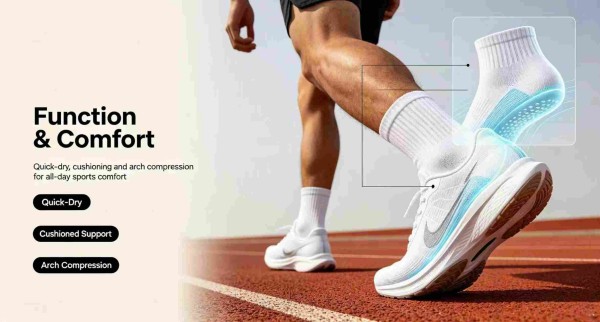
Production starts on computerized circular machines running multi-zone programs. The foot section uses fine, dense knitting with light terry under the sole for cushioning. The leg section is ribbed for stretch and hold. Modern performance models add mesh ventilation channels across the instep — soccer feet run hot — and elastic arch bands to keep the sock positioned. Fold-over cuffs sit below the knee. Yarns are almost universally moisture-wicking polyamide or polyester blends with elastane; cotton survives only in training and youth price tiers.
Team Identity in the Knit
Club colors are knitted directly into the sock — body colors, hoop stripes, and contrast foot sections — using jacquard technique so the identity survives an entire season of washing. Design files are digitized from club artwork, and the precision matters: mismatched hoops between a team’s left and right socks, or color drift between the sock and the club kit, are rejected by kit managers. Sublimated print decoration allows photo-grade crests and sponsor elements on lighter-weight socks.
Numbers, Names, and Squad Kitting
The distinctive logistics challenge of soccer sock production is personalization: squad numbers applied to the cuff of each pair, matched to player sizes, then kitted per player into labeled bags. A single academy order might combine 20 designs across 8 sizes with 200 individually numbered pairs. Factories serving club channels run dedicated kitting lines for this work — the organizational discipline involved is a genuine differentiator between teamwear producers and commodity factories.
Shin Guard Integration and Grip
Beyond classic over-the-calf styles, the category now includes grip-equipped performance socks (silicone grip zones locking the foot in the cleat) and shin guard sleeve socks — stretch tubes holding guards without tape. Grip application follows the same curing discipline as other grip socks: tested adhesion after repeated washing, because match-play friction is merciless.
Quality Control for Match Play
QC checks pattern matching between pairs, stripe alignment, reinforcement integrity at heel and toe, cuff elasticity recovery (a sock that sags by the second half failed), and colorfastness — deep club colors like royal blue and maroon are dye-lot risks. Team orders verify number application quality and complete, correctly kitted packaging per player before shipment.
How Are Ski Socks Made? picks up where this article leaves off.
FAQ
Q: Can we order soccer socks with our club crest and sponsor logos?
A: Yes — crests and sponsor marks are knitted, embroidered or sublimated; most factories accept club vector artwork and match it across sizes.
Q: What is the minimum order for custom team soccer socks?
A: Typical MOQs run 300–1,000 pairs per design, often splittable across sizes; numbered squad kitting usually has modest minimums per player set.
Q: Why do professional clubs use grip soccer socks?
A: Internal grip zones stop the foot sliding inside the cleat during direction changes — measurable traction gain and fewer blisters.
CONCLUSION
A soccer sock is teamwork in textile form: zoned engineering for cleats and guards, knitted team identity, per-player kitting discipline, and durability tested by match play. Clubs and brands should judge suppliers on exactly those axes — and the best teamwear factories welcome every one of those questions.
Ready to price this out? Start with a sample from Sockmader’s custom sports socks team, or send your artwork and target quantity for a quote.