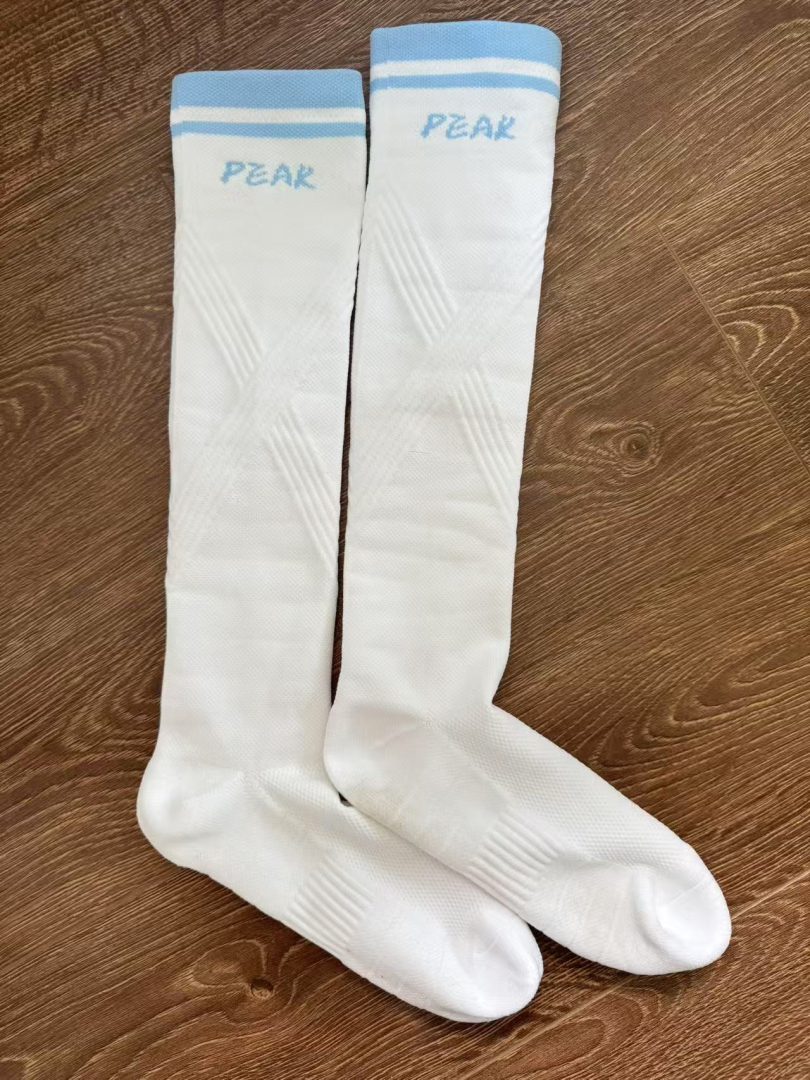
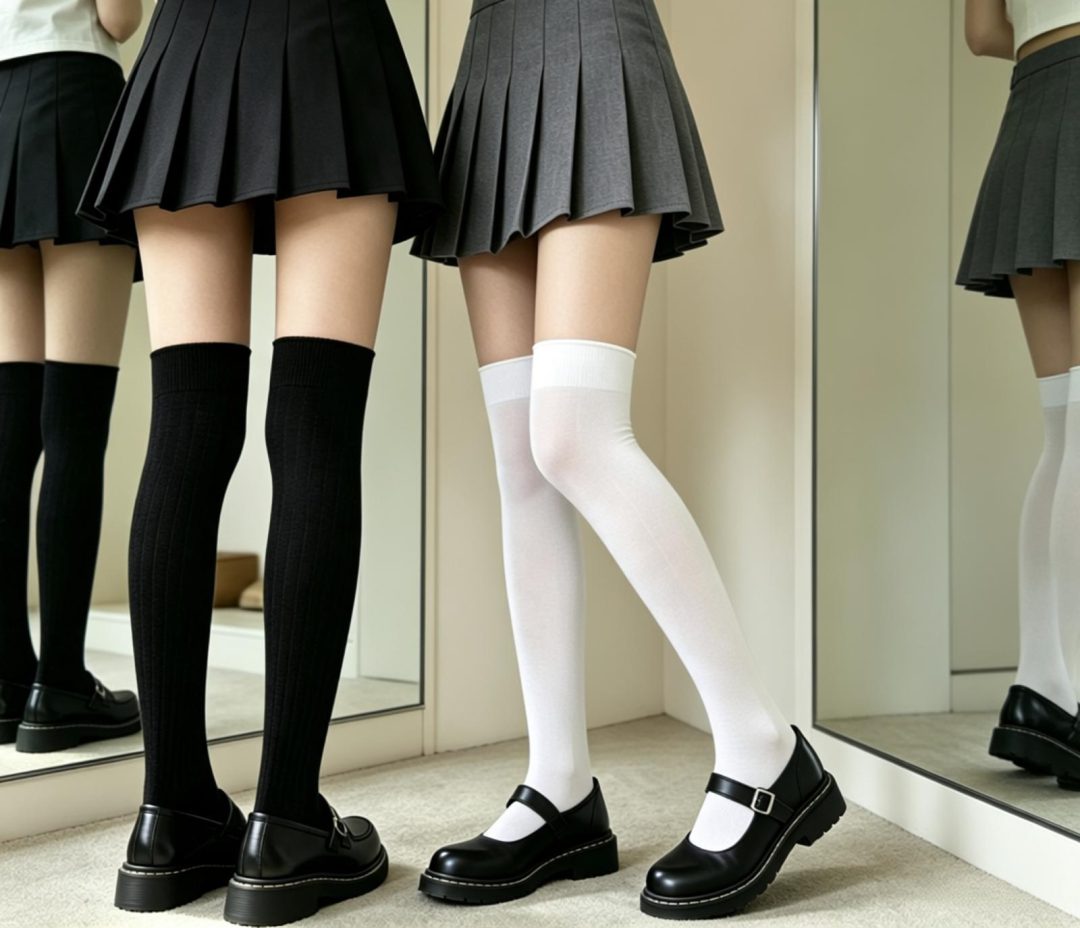
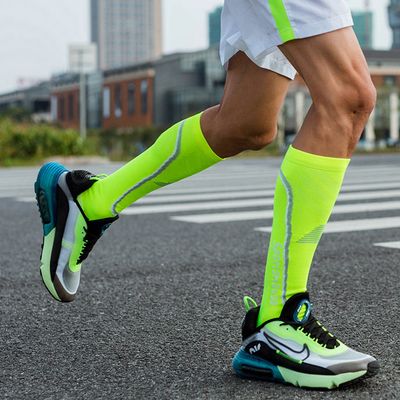
Thigh-high socks are the most mechanically ambitious products in the sock world. They must stay in place on the human body’s most taper-prone terrain — the thigh — without garters, squeeze without marking, and survive the fashion category’s strictest appearance standards across an unusually long fabric run. That length creates manufacturing challenges invisible in the final product. Here is how they are made.
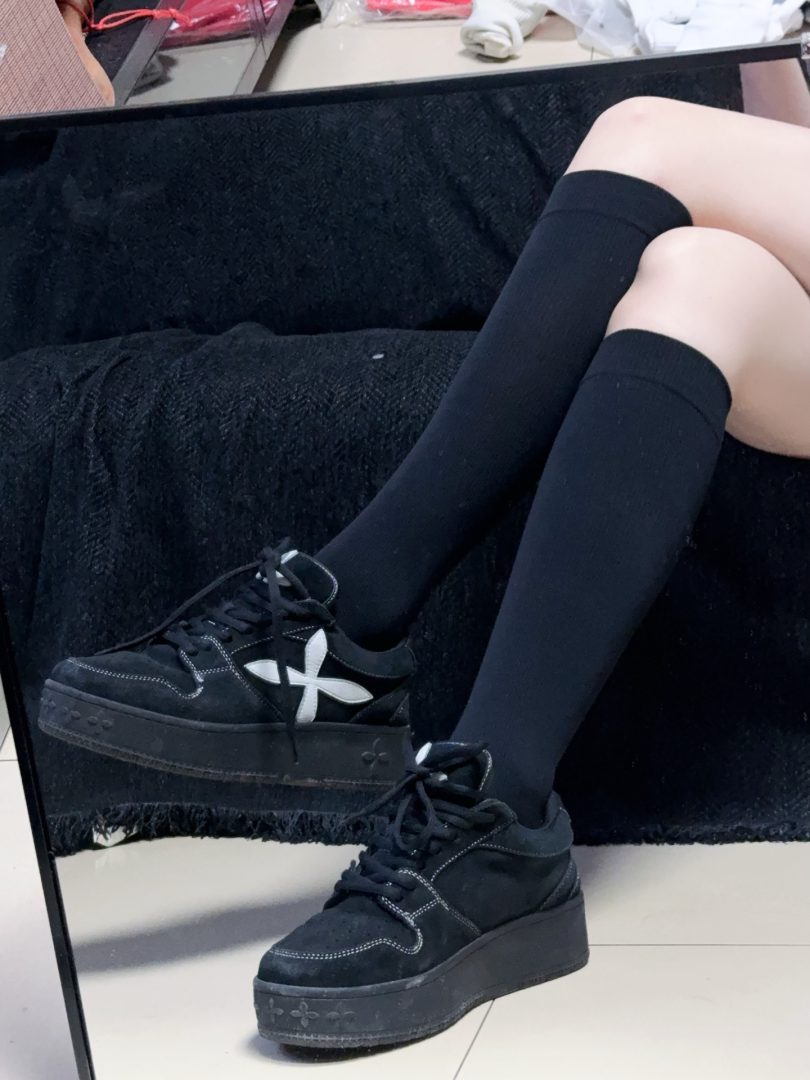
You will see every step below in custom knee-high socks, where sampling runs before bulk production and MOQ starts at 100 pairs per design.
The Length Problem
A thigh-high sock is simply much more fabric than any other sock: roughly twice the knit time and yarn of a crew sock, produced on the same circular machines with extended knitting programs. Long runs amplify every defect — gauge drift that is invisible over 20cm becomes visible sag over 60cm, and yarn tension inconsistency that a crew sock hides shows as fit variation between pairs. Quality thigh-high production demands tightly maintained machines; this is where factory discipline shows.
The Stay-Up Band: The Defining Technology
The engineering heart of a thigh-high is the top band. Three constructions dominate. Silicone grip bands: the band’s inner surface carries one or two silicone strips that grip the skin, holding the sock without constriction — the modern standard for fashion thigh-highs. Deep ribbed or lace bands: structured knit with strong elastic recovery that stays up through compression of the knit itself, common in athletic and vintage styles. And garter-compatible tops: decorative lace designed to be worn with garter belts, where the top is aesthetic rather than functional. Silicone application requires its own application and curing process, and adhesion after washing is a QC checkpoint.
Grading for Real Bodies
Thigh circumference varies more than any other body measurement the sock industry addresses — and unlike calf-length socks, a thigh-high that fails to stretch to the wearer’s thigh simply cannot be worn. Professional size runs specify thigh circumference ranges (not just shoe size), and plus-size grading (1X–3X) is a fast-growing, underserved segment. Length grading matters too: the same sock must reach mid-thigh on both a 5’2″ and a 5’10” customer, which is why quality ranges offer regular and tall versions.
Knitting Fashion and Function Together
Thigh-highs live in fashion, so appearance engineering matters: sheer and semi-sheer styles use fine-gauge knitting with covered elastane for smooth, uniform transparency; opaque and ribbed styles deliver structure and cozy positioning; lace tops, back seams, and jacquard motifs add design identity. The transition zone where the band meets the leg body must knit cleanly — a visible join line is a quality failure in this category. Colorfastness and sheen uniformity are checked more strictly than in casual socks because fashion wearers scrutinize appearance.
Finishing and QC
Boarding for thigh-highs uses extended leg-shaped plates that set the full length without stretch distortion. Quality control checks: band grip effectiveness and silicone adhesion after wash cycles, elastic recovery (no bagging after wear), length conformity across the size run, and appearance standards for sheer styles — pinholes, irregularities, and band joins are reject criteria. Pairing must match pattern placement between left and right socks precisely on patterned styles.
Fashion Positioning and Wholesale Notes
Thigh-highs serve fashion, cosplay, gothic and Halloween styling, school-uniform-adjacent trends, and cold-weather fashion layers — with strong seasonal spikes around Halloween and holiday party season. Wholesalers should note the category’s high return sensitivity to sizing: accurate thigh circumference charts and honest fit photography are the difference between a cult favorite and a returns magnet.
We go deeper on How Are Leg Warmers Made? in a separate guide.
FAQ
Q: How do thigh-high socks stay up without garters? A: Silicone grip strips on the inner top band hold against the skin; deep-ribbed elastic tops are the garter-free alternative for athletic styles.
Q: What sizing matters most for thigh-highs? A: Thigh circumference first, length second, shoe size last — ranges without thigh measurements fit by luck, not design.
Q: Can thigh-highs be made in plus sizes? A: Yes, and demand is growing fast — graded plus-size thigh-highs (1X–3X) are among the most requested underserved products in fashion hosiery.
CONCLUSION
Thigh-high socks are a study in applied engineering at the extreme of hosiery length: extended knitting programs, stay-up silicone technology, and grading for the most variable body measurement in the industry. Brands that respect those realities — and factories that master them — own one of fashion hosiery’s most loyal categories.
Ready to price this out? Start with a sample from Sockmader, or send your artwork and target quantity for a quote.
If you are planning your own line, our custom knee-high socks program covers sampling, MOQ and lead times in one place.