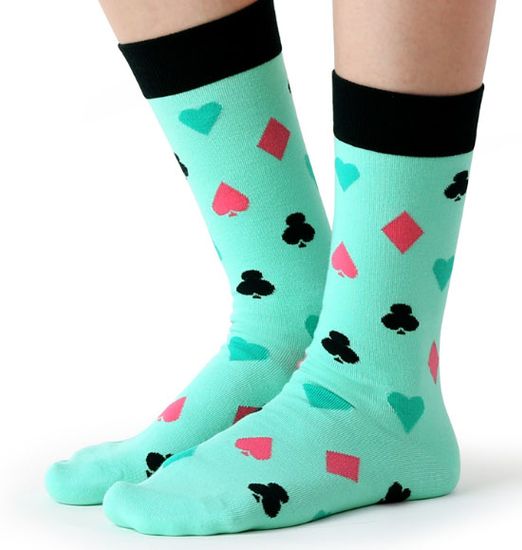
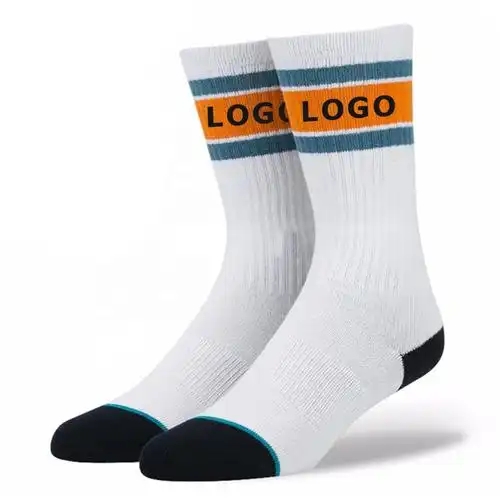
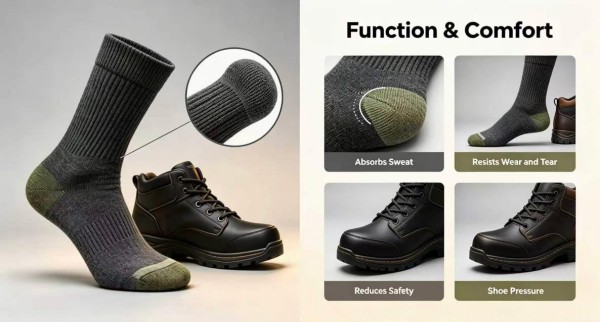
A printed sock is a finished sock — usually knitted in white or a pale colour — that has had artwork applied to its surface after knitting. The print sits on the fabric rather than in it, which is the single fact that determines everything about how printed socks look, feel, perform and age. Understanding that distinction, and the three printing methods in commercial use, tells you what a printed sock can and cannot do.
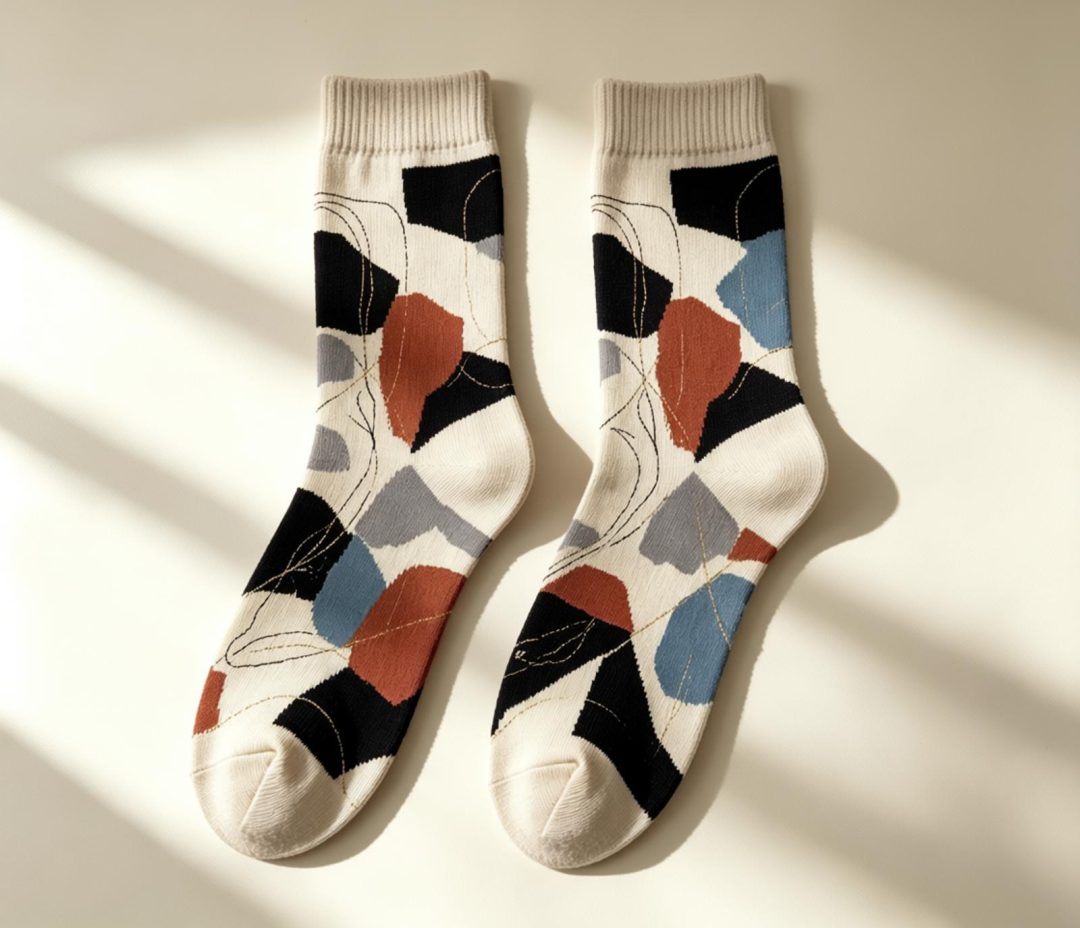
The yarn, gauge and MOQ options for this style are listed on the custom printed sock range page.
Why the Blank Matters Printing works best on synthetic fibre. The inks used in sock printing — disperse dyes for sublimation, pigment inks for direct printing — bond far more strongly to polyester than to cotton. This is why printed sock blanks are typically 90 per cent polyester or higher, often with a small elastane content for fit. A cotton sock can be printed, but the colour will be duller and will wash out faster. If a supplier offers printing on a cotton-rich sock, ask for wash-test data.
Digital Direct Printing The most flexible method. The sock is mounted on a flat form and an inkjet head deposits ink directly onto the fabric, which is then fixed with heat. It handles unlimited colour, gradients and photographic detail, has no setup cost, and supports minimums as low as a single pair. Its limitation is that very dark or saturated coverage can feel slightly stiff on the fabric, and there can be a visible seam line where the tube passes under the head.
Dye Sublimation In sublimation, artwork is printed onto transfer paper and then heat-pressed onto the sock, where the dye turns to gas and bonds into the fibre. Because the dye becomes part of the fibre rather than sitting on it, sublimation produces the softest hand feel and excellent wash durability. It requires high polyester content and it works best on light-coloured blanks, since the dye is translucent and cannot print white.
Screen and Transfer Printing Traditional methods still used for long runs of simple, flat-colour designs. Screen printing lays down thick, opaque ink with excellent coverage — including white on dark socks — but each colour requires a screen and setup, so it suits quantity rather than variety. Heat transfers apply a printed film to the sock and are used for small, positioned motifs. Both are less flexible than digital and remain cost-effective only at scale.
How Printed Differs From Knitted Jacquard Jacquard puts the pattern into the structure by selecting coloured yarns during knitting. The pattern cannot fade because it is the fabric, and there is no added hand feel. It is limited to around four colours and to hard-edged patterns. Printing offers unlimited colour and photographic detail on the surface, with a slightly different hand feel and gradual fading. Neither is better — they are different tools.
How It Differs From Embroidery Embroidery stitches thread onto a finished sock, producing a raised, textured logo with a premium feel. It is slow, expensive per unit, limited to simple shapes, and the stitching adds bulk on the inside. It suits small logos on premium socks. Print suits full-colour artwork across the whole sock. Many premium socks use both: a printed design with an embroidered mark on the cuff.
How to Design Printed Socks picks up where this article leaves off.
FAQ
Q: Do printed socks fade? A: Gradually, yes. Sublimation fades least, direct digital slightly more, screen printing least predictably depending on ink thickness.
Q: Can you print on black socks? A: With screen printing or white-underbase digital, yes. Sublimation cannot, because the dye is translucent.
Q: Does printing make the sock stiff? A: Modern inks add very little stiffness, though heavy dark coverage over a large area can be noticeable.
Q: How do I wash them? A: Cool wash, inside out, no bleach. Heat is what degrades printed colour fastest.
CONCLUSION
Printed socks are finished socks with artwork applied to the surface, produced by digital, sublimation or screen printing, almost always on a polyester-rich blank. They offer unlimited colour and photographic detail that knitting cannot match, at the cost of gradual fading. Choose print for complex artwork and short runs; choose jacquard for hard-edged patterns that must last.
Ready to price this out? Start with a sample from Sockmader’s custom printed socks team, or send your artwork and target quantity for a quote.