Fuzzy socks are a feel-first product: customers buy them in-store by touching them. That makes the manufacturing process — specifically the brushing and finishing stages — the entire basis of the product’s value. Yet “fuzzy” is not one construction but several, and the difference between a sock that stays soft through fifty washes and one that pills into a matted mess within a month comes down to decisions made in the factory. Here is how quality fuzzy socks are actually made.
You will see every step below in wholesale thermal socks, where sampling runs before bulk production and MOQ starts at 100 pairs per design.
Choosing the Fuzz: Chenille, Brushed Terry, or Sherpa
There are three main routes to a fuzzy sock. Chenille yarns — plush, caterpillar-like threads — are knitted directly for a dense, velvet fuzz. Brushed terry (the most common method) knits a looped terry interior that is then mechanically brushed into a soft nap. Sherpa or faux-fur styles bond or knit pile fleece for maximum fluff. Each route has different costs, weights, and durability profiles; brushed terry polyester is the market’s volume workhorse, while chenille commands a premium feel and price.
Step 1: Yarn Preparation
The dominant fiber is polyester — specifically, low-pill spun or filament polyester engineered for raised surfaces. Cotton-blend and recycled polyester (rPET) versions serve eco-positioned lines. Yarn twist and draw ratio are controlled tightly because over-twisted yarns resist brushing, while under-twisted yarns shed fiber in the wash. Anti-pilling finishes begin here at the yarn stage, not after.
Step 2: Terry Loop Knitting
For brushed styles, machines knit a terry structure — loops standing on the inside face of the sock. Loop height (typically 2–4 mm) determines the depth of the final fuzz. Terry loops must be uniform in height; uneven loops create patchy softness that no amount of finishing can fix. The cuff, heel, and toe are usually knitted in smooth plain jersey for structure and durability where fuzz adds nothing.
Step 3: The Brushing Process
This is the signature step. Socks pass through brushing machines fitted with fine wire-covered rollers that tease the terry loops open into a raised nap. Roller speed, contact angle, and the number of passes control nap depth. Skilled factories brush in two passes — one to open the loops, a lighter one to align the nap — producing fuzz that is lofty rather than tangled. This is genuinely a craft stage: over-brushing weakens the fabric and causes pilling; under-brushing leaves the sock feeling merely soft rather than fuzzy.
Step 4: Washing, Anti-Pilling Treatment, and Drying
Brushed socks are washed to remove loose fibers and stabilize the pile, then dried in tumble units that keep the nap standing. Many factories add a chemical anti-pilling finish or rely on yarn-level treatments. The internationally recognized benchmark is the pilling grade (1–5 scale under ISO 12945 or Martindale testing); quality fuzzy socks should score 3.5–4 or higher.
Step 5: Boarding and Final QC
Light boarding sets shape without crushing the nap. QC checks pilling grade, weight (fuzzy socks run 80–120 GSM heavier than plain socks), nap uniformity across the pair, seam quality, and stretch recovery. Colorfastness matters especially for pastel shades, where loose white fibers can contaminate dyed batches.
Step 6: Pairing and Packaging
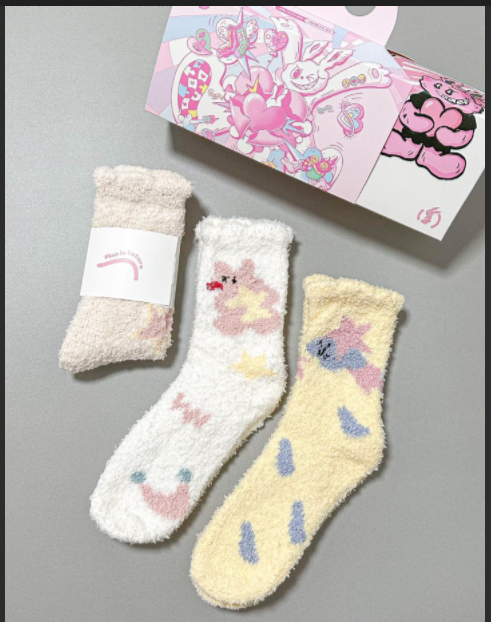
Fuzzy socks are heavy, airy products that compress well — most retail as 2-pair or 3-pair gift packs, polybag with header card, or slide-in boxes. Gift-oriented packaging dominates this category because fuzzy socks are a top-three stocking stuffer and add-on gift item.
We handle the adjacent decision in Fuzzy Socks Size Chart.
FAQ
Q: Do fuzzy socks pill after washing? A: Quality pairs should not. Pilling resistance depends on yarn quality and anti-pilling treatment; ask suppliers for pilling test grades of 3.5+ on the ISO 12945 scale.
Q: What MOQ applies to custom fuzzy socks? A: Typical minimums are 500–1,000 pairs per design, with brushed-terry styles at the lower end and chenille blends slightly higher.
Q: Are recycled polyester fuzzy socks available? A: Yes — GRS-certified recycled polyester can be brushed to the same softness as virgin fiber, ideal for sustainability-focused brands.
CONCLUSION
Softness that survives the washing machine is engineered, not accidental. When sourcing fuzzy socks, request pilling test reports, ask how many brushing passes the factory uses, and always wash-test samples five times before approving production. A supplier who can answer those questions confidently is one whose fuzz will still be selling — and still feeling cloud-soft — long after your competitors’ pairs have gone flat.
When you are ready to produce, Sockmader’s custom sock manufacturing team covers sampling, MOQ and lead times in one place.
Start your next order with custom thermal socks from Sockmader — send artwork, size range and target quantity for a quote.