Compression socks look simple, but they are one of the most technically demanding products in the hosiery industry. Unlike a standard crew sock, a compression sock must apply a precisely engineered amount of pressure that is strongest at the ankle and gradually decreases up the calf. Achieving that “graduated pressure” consistently across thousands of pairs requires specialized machinery, elastane-rich yarns, and a testing regime that ordinary socks never undergo. For brands, retailers, and medical distributors, understanding how these products are actually made is the fastest way to evaluate whether a supplier can deliver consistent quality at scale.
You will see every step below in custom compression socks, where sampling runs before bulk production and MOQ starts at 150 pairs per design.
Step 1: Yarn Preparation — The Foundation of Pressure
Every compression sock begins with its yarn package. The core component is a covered elastane (spandex) yarn — typically nylon or polyester filament wrapped around a spandex core in a single or double covering. The ratio of elastane to nylon, usually between 15% and 30% elastane, is the primary determinant of the final compression level. Yarns are wound onto bobbins and conditioned in a temperature-controlled room, because elastane tension is sensitive to humidity. Factories that skip proper conditioning produce socks whose pressure varies from batch to batch — a defect you cannot see but your customers will feel.
Step 2: Circular Knitting with Zoned Tension
The socks are knitted on computerized circular knitting machines, commonly 144 to 200 needles (referred to as gauge or “N”). The machine’s program controls stitch density and elastane feed at every height of the sock: tighter, denser stitching at the ankle, progressively looser toward the calf opening. Modern machines store these programs digitally, which means a verified pressure profile can be reproduced exactly on repeat orders. This is the single most important capability to confirm when auditing a compression sock factory.
Step 3: Toe Closing and Seaming
Once knitted, the tube is closed at the toe. Compression socks generally use flat-lock or rosso linking seams rather than bulky overlock stitches, because a raised seam across the toes can restrict circulation — the exact opposite of what the product is designed to do. Seamless or hand-linked toes are available for medical-grade lines and are worth specifying for diabetic-adjacent product ranges.
Step 4: Boarding and Heat Setting
The socks are pulled onto metal boarding plates shaped like legs and passed through a steam or dry-heat tunnel. This heat-setting step locks the knit structure into its final dimensions and stabilizes the elastane. Poorly boarded socks lose pressure after just a few washes; properly heat-set garments retain 90%+ of their compression through 30+ wash cycles.
Step 5: Pressure Testing and Quality Control
This is where compression socks diverge completely from fashion hosiery. Each production lot should be tested on a medical pressure tester that measures mmHg (millimeters of mercury) at standard points — ankle, mid-calf, and below-knee. Commercial grades run 15–20 mmHg, medical class I 20–30 mmHg, and class II 30–40 mmHg. Reputable factories test to recognized standards such as RAL-GZ 387 or British Standard BS 6612 and can supply test reports per shipment. Additional checks cover size conformity, seam strength, fabric weight (GSM), and colorfastness.
Step 6: Pairing, Branding, and Packaging
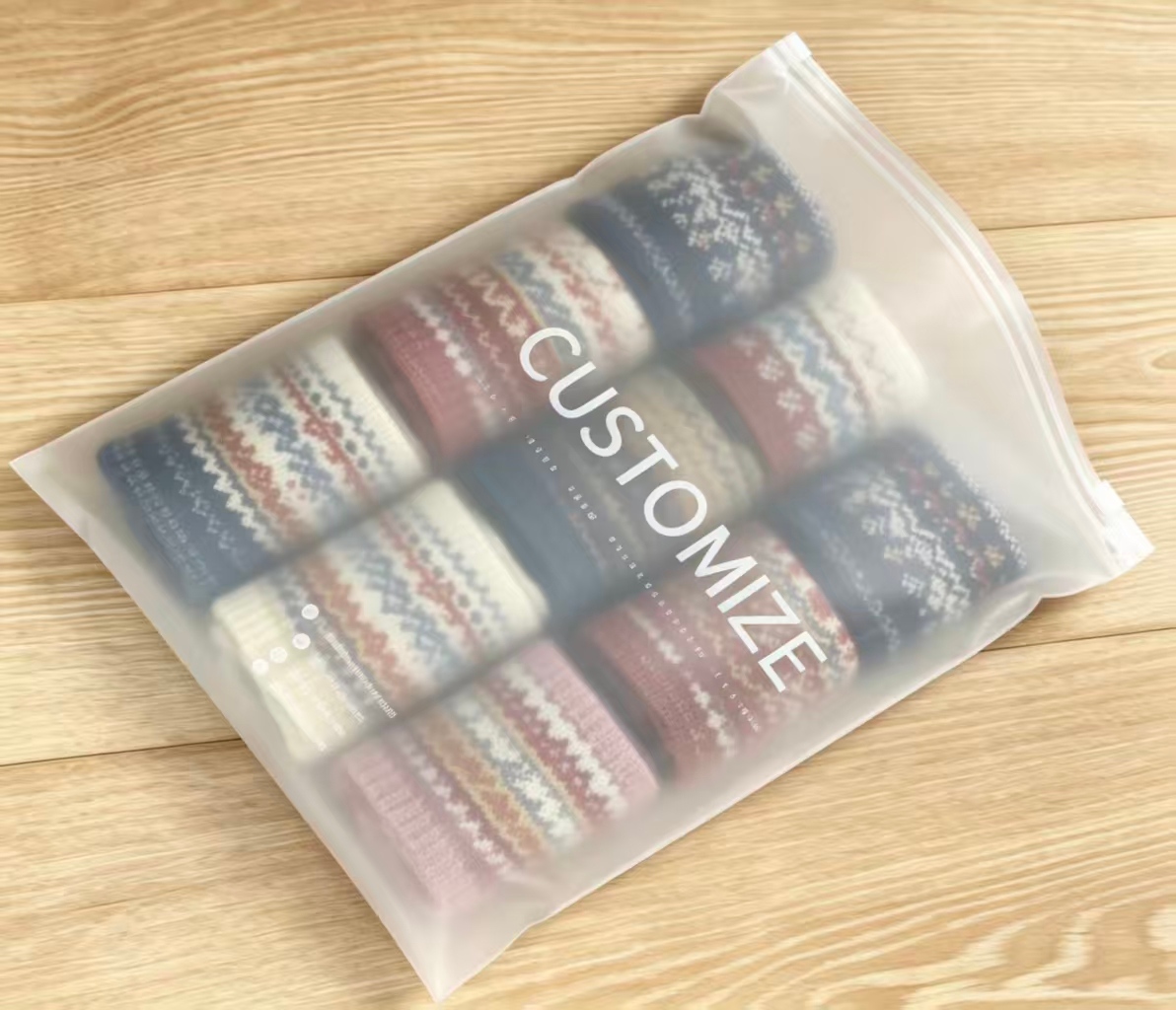
Passed socks are paired, then finished with your branding: woven or printed labels, hang tags, and retail-ready packaging such as header cards, blister packs, or printed polybags. Because compression socks are often sold as wellness or medical products, packaging frequently needs compliance text — pressure class, size, and care instructions — which your manufacturer should be able to print and apply in-house.
We go deeper on Compression Socks Buying Guide in a separate guide.
FAQ
Q: What is the typical MOQ for custom compression socks?
A: Most manufacturers set MOQ around 500–1,000 pairs per design for custom-knit compression socks, with lower MOQs possible for stock programs with added branding.
Q: Can factories customize the compression level?
A: Yes. By adjusting elastane content and knit density, factories can produce 15–20, 20–30, or 30–40 mmHg grades, each verified by pressure testing before shipment.
Q: What certifications should I ask for?
A: Request OEKO-TEX Standard 100 for fabric safety, ISO 9001 for quality management, and pressure test reports per RAL-GZ 387 or BS 6612 for medical-market compliance.
CONCLUSION
The difference between a premium compression sock and a disappointing one is decided on the factory floor — in yarn conditioning, knit programming, heat setting, and pressure verification. If you are sourcing compression socks for your brand, ask prospective suppliers three questions: How do you condition elastane? Can you show mmHg test reports per lot? And how do you reproduce the same pressure profile on repeat orders? A factory that answers these fluently is one that can scale with your business.
Ready to price this out? Start with a sample from Sockmader, or send your artwork and target quantity for a quote.
If you are planning your own line, our custom compression socks program covers sampling, MOQ and lead times in one place.